Type text, add images, blackout confidential details, add comments, highlights and more.
02. Sign it in a few clicks
Draw your signature, type it, upload its image, or use your mobile device as a signature pad.
03. Share your form with others
Send affidavit of executor example via email, link, or fax. You can also download it, export it or print it out.
How to use or fill out affidavit executor with our platform
Ease of Setup
DocHub User Ratings on G2
Ease of Use
DocHub User Ratings on G2
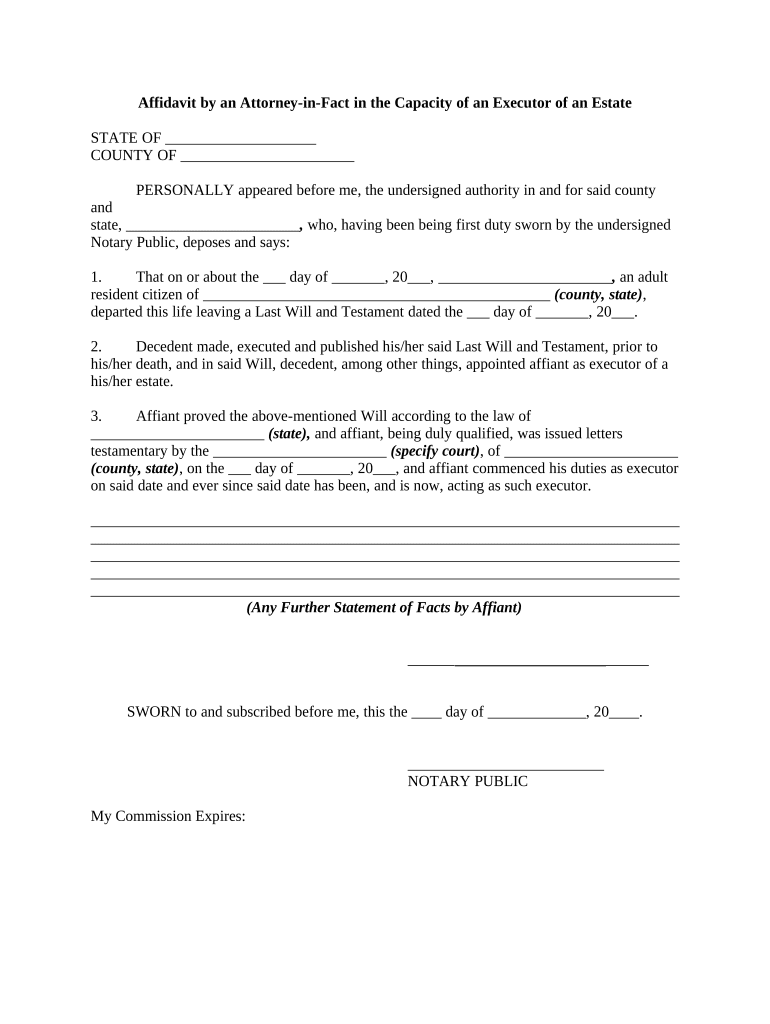
Click ‘Get Form’ to open the affidavit executor in the editor.
Begin by filling in the 'STATE OF' and 'COUNTY OF' fields at the top of the document. This identifies the jurisdiction where the affidavit is being executed.
In the first section, provide the date of death of the decedent and their full name. Ensure accuracy as this information is crucial for legal purposes.
Next, specify the county and state of residence of the decedent. This helps establish their legal domicile.
In section two, confirm that you are appointed as executor in the Last Will and Testament. You may need to reference specific clauses from the will if applicable.
Fill out details regarding your qualification as an executor, including court information and dates when letters testamentary were issued.
If necessary, add any further statements or facts relevant to your role as executor in the designated area provided at the bottom of the form.
Finally, ensure all fields are completed accurately before signing. Use our platform’s signature feature to sign electronically.
Start using our platform today for free to complete your affidavit executor efficiently!
How to get a affidavit executorAffidavit executor exampleAffidavit executor templateAffidavit executor sampleAffidavit OF EXECUTOR VictoriaAffidavit executor pdfAffidavit of executor NSWAffidavit OF EXECUTOR Probate
Security and compliance
At DocHub, your data security is our priority. We follow HIPAA, SOC2, GDPR, and other standards, so you can work on your documents with confidence.
Affidavit from 37 CFR 42.2 | LII / Legal Information Institute
Affidavit means affidavit or declaration under 1.68 of this chapter. A transcript of an ex parte deposition or a declaration under 28 U.S.C. 1746 may be used asRead more
Cookie consent notice
This site uses cookies to enhance site navigation and personalize your experience.
By using this site you agree to our use of cookies as described in our Privacy Notice.
You can modify your selections by visiting our Cookie and Advertising Notice.