Nevada summary administration 2026

Get Form
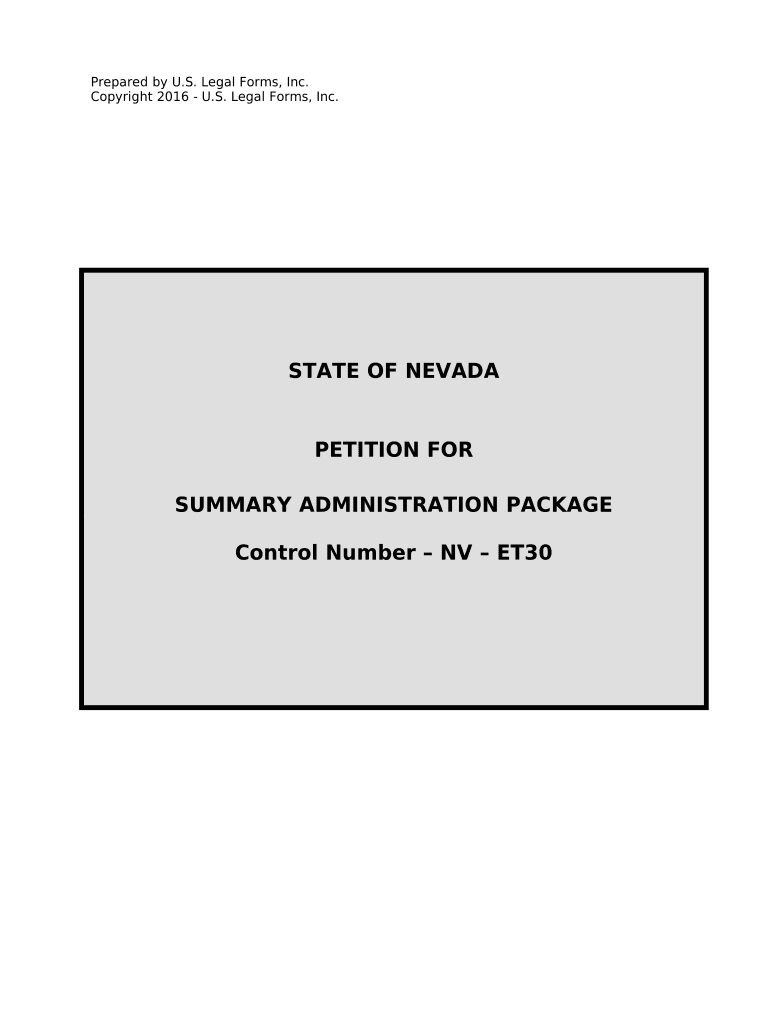
nevada summary administration Preview on Page 1

Here's how it works

01. Edit your form online
Type text, add images, blackout confidential details, add comments, highlights and more.
02. Sign it in a few clicks
Draw your signature, type it, upload its image, or use your mobile device as a signature pad.
03. Share your form with others
Send it via email, link, or fax. You can also download it, export it or print it out.

How to use or fill out Nevada Summary Administration with our platform

Form edit decoration
9.5
Ease of Setup
DocHub User Ratings on G2
9.0
Ease of Use
DocHub User Ratings on G2
  1. Click ‘Get Form’ to open the Nevada Summary Administration document in the editor.
  2. Begin by filling out the 'Petition for Letters of Summary Administration' section. Enter your name, address, and contact information in the designated fields.
  3. Provide jurisdictional information regarding the deceased's residence and details about their passing, including whether a will exists.
  4. List all real and personal property of the decedent along with their estimated values. Ensure that this total does not exceed $200,000 to qualify for summary administration.
  5. Include names and addresses of all interested parties, noting any minors and their relationships to the decedent.
  6. Complete any additional forms included in the package, such as notices to creditors and final account petitions, ensuring all required fields are filled accurately.

Start using our platform today for free to streamline your document editing and completion process!

be ready to get more

Complete this form in 5 minutes or less

Get form

Got questions?

We have answers to the most popular questions from our customers. If you can't find an answer to your question, please contact us.
Contact us
When someone dies, their estate goes through a legal process known as probate. This process is overseen by an executor, who is appointed by the court to manage the estate and distribute its assets. In Nevada, the executor or personal representative is typically paid a commission based on the size of the estate.
Longevity of the Probate Process Summary Administration: This usually takes 3 to 6 months. Its faster and easier for estates with simple assets, like those worth less than $75,000. Formal Administration: This longer process usually takes 6 to 18 months.
Most claims are informalthat is, theyre just ordinary bills, sent to the deceased person, that get forwarded to the executor. The executor has authority to pay these debts as they come in, using estate assets. (Usually, the executor consolidates the deceased persons liquid assets into an estate checking account.)
Pros of Serving as an Executor or Trustee Fulfilling a loved ones wishes. Serving as an executor or trustee allows you to help ensure that your loved ones final wishes are carried out ing to their intentions. Strengthening family relationships. Developing new skills. Potential compensation.
If you are in the trade or business of being an executor, report fees received from the estate as self-employment income on Schedule C, Profit or Loss From Business, of your Form 1040.

Security and compliance

At DocHub, your data security is our priority. We follow HIPAA, SOC2, GDPR, and other standards, so you can work on your documents with confidence.

Learn more
ccpa2
pci-dss
gdpr-compliance
hipaa
soc-compliance

People also ask

Assets Exempt from Probate in Nevada Joint Tenancy Property. Joint tenancy is a form of property ownership where two or more individuals own a property equally and includes a right of survivorship. Payable on Death (POD) Accounts. Transferable On Death (TOD) Accounts. Assets in a Trust.
The purpose of summary administration is to divide the assets amongst the devisees and heirs and pay off the estates creditors. The petitioner in summary administration, if approved by the court, becomes the personal representative of the estate.
Nevada Executor Fee Calculation In Nevada, executor or personal representative fees are statutory and the court will calculate executor fees using a tiered percentage system based on the value of the estate as follows: 4% of the first $15,000; 3% of the next $85,000; and. 2% for amounts above that.

Related links