Complaint legal 2026

Get Form
lloyd is drafting a complaint what should be included Preview on Page 1

Here's how it works

01. Edit your lloyd is drafting a complaint what should be included online
Type text, add images, blackout confidential details, add comments, highlights and more.

02. Sign it in a few clicks
Draw your signature, type it, upload its image, or use your mobile device as a signature pad.

03. Share your form with others
Send lloyd is drafting a complaint via email, link, or fax. You can also download it, export it or print it out.

Definition & Meaning of Legal Complaint

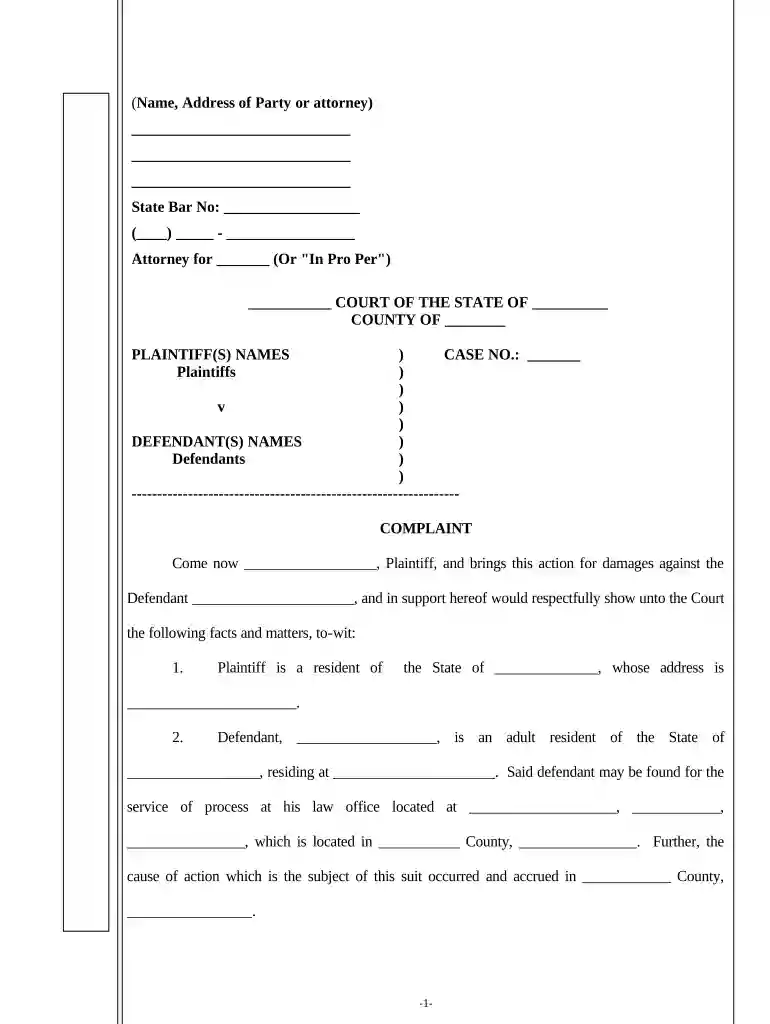
A legal complaint is a formal document filed by a plaintiff in a court that outlines the details of a case against a defendant. It serves as the foundational basis for a legal action and typically alleges violations of legal rights, such as negligence, breach of contract, or fraud. The complaint must clearly detail the claims against the defendant and the legal grounds for those claims. It establishes jurisdiction, sets forth the facts of the case, and specifies the remedies sought, such as monetary damages or injunctive relief.

  • Purpose: To notify the defendant of the allegations and initiate legal proceedings.
  • Structure: Generally includes a caption (court name, case number), parties involved, and a statement of facts leading to the plaintiff's claims.
  • Jurisdictional Basis: Establishes the court's authority over the case, which can be based on state laws, subject matter jurisdiction, or party residency.

Key Elements of a Legal Complaint

When drafting a legal complaint, specific key elements must be included to ensure the document serves its purpose effectively:

  1. Caption: Identifies the court, parties involved, and the case number.
  2. Statement of Jurisdiction: Details why the court has jurisdiction over the matter, including relevant statutes.
  3. Factual Allegations: A comprehensive narrative of the facts that underlie the claims. This section must be clear and detailed to establish the context for the lawsuit.
  4. Claims for Relief: Each count must specify the legal grounds upon which the claims are based, such as negligence or breach of contract.
  5. Prayer for Relief: Concludes the complaint with the specific relief sought by the plaintiff, such as compensatory damages or specific performance.

Including these elements accurately and thoroughly is critical for the complaint to be effective and legally sound.

Steps to Complete the Legal Complaint

Completing a legal complaint involves several structured steps to ensure the document is appropriate for submission to the court.

  1. Identify the Defendant: Determine who the defendant is and the relationship to the claims being made.
  2. Research Jurisdiction: Establish which court has jurisdiction over your case based on legal and factual circumstances.
  3. Draft the Complaint: Using a structured format, include all necessary elements such as a caption, statement of jurisdiction, factual allegations, claims for relief, and prayer for relief.
  4. Review for Accuracy: Carefully check for accuracy in facts and legal citations, ensuring compliance with court rules.
  5. Filing the Complaint: Choose the appropriate filing method, whether electronically or by mail, based on court requirements.

Each step is crucial in ensuring that the complaint is properly structured to withstand legal scrutiny and advance the plaintiff’s case.

Common Mistakes in Legal Complaints

Avoiding common pitfalls is essential for drafting a successful legal complaint. Below are frequent errors to watch for:

  • Lack of Clarity: Failing to clearly articulate the facts can confuse the court or the defendant.
  • Inadequate Jurisdictional Statements: Not specifying why the court has jurisdiction can lead to dismissal.
  • Missing Elements: Omitting crucial components, like the prayer for relief, can render the complaint incomplete.
  • Incorrect Formatting: Every court has specific filing requirements; failing to adhere to these can result in rejection.
  • Insufficient Evidence: Supporting claims with vague statements rather than concrete evidence can undermine credibility.

Understanding these pitfalls can help in drafting a more effective and credible legal complaint.

Important Terms Related to Legal Complaints

Acquainting oneself with key legal terminology is vital when engaging in the complaint process. Below are important terms frequently associated with legal complaints:

  • Plaintiff: The party initiating the lawsuit.
  • Defendant: The party being accused or sued in the legal action.
  • Jurisdiction: The authority granted to a legal body to administer justice.
  • Allegation: A claim made in a complaint that is yet to be proven in court.
  • Relief: The compensation or remedy sought by the plaintiff in a legal action.

Understanding these terms is crucial to navigating the legal process effectively and ensures all parties are on the same page regarding the legal proceedings.

State-Specific Rules for Legal Complaints

Legal complaints are subject to varying regulations and requirements that can differ significantly by state. Here are key aspects that vary state-to-state:

  • Filing Fees: Different courts impose varying fees that must be paid upon filing a legal complaint.
  • Time Limits: States have specific statutes of limitations governing how long a plaintiff has to file a complaint; this varies by case type.
  • Format Requirements: Some jurisdictions require specific formats for a legal complaint, including font types, sizes, and pagination.
  • Local Rules: Each jurisdiction may have local rules that further clarify how complaints should be drafted and submitted.

Being aware of these differences can prevent procedural delays and ensure compliance with local court standards.

Examples of Using Legal Complaints

Legal complaints can arise in diverse scenarios. Here are some common examples:

  • Negligence Cases: A plaintiff sues a defendant for damages caused by an accident on their property due to unsafe conditions.
  • Breach of Contract: A business files a complaint against another for failing to fulfill contractual obligations, seeking damages for losses incurred.
  • Fraud: A plaintiff alleges that the defendant provided false information, leading to financial harm.

These examples illustrate the various circumstances under which a legal complaint can be filed and the diverse areas of law it can encompass.

be ready to get more

Complete this form in 5 minutes or less

Get form

Got questions?

We have answers to the most popular questions from our customers. If you can't find an answer to your question, please contact us.
Contact us
The purpose of a legal complaint is twofold. Firstly, it notifies the defendant of the plaintiffs claims against them, providing them with an opportunity to respond. Secondly, it informs the court of the nature of the dispute, allowing it to prepare for the upcoming proceedings.
A complaint is the pleading that starts a case. Essentially, a document that sets forth a jurisdictional basis for the courts power, the plaintiffs cause of action, and a demand for judicial relief.
A complaint is the pleading that starts a case. Essentially, a document that sets forth a jurisdictional basis for the courts power, the plaintiffs cause of action, and a demand for judicial relief. A plaintiff starts a civil action by filing a pleading called a complaint.
In essence, a legal complaint initiates a lawsuit, while a lawsuit encompasses the entire process of resolving the dispute in court. The existence of a lawsuit and its course through the judicial process is also referred to as litigation.
Criminal Complaints: Entail accusations of committing crimes such as , assault, burglary, felony, and more (Criminal suits are filed against the defendant by the government on behalf of the people. ) Family Law Complaints: Covers civil complaints, such as divorce, alimony, child support cases, etc.

Security and compliance

At DocHub, your data security is our priority. We follow HIPAA, SOC2, GDPR, and other standards, so you can work on your documents with confidence.

Learn more
ccpa2
pci-dss
gdpr-compliance
hipaa
soc-compliance
be ready to get more

Complete this form in 5 minutes or less

Get form

People also ask

Complaint: The complaint is the legal action in which one party (the plaintiff) sues another party (the defendant). Federal civil cases begin with the filing of a complaint.
A criminal complaint is a formal legal document sworn under oath that alleges you committed specific crimes at particular times and locations. Unlike rumors or accusations, this document initiates official legal proceedings against you and creates a permanent record in the criminal justice system.

legal complaint form