Reaffirmation Agreement - Louisiana 2026

Get Form
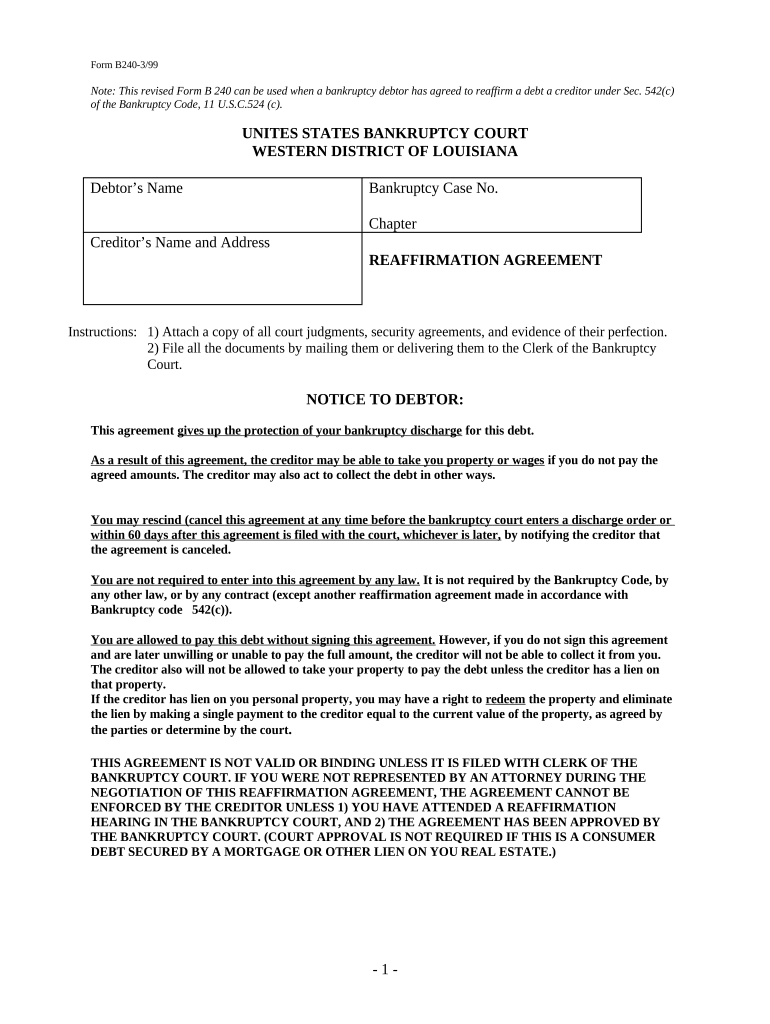
Reaffirmation Agreement - Louisiana Preview on Page 1

Here's how it works

01. Edit your form online
Type text, add images, blackout confidential details, add comments, highlights and more.
02. Sign it in a few clicks
Draw your signature, type it, upload its image, or use your mobile device as a signature pad.
03. Share your form with others
Send it via email, link, or fax. You can also download it, export it or print it out.

How to use or fill out Reaffirmation Agreement - Louisiana with our platform

Form edit decoration
9.5
Ease of Setup
DocHub User Ratings on G2
9.0
Ease of Use
DocHub User Ratings on G2
  1. Click ‘Get Form’ to open the Reaffirmation Agreement - Louisiana in the editor.
  2. Begin by entering the debtor’s name and bankruptcy case number at the top of the form. Ensure accuracy as this information is crucial for identification.
  3. Fill in the creditor’s name and address. This section is essential for establishing who you are reaffirming the debt with.
  4. In the 'THE DEBT' section, provide details such as total amount of debt when the case was filed, total amount reaffirmed, interest accrued, attorney's fees, and any other related costs. Be thorough to avoid future disputes.
  5. Complete the 'CREDITOR’S STATEMENT' section if applicable, detailing any collateral involved. This helps clarify what assets are tied to this agreement.
  6. In the 'DEBTOR’S STATEMENT OF EFFECT OF AGREEMENT ON DEBTOR’S FINANCES', input your monthly income and expenses. This will help assess whether this agreement imposes an undue hardship on you.
  7. Finally, ensure all signatures are completed at the bottom of the form. If you have an attorney, their certification is also required for validation.

Start using our platform today to easily fill out your Reaffirmation Agreement - Louisiana for free!

be ready to get more

Complete this form in 5 minutes or less

Get form

Got questions?

We have answers to the most popular questions from our customers. If you can't find an answer to your question, please contact us.
Contact us
You cannot reaffirm any debt after your bankruptcy has been discharged. Bankruptcy law requires any reaffirmation to occur before the discharge is entered. In addition, the only reason to reaffirm is to persuade the mortgage company to report your ongoing payments to the credit bureaus.
Agreeing to repay the excess loan amount in accordance with the terms of the promissory note is called reaffirmation. You can reaffirm an excess loan amount by signing a reaffirmation agreement with your loan servicer.
Once a reaffirmation agreement is approved, the debt becomes an ongoing obligation. The debtor must continue making payments as agreed, and if they default, the creditor can take legal action, such as repossessing the collateral or suing for the remaining balance.
Cons of a Reaffirmation Agreement The biggest downside is that reaffirmation takes away one of the key benefits of Chapter 7: having your personal responsibility for the debt erased. Once you reaffirm, youre legally on the hook for the loan again. That means if you fall behind later, your car can still be repossessed.
How long does the reaffirmation process take? The reaffirmation process will vary based on your Federal Loan Servicer. We recommend you allow at least 4-6 weeks for this process once the request has been initiated.

Security and compliance

At DocHub, your data security is our priority. We follow HIPAA, SOC2, GDPR, and other standards, so you can work on your documents with confidence.

Learn more
ccpa2
pci-dss
gdpr-compliance
hipaa
soc-compliance

People also ask

Reaffirming a debt informs the lender that you intend to continue to pay the loan. Generally, the lender will continue to report the loan and all payments made on that loan to the credit reporting agencies, which may help improve your credit score after bankruptcy, provided timely payments are made on the loan.
A reaffirmation agreement is an agreement between a chapter 7 debtor and a creditor that the debtor will pay all or a portion of the money owed, even though the debtor has filed bankruptcy. In return, the creditor promises that, as long as payments are made, the creditor will not repossess or take back its collateral.

Related links