Request judgment 2026

Get Form
request judgment Preview on Page 1

Here's how it works

01. Edit your form online
Type text, add images, blackout confidential details, add comments, highlights and more.
02. Sign it in a few clicks
Draw your signature, type it, upload its image, or use your mobile device as a signature pad.
03. Share your form with others
Send it via email, link, or fax. You can also download it, export it or print it out.

How to use or fill out request judgment with our platform

Form edit decoration
9.5
Ease of Setup
DocHub User Ratings on G2
9.0
Ease of Use
DocHub User Ratings on G2
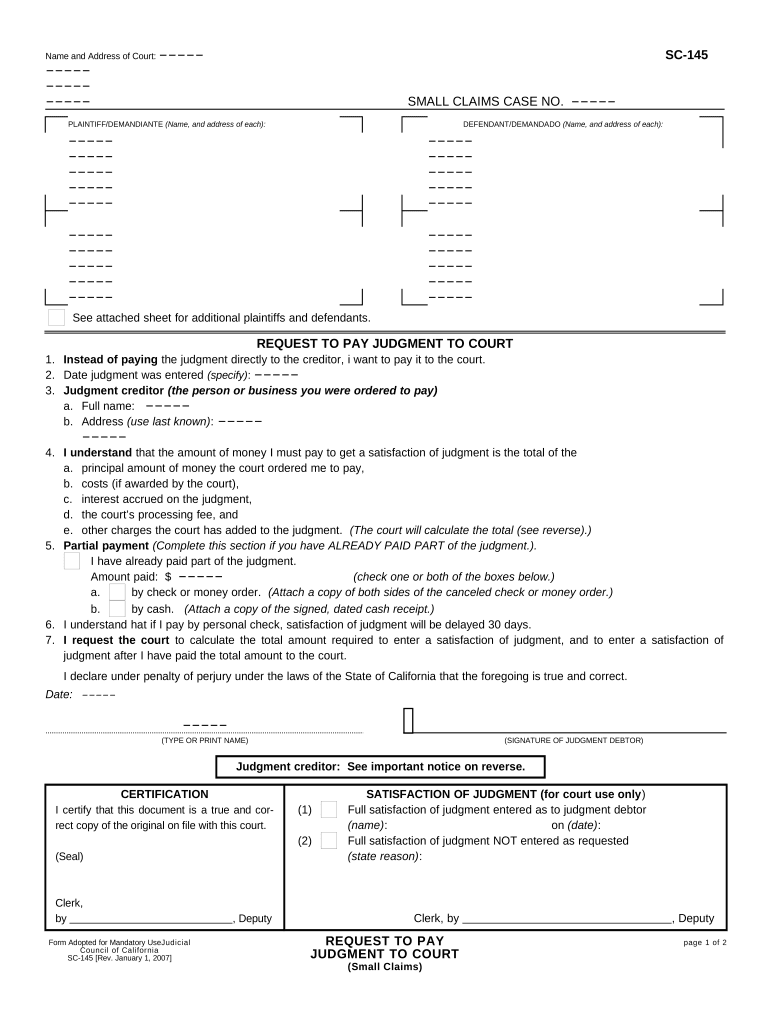
  1. Click ‘Get Form’ to open the request judgment document in the editor.
  2. Begin by entering the Name and Address of the Court at the top of the form. Ensure accuracy as this information is crucial for processing your request.
  3. Fill in the SMALL CLAIMS CASE NO. and provide details for both PLAINTIFF and DEFENDANT, including names and addresses. If there are additional parties, refer to the attached sheet.
  4. In the 'REQUEST TO PAY JUDGMENT TO COURT' section, indicate your preference to pay directly to the court instead of the creditor by checking the appropriate box.
  5. Specify the date when the judgment was entered and provide details about the judgment creditor, including their full name and last known address.
  6. Complete any relevant sections regarding partial payments if applicable, ensuring you attach necessary documentation like canceled checks or receipts.
  7. Finally, review all entries for accuracy before signing and dating your declaration under penalty of perjury.

Start using our platform today to streamline your document editing and ensure a smooth submission process!

be ready to get more

Complete this form in 5 minutes or less

Get form

Got questions?

We have answers to the most popular questions from our customers. If you can't find an answer to your question, please contact us.
Contact us
In law, a summary judgment, also referred to as judgment as a matter of law or summary disposition, is a judgment entered by a court for one party and against another party summarily, i.e., without a full trial.
A judgment generally operates to settle finally and authoritatively matters in dispute before a court. Judgments may be classified as in personam, in rem, or quasi in rem.
A judgment is a court order stating that you owe the debt collector money because of a lawsuit. You may have received a judgment because the court decided in favor of the debt collector in a trial, or because you did not respond to a lawsuit that was filed against you.
But the judgment is composed of three elements: subject, attribute, and copula. To these three elements of the judgment correspond the three elements of the proposition: two terms, which express the subject and predicate or attribute, and the copula, which unites them.
There is first the judgment of the world, which he does not regard. There is the judgment of self whereby he is not justified. Then Paul says, He that judgeth me is the Lord. There is the third judgment which is the judgment of God.

Security and compliance

At DocHub, your data security is our priority. We follow HIPAA, SOC2, GDPR, and other standards, so you can work on your documents with confidence.

Learn more
ccpa2
pci-dss
gdpr-compliance
hipaa
soc-compliance

People also ask

During this week we will consider the end-time judgment process with its three main phases: the pre-advent judgment, the millennial judgment, and the executive judgment. The whole process ends with the vindication of the righteous and the second death of the wicked.
A judgment lasts for 12 years and the plaintiff can renew the judgment for another 12 years.
Judgment is a court decision that settles a dispute between two parties by determining the rights and obligations of each party. Judgments are classified as in personam, in rem, or quasi in rem. Judgments are usually monetary, but can also be non-monetary, and are legally enforceable.

Related links