Type text, add images, blackout confidential details, add comments, highlights and more.

02. Sign it in a few clicks
Draw your signature, type it, upload its image, or use your mobile device as a signature pad.

03. Share your form with others
Send it via email, link, or fax. You can also download it, export it or print it out.

How to use or fill out ny order protection with our platform
Ease of Setup
DocHub User Ratings on G2
Ease of Use
DocHub User Ratings on G2
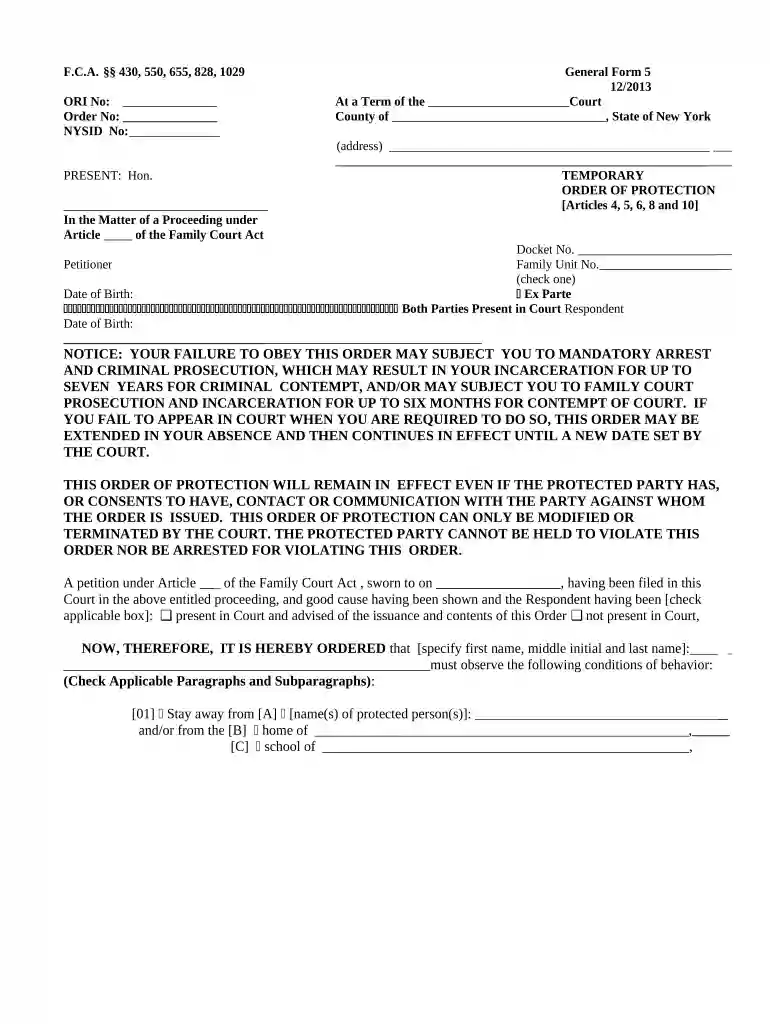
Click ‘Get Form’ to open the ny order protection document in the editor.
Begin by filling in the 'Order No' and 'NYSID No' fields at the top of the form. These identifiers are crucial for tracking your case.
In the 'PRESENT' section, enter the name of the presiding judge and the county where your case is being heard.
Complete the 'In the Matter of a Proceeding under Article' section by specifying which article applies to your situation.
Fill in both parties' names and dates of birth in their respective fields. This information is essential for identifying all involved individuals.
Check applicable boxes regarding conditions of behavior that must be observed, such as staying away from protected persons or refraining from communication.
Review all entries for accuracy before saving or printing your completed form. Ensure that all necessary signatures are included.
Start using our platform today to easily fill out your ny order protection form for free!
What are the requirements for an order of protection in NY?
To get an order of protection, you must allege that the abuser committed one or more family offenses against you. The following crimes are considered to be family offenses when the victim and abuser are/were related by blood, marriage, in an intimate relationship, or they have a child in common: Disorderly conduct.
How long does order of protection last in NY?
A Final Order of Protection can last from one year to several years, depending upon the seriousness of the case.
What is the difference between a restraining order and an order of protection in New York?
In New York, an order of protection is a legal term that refers to a protective order, commonly referred to as a restraining order, issued by the court as a means to help keep a person safe from further abuse or other harm or harassment.
What is the burden of proof for order of protection in New York?
Order of Protection: This is considered a civil law case, and the victim has to give some evidence and generally the burden is low and the victim must establish preponderance of the evidence of a past act or acts of abuse. In a civil case, the judge assesses whether the claims made by the accuser are more likely
What is the most common restraining order?
There are several types of restraining orders, but the most common ones that defendants face are: Domestic Violence Restraining Orders (DVRO): This is the most common type of restraining order. It is designed to protect victims of domestic violence by family or household members.
Related Searches
nys order of protection lookuphow to get an order of protectionfile order of protection onlineorder of protection for harassment in new yorkrestraining order vs order of protectionorder of protection family courtnys order of protection formcriminal court order of protection
Security and compliance
At DocHub, your data security is our priority. We follow HIPAA, SOC2, GDPR, and other standards, so you can work on your documents with confidence.
Orders of Protection | Office for the Prevention of Domestic
It is used to address safety issues, including domestic violence. It can be issued for civil, family, and criminal complaints. What does an order of protection
Rules and Regulations on Controlled Substances in NYS
(e) Bureau of Narcotic Enforcement means the Bureau of Narcotic Enforcement of the. Department of Health of the State of New York. (f) Drug Enforcement
Order of Protection or Deportation? How Civil - BrooklynWorks
by SE Corsico 2023 Cited by 2 Order of Protection or Deportation? HOW CIVIL ORDERS OF PROTECTION ENTANGLE. NONCITIZENS AND THEIR FAMILIES IN THE. IMMIGRATION AND CRIMINAL
Cookie consent notice
This site uses cookies to enhance site navigation and personalize your experience.
By using this site you agree to our use of cookies as described in our Privacy Notice.
You can modify your selections by visiting our Cookie and Advertising Notice.