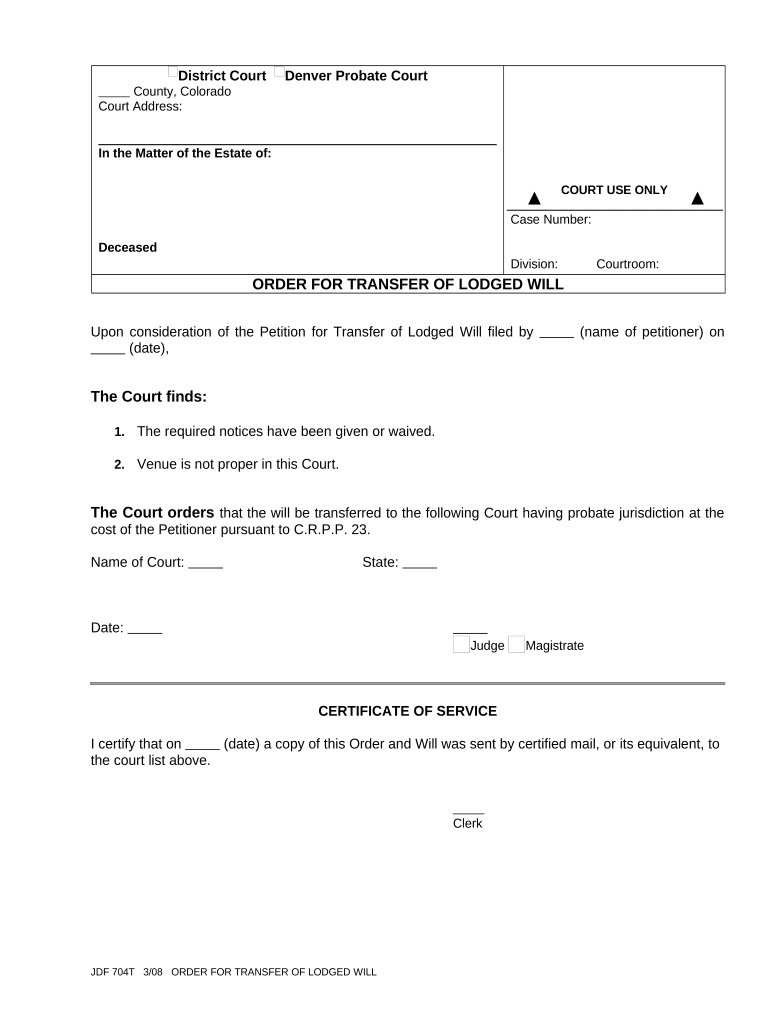
Order for Transfer of Lodged Will - and Codicils - Will Changes or Amendments - Colorado 2026

Get Form
Order for Transfer of Lodged Will - and Codicils - Will Changes or Amendments - Colorado Preview on Page 1

Here's how it works

01. Edit your form online
Type text, add images, blackout confidential details, add comments, highlights and more.
02. Sign it in a few clicks
Draw your signature, type it, upload its image, or use your mobile device as a signature pad.
03. Share your form with others
Send it via email, link, or fax. You can also download it, export it or print it out.

How to use or fill out Order for Transfer of Lodged Will - and Codicils - Will Changes or Amendments - Colorado with DocHub

Form edit decoration
9.5
Ease of Setup
DocHub User Ratings on G2
9.0
Ease of Use
DocHub User Ratings on G2
  1. Click ‘Get Form’ to open it in the editor.
  2. Begin by entering the case number in the designated field. This is crucial for identifying the specific probate case related to the lodged will.
  3. Fill in the name of the deceased in the appropriate section. Ensure accuracy as this information is vital for legal documentation.
  4. In the 'Petition for Transfer of Lodged Will' section, input the date and name of the petitioner who filed this request. This establishes who is requesting the transfer.
  5. Review and confirm that all required notices have been given or waived, as indicated in point one of the court findings.
  6. Specify the name and state of the court where you are transferring the will. This ensures proper jurisdiction for handling probate matters.
  7. Finally, complete the certificate of service by entering the date when a copy of this order was sent to the specified court via certified mail.

Start using our platform today to streamline your document editing and ensure your forms are completed accurately and efficiently!

be ready to get more

Complete this form in 5 minutes or less

Get form

Got questions?

We have answers to the most popular questions from our customers. If you can't find an answer to your question, please contact us.
Contact us
While both codicils and addendums are used to make changes to existing documents, they serve different purposes in legal contexts. A codicil is specifically used to modify or add to a will, while an addendum is a more general term used for additions to various types of documents, including contracts or reports.
Handwriting: The entire codicil must be handwritten by the testator themselves. Typewritten or computer-generated codicils are generally not considered holographic. Date: The holographic codicil should include the date of its creation.
I subscribe my name to this codicil this [day, e.g. 1st] day of [month], [year], at [full address where signed], in the presence of [full name of first witness to codicil], [full name of second witness to codicil], and [full name of third witness to codicil], attesting witnesses, who subscribe their names here in my
Specifically, a codicil must be in writing and signed by the testator. In order to revoke his will or create a codicil, a testator must understand the sig- nificance of his action and must not be unduly influenced or forced to do so by another person.
A will can be amended or revoked by a testator. An amend- ment to a will is called a codicil. In order to revoke your will or create a codicil, a testator must meet the same require- ments as if he were creating a will. Specifically, a codicil must be in writing and signed by the testator.

Security and compliance

At DocHub, your data security is our priority. We follow HIPAA, SOC2, GDPR, and other standards, so you can work on your documents with confidence.

Learn more
ccpa2
pci-dss
gdpr-compliance
hipaa
soc-compliance

People also ask

16. ​ To enter similar orders upon the stipulation of all interested person. b)​ All orders made and proceedings had by the clerk or deputy clerk under this rule shall be made of permanent records as provided for acts of the court done by the judge.
Instead, the executor of an estate can file for informal probate, which requires limited court supervision. Informal probate in Colorado typically takes six months to a year, depending on how quickly debts and assets are settled.
A will may be deemed invalid if it is the product of undue influence. In Colorado, this occurs when another persons actions take away the free will of the testator, such as in cases of coercion or duress.

Related links