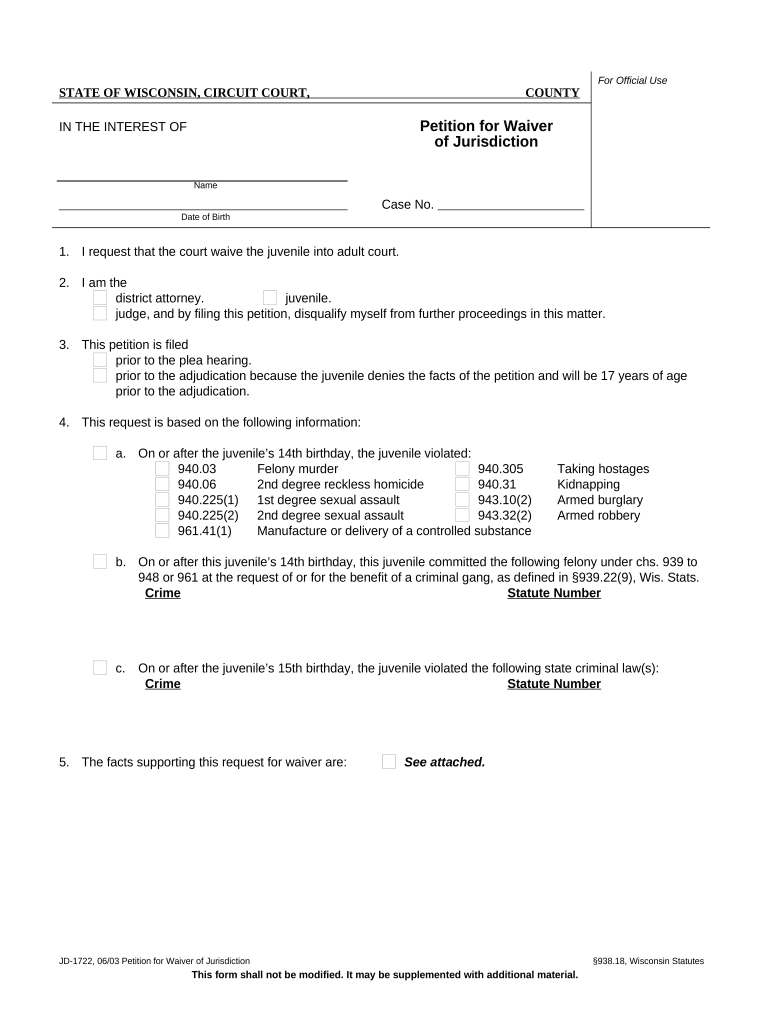
Petition for Waiver of Jurisdiction - Wisconsin 2026

Get Form
Petition for Waiver of Jurisdiction - Wisconsin Preview on Page 1

Here's how it works

01. Edit your form online
Type text, add images, blackout confidential details, add comments, highlights and more.
02. Sign it in a few clicks
Draw your signature, type it, upload its image, or use your mobile device as a signature pad.
03. Share your form with others
Send it via email, link, or fax. You can also download it, export it or print it out.

How to use or fill out Petition for Waiver of Jurisdiction - Wisconsin with our platform

Form edit decoration
9.5
Ease of Setup
DocHub User Ratings on G2
9.0
Ease of Use
DocHub User Ratings on G2
  1. Click ‘Get Form’ to open the Petition for Waiver of Jurisdiction in the editor.
  2. Begin by entering the juvenile's name and case number at the top of the form. Ensure accuracy as this information is crucial for identification.
  3. In section 1, clearly state your request for the court to waive jurisdiction. Select whether you are the district attorney, juvenile, or judge.
  4. For section 3, indicate if this petition is filed prior to the plea hearing or adjudication. This helps establish the timeline of proceedings.
  5. In section 4, provide detailed information about any violations committed by the juvenile after their 14th birthday. List each crime along with its corresponding statute number.
  6. Use section 5 to outline facts supporting your waiver request. If necessary, attach additional documentation for clarity.
  7. Finally, sign and print your name in the designated area before submitting your completed petition.

Start using our platform today to fill out your Petition for Waiver of Jurisdiction quickly and efficiently!

be ready to get more

Complete this form in 5 minutes or less

Get form

Got questions?

We have answers to the most popular questions from our customers. If you can't find an answer to your question, please contact us.
Contact us
There are 94 district courts, 13 circuit courts, and one Supreme Court throughout the country. Courts in the federal system work differently in many ways than state courts.
United States (383 U.S. 541, 566-67 (1966)) that must be met before the court may consider waiver in a given case: generally a minimum age, a specified type or level of offense, a sufficiently serious record of previous delinquency, or some combination of the three.
Judicial waiver laws authorize or require juvenile court judges to remove certain youth from juvenile court jurisdiction to be tried as adults in criminal court. There are three broad categories for judicial waiver: discretionary, presumptive, and mandatory.
Youth who are accused of committing crimes fall into three categories: Juvenile Delinquent, Juvenile Offender, and Adolescent Offender. A Juvenile Delinquent is a child over 12, but under 18 years of age, who commits an act that would be a crime if it had been committed by an adult.
The second type of waiver is judicial waiver. Under this system, if a person over a certain age is accused of certain offenses, a hearing (often called a fitness hearing) is held. The judge considers several factors to determine whether the minor is amenable to treatment by the juvenile justice system.

Security and compliance

At DocHub, your data security is our priority. We follow HIPAA, SOC2, GDPR, and other standards, so you can work on your documents with confidence.

Learn more
ccpa2
pci-dss
gdpr-compliance
hipaa
soc-compliance

People also ask

Also called concurrent jurisdiction, direct file waivers occur when the prosecutor has the option of filing the case in either juvenile or adult court. A form of judicial waiver. It is the oldest and most common type in the United States.
A waiver of jurisdictional defenses occurs when a party voluntarily gives up their right to challenge the jurisdiction of a court over themselves or their case.

Related links