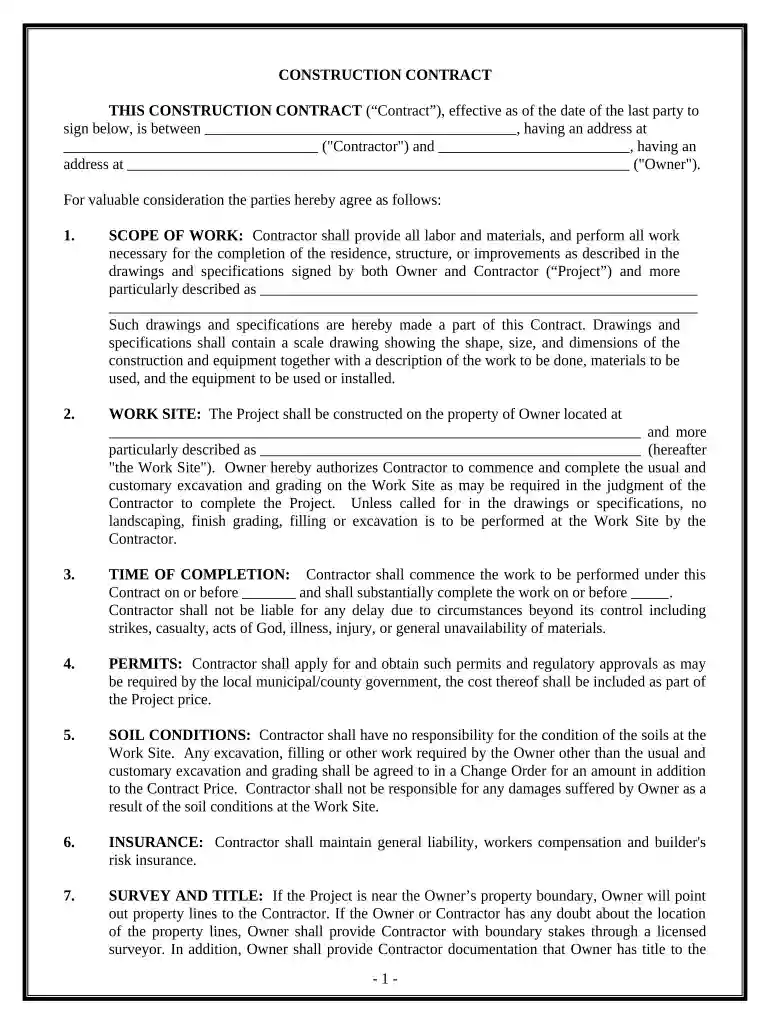
Construction Contract Cost Plus or Fixed Fee - Ohio 2026

Get Form
fixed price contract example construction Preview on Page 1

Here's how it works

01. Edit your fixed price contract example construction online
Type text, add images, blackout confidential details, add comments, highlights and more.

02. Sign it in a few clicks
Draw your signature, type it, upload its image, or use your mobile device as a signature pad.

03. Share your form with others
Send fixed price contract example via email, link, or fax. You can also download it, export it or print it out.

How to use or fill out Construction Contract Cost Plus or Fixed Fee - Ohio

Form edit decoration
9.5
Ease of Setup
DocHub User Ratings on G2
9.0
Ease of Use
DocHub User Ratings on G2
  1. Click ‘Get Form’ to open it in the editor.
  2. Begin by filling in the Contractor and Owner details, including names and addresses. This establishes the parties involved in the contract.
  3. In the 'SCOPE OF WORK' section, describe the project clearly, referencing any drawings or specifications that outline the work to be done.
  4. Specify the 'WORK SITE' address where construction will take place. Ensure this is accurate to avoid any future disputes.
  5. Set a timeline for completion in the 'TIME OF COMPLETION' section, noting start and end dates.
  6. Choose between 'COST PLUS' or 'FIXED FEE' payment structures and fill in the respective amounts. This defines how payments will be made throughout the project.
  7. Review all sections for accuracy before saving your changes. Utilize our platform's features to sign and share your completed contract seamlessly.

Start using our platform today to streamline your construction contract process for free!

be ready to get more

Complete this form in 5 minutes or less

Get form

Got questions?

We have answers to the most popular questions from our customers. If you can't find an answer to your question, please contact us.
Contact us
In A-level economics, cost-plus pricing refers to a method where firms calculate the total cost of production and then add a percentage markup to set the final price.
Cost-plus pricing is a pricing strategy by which the selling price of a product is determined by adding a specific fixed percentage (a markup) to the products unit cost. Essentially, the markup percentage is a method of generating a particular desired rate of return.
For cost-plus contracts (where the client agrees to pay all costs, plus a specific percentage margin to the builder), a common practice is costs plus 15 to 20 per cent margin, although there are some contracts which include a margin as small as 5 per cent. The builders margin may also be a fixed amount.
Most contracts have a cost-plus fee scale of 10-25%. A contractor would use takeoff software to calculate the materials costs, but they wouldnt need to be exact. Some companies use a cost-plus-fixed-fee (CPFF) instead of a percentage.
In cost-plus contracts, contractors receive reimbursement for all allowable costs plus a profit margin, thus the buyer takes on more risk, particularly of cost overruns. Conversely, fixed-price contracts shift the risk to the contractor, as they must complete the project within the agreed-upon sum.

Security and compliance

At DocHub, your data security is our priority. We follow HIPAA, SOC2, GDPR, and other standards, so you can work on your documents with confidence.
Learn more
ccpa2
pci-dss
gdpr-compliance
hipaa
soc-compliance
be ready to get more

Complete this form in 5 minutes or less

Get form

People also ask

A cost-plus-fixed-fee contract is a cost-reimbursement contract that provides for payment to the contractor of a negotiated fee that is fixed at the inception of the contract. The fixed fee does not vary with actual cost, but may be adjusted as a result of changes in the work to be performed under the contract.
Cost-plus contracts reduce risk for contractors but can increase costs for clients if not managed properly.

cost plus construction