Act 168 2026

Get Form
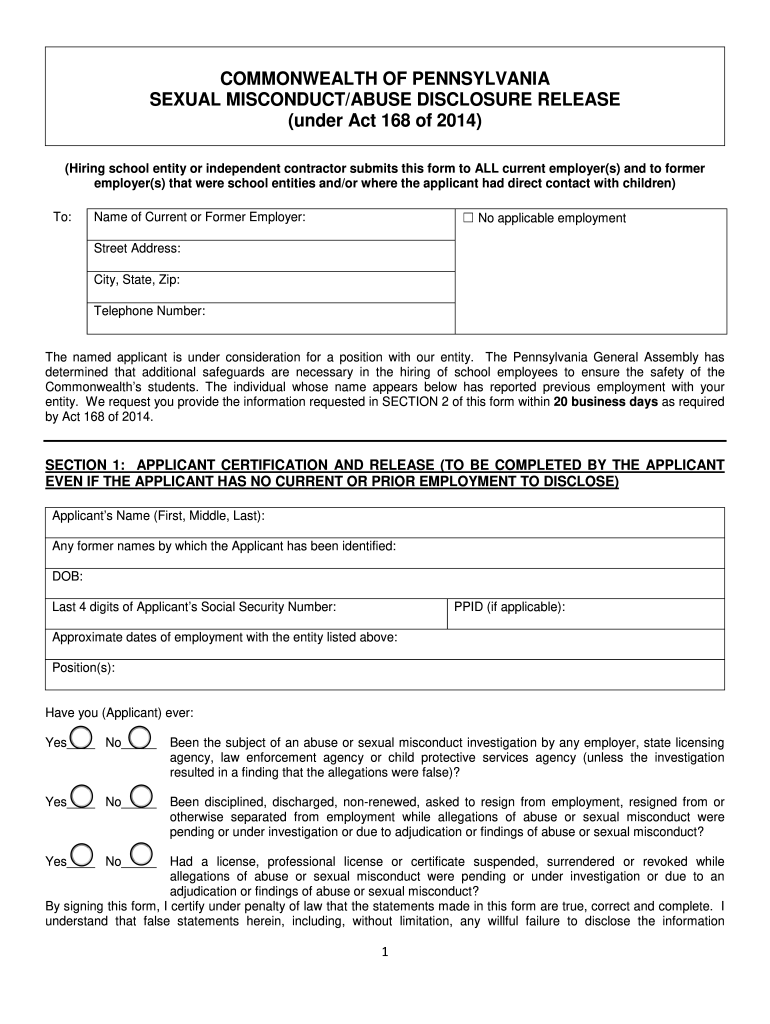
act 168 Preview on Page 1

Here's how it works

01. Edit your form online
Type text, add images, blackout confidential details, add comments, highlights and more.
02. Sign it in a few clicks
Draw your signature, type it, upload its image, or use your mobile device as a signature pad.
03. Share your form with others
Send it via email, link, or fax. You can also download it, export it or print it out.

How to use or fill out act 168 with our platform

Form edit decoration
9.5
Ease of Setup
DocHub User Ratings on G2
9.0
Ease of Use
DocHub User Ratings on G2
  1. Click ‘Get Form’ to open it in the editor.
  2. Begin with SECTION 1, where you will enter your personal information. Fill in your name, any former names, date of birth, and the last four digits of your Social Security Number.
  3. Next, provide details about your employment history. Include the approximate dates of employment and positions held at the current or former employer listed.
  4. Answer the questions regarding any past investigations or disciplinary actions related to abuse or sexual misconduct. Be sure to check 'Yes' or 'No' as applicable.
  5. Sign and date the form at the bottom of SECTION 1 to certify that all information is accurate.
  6. Once completed, submit this form to your current and former employers for them to fill out SECTION 2.

Start using our platform today for free to complete your act 168 form efficiently!

be ready to get more

Complete this form in 5 minutes or less

Get form

Got questions?

We have answers to the most popular questions from our customers. If you can't find an answer to your question, please contact us.
Contact us
168Failure to give, or giving false, name and address in case of reckless or careless or inconsiderate driving or cycling.
The finder of goods has no right to sue the owner for compensation for trouble and expense voluntarily incurred by him to preserve the goods and to find out the owner; but he may retain the goods against the owner until he receives such compensation; and, where the owner has offered a specific reward for the return of
In addition to the disqualifying criminal offenses listed above in sections (a) and (b), applicants will not pass the criminal background check if they were convicted of a felony within the last 10 years or were convicted of any crime involving fraudulent activities.
In Pennsylvania, Child Protective Services (CPS) can investigate abuse/neglect reports, interview children (even privately), unannounced home visits, and request drug tests if substance abuse suspected, but they cannot enter your home without permission or a court order, arrest people, or remove a child without judicial approval and strong evidence; their role is to assess risk and provide services (like counseling, parenting classes) to keep families together when possible. What CPS Can Do: Investigate reports: Look into any report of suspected abuse or neglect, even anonymous ones. Unannounced visits: Show up at your home to check for safety and living conditions (heat, water, food). Interview children: Talk to your child without you present, sometimes without your knowledge. Request testing: Ask for drug/alcohol testing if substance abuse is suspected. Create service plans: Develop plans for family counseling, parenting classes, or other support to help families. Work with law enforcement: Collaborate with police if a child is in immediate danger. Seek court orders: Get court orders to enter homes or remove children if theres evidence of harm. What CPS Cannot Do: Enter without permission: Cannot force entry into your home without a court order. Arrest or enforce laws: They are social workers, not police; they cant make arrests. Remove a child arbitrarily: Need judicial approval and strong evidence to remove a child. Intervene in minor disputes: Disagreements over parenting styles are usually outside their scope unless actual harm is present. Make promises they cant keep: Cannot guarantee specific placements or visitation outcomes; courts make final decisions. Key Things to Remember: Evidence is key: CPS must have evidence of harm or risk to justify removal or further action. Your rights: You have rights, including the right to know why actions are being taken and the right to legal counsel. Cooperation: Cooperating doesnt mean admitting guilt; its part of the process to ensure child welfare. For legal advice, consult a professional. What CPS Can And Cant Do During InvestigationsCarroll, Papp Cunabaugh, Attorneys at LawWhat CPS Can and Cannot Do: An Attorney Weighs inJun 23, 2025 Investigate reports of abuse or neglect even anonymous ones. Interview your child sometimes without your permissioBACtrack View
Act 168 requires the applicant to disclose all former employers that were school entities and/or where the prospective employee had direct contact with children, and the employment history review conducted by the hiring entity must include all such employers listed by the applicant.

Security and compliance

At DocHub, your data security is our priority. We follow HIPAA, SOC2, GDPR, and other standards, so you can work on your documents with confidence.

Learn more
ccpa2
pci-dss
gdpr-compliance
hipaa
soc-compliance
be ready to get more

Complete this form in 5 minutes or less

Get form

People also ask

Yes. Even in an at-will state, you may sue when a firing violates federal statutes (e.g., Title VII, ADA, ADEA, FMLA), Pennsylvanias Human Relations Act, public-policy exceptions (refusing to commit an illegal act, reporting safety or regulatory violations), or an employment contract.
In Pennsylvania, an employer who discloses information about a current or former employees job performance to a prospective employer . . ., upon request of the prospective employer or the current or former employee, is presumed to be acting in good faith. 42 Pa. Cons. Stat. 8340.1.

Related links