




Here's how it works

01. Edit your form online
Type text, add images, blackout confidential details, add comments, highlights and more.

02. Sign it in a few clicks
Draw your signature, type it, upload its image, or use your mobile device as a signature pad.

03. Share your form with others
Send it via email, link, or fax. You can also download it, export it or print it out.
How to use or fill out colorado forcible with our platform

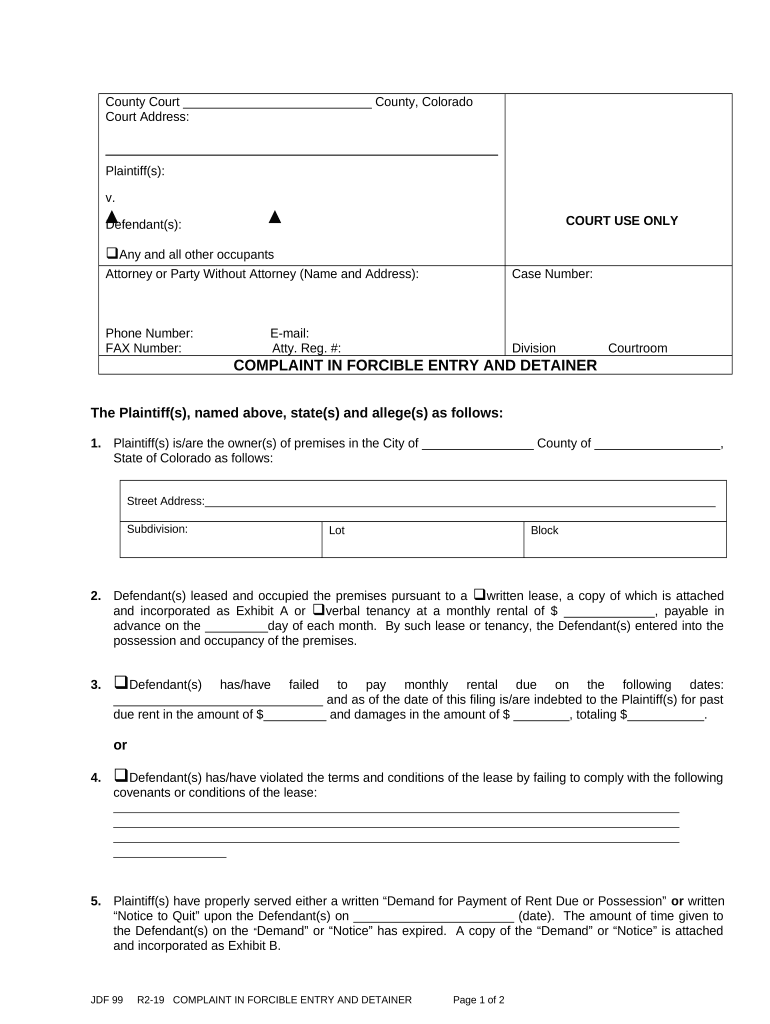
- Click ‘Get Form’ to open the Colorado Forcible Entry and Detainer form in the editor.
- Begin by entering the court address and case number at the top of the form. This information is crucial for identifying your case.
- Fill in the plaintiff(s) and defendant(s) details, including names and addresses. Ensure accuracy to avoid delays.
- In section 1, provide the street address of the premises involved in the dispute, along with subdivision, lot, and block details if applicable.
- Specify whether there was a written lease or verbal tenancy in section 2, and include rental amounts and payment due dates.
- Detail any missed payments or lease violations in sections 3 and 4. Be specific about dates and amounts owed.
- Complete section 5 by indicating whether a demand for payment or notice to quit has been served on the defendant(s).
- Finally, review all entries for accuracy before signing at the bottom of the form. Check appropriate boxes regarding changes made.
Start using our platform today to fill out your Colorado Forcible Entry and Detainer form easily and for free!
Fill out colorado forcible online
It's free
It's free
Got questions?
We have answers to the most popular questions from our customers. If you can't find an answer to your question, please contact us.
Contact us
What is forcible entry and detainer in Colorado?
If any person enters peaceably upon any lands, tenements, mining claims, or other possessions, whether any person is actually in or upon the same at the time of such entry and by force turns the party in possession out or, by threats or by words or actions which have a natural tendency to excite fear or apprehension of
What is a motion to enforce in Colorado?
In Colorado, a motion to enforce is a legal tool that can be used to ensure that an existing court order or agreement is followed. When one party fails to comply with the terms of a court order or agreement, the other party may file a motion to enforce to seek enforcement of the terms.
What is the WARN Act in Colorado?
Colorados WARN Act is meant to ensure that workers are protected when facing layoffs or plant closures. Employers in Colorado have to provide advance notice to employees when aware of impending closures or layoffs. The purpose of this notice is to offer employees enough time to find alternative employment options.
Is it illegal to puff your car in Colorado?
However, leaving your car running and unattended, also known as puffing, is illegal in Colorado due to the increased risk of vehicle theft. Only vehicles equipped with remote start or systems that keep the doors locked while running are exempt.
What are employee rights in Colorado?
Colorado employee rights protect workers from mistreatment and unreasonable safety risks. Even though Colorado is an at-will employment state, there are still many protections for workers. An employer may not discriminate or harass employees on the basis of gender, disability, age, race, or whether you have children.
Security and compliance
At DocHub, your data security is our priority. We follow HIPAA, SOC2, GDPR, and other standards, so you can work on your documents with confidence.
Learn more


People also ask
Can I record my boss yelling at me in Colorado?
Overview of Colorado Laws On Recording Conversations Colorado is a one-party consent state when it comes to recording conversations. This means that conversations cannot be recorded without the consent of at least one party. So, you can record a conversation without informing the other party.
What is considered a hostile work environment in Colorado?
Harassment-Hostile Work Environment Claim The claim includes these general elements: The conduct was unwelcome. The conduct was offensive. The conduct was based on a protected trait, such as sex, or directed against a person because of the individuals protected class, such as race.


