Attachment family law 2026

Get Form
foah family law Preview on Page 1

Here's how it works

01. Edit your foah family law online
Type text, add images, blackout confidential details, add comments, highlights and more.
02. Sign it in a few clicks
Draw your signature, type it, upload its image, or use your mobile device as a signature pad.
03. Share your form with others
Send it via email, link, or fax. You can also download it, export it or print it out.

How to use or fill out attachment family law with our platform

Form edit decoration
9.5
Ease of Setup
DocHub User Ratings on G2
9.0
Ease of Use
DocHub User Ratings on G2
  1. Click ‘Get Form’ to open the attachment family law document in the editor.
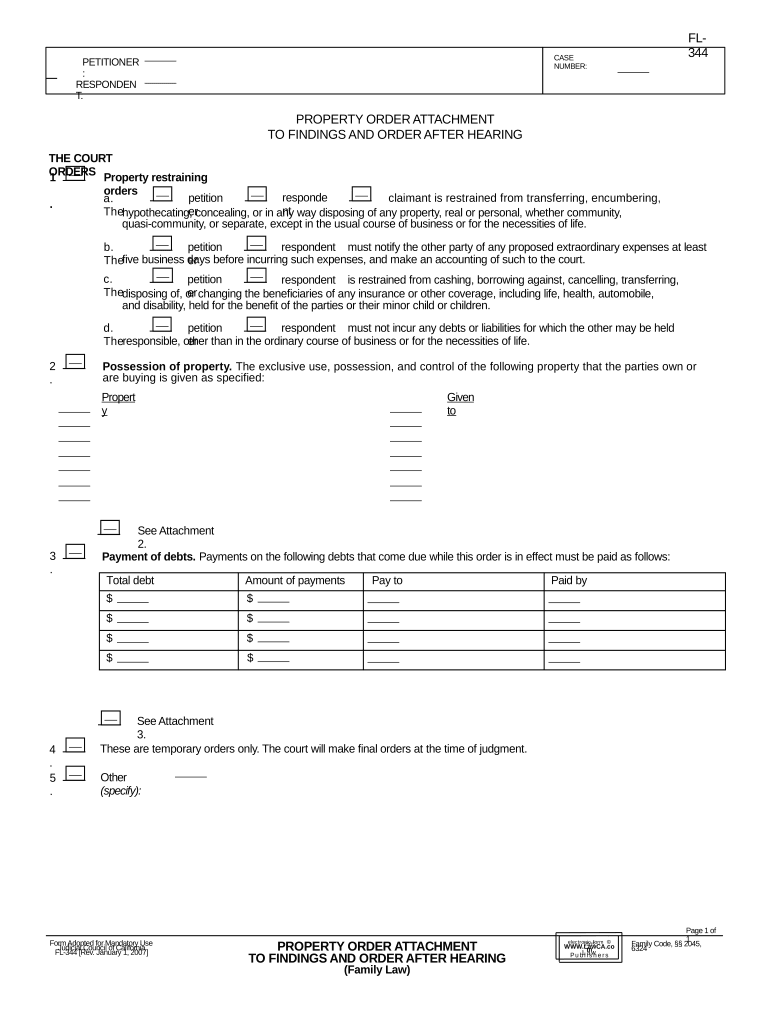
  2. Begin by entering the names of the Petitioner and Respondent at the top of the form, along with the case number (FL344). This information is crucial for identifying your case.
  3. In Section 1, review and complete each property restraining order. Specify any restrictions on transferring or encumbering property, ensuring you understand what is allowed under ordinary circumstances.
  4. For Section 2, list any property that will be exclusively possessed by one party. Clearly indicate which party is granted possession and provide details about the property.
  5. In Section 3, outline payment responsibilities for debts that arise during this order. Fill in total debt amounts and specify who will make payments to ensure clarity.
  6. Finally, review all entries for accuracy before saving your changes. Ensure that all necessary attachments are included as indicated in the form.

Start using our platform today to easily fill out your attachment family law document online for free!

be ready to get more

Complete this form in 5 minutes or less

Get form

Got questions?

We have answers to the most popular questions from our customers. If you can't find an answer to your question, please contact us.
Contact us
The concept of attachment styles grew from attachment theory and the research that emerged throughout the 1960s and 1970s. Today, psychologists typically recognize four main attachment styles: secure, ambivalent, avoidant, and disorganized.
Attachment can be defined as a reciprocal relationship. In parenting (or child development) it generally refers to the relationship that develops first between the infant/child and his primary caregiver (often Mother).
Section 72 creates the right to spousal maintenance and provides that a party to a marriage is liable to maintain the other party. The test for spousal maintenance or the threshold test can be divided as follows: The applicant is unable to support himself or herself adequately; and.
The Four Attachment styles are: secure, anxious, avoidant, disorganized / fearful avoidant. Attachment Theory explains how the emotional bonds we form with our parents in early life influence our relationships and attachment styles as adults. The attachment styles shape how we connect with others, express intimacy, and.
Four types of attachment styles may develop due to early childhood experiences: secure, anxious, avoidant, and disorganized. Avoidant, anxious, and disorganized are considered insecure attachment styles. Secure attachments develop when children can consistently rely on caregivers to fulfill their needs.

Security and compliance

At DocHub, your data security is our priority. We follow HIPAA, SOC2, GDPR, and other standards, so you can work on your documents with confidence.

Learn more
ccpa2
pci-dss
gdpr-compliance
hipaa
soc-compliance
be ready to get more

Complete this form in 5 minutes or less

Get form

People also ask

Understanding your attachment style is crucial for building healthier romantic relationships. By focusing on the 4 Cs of Attachment StylesContext, Connection, Comfort, and Conflict, you can gain clarity about how you navigate emotional dynamics and identify areas for growth.
Within attachment theory, attachment means an affectional bond or tie between an individual and an attachment figure (usually a caregiver/guardian).
Attachment theory provides the primary theoretical and clinical framework of ABFT (Bowlby, 1969, 2008). Attachment theory proposes that children who experience their caregivers as sensitive, responsive, and available develop confident expectations of relational security.

Related links