




01. Edit your entertainment contract template online
Type text, add images, blackout confidential details, add comments, highlights and more.

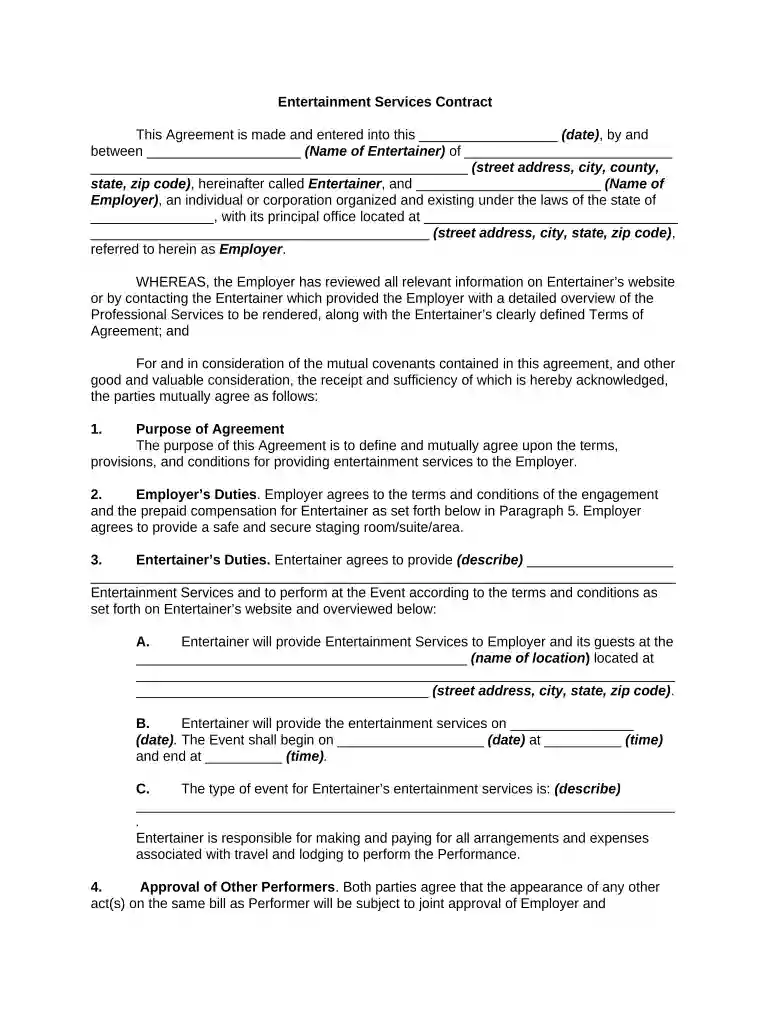
Type text, add images, blackout confidential details, add comments, highlights and more.

Draw your signature, type it, upload its image, or use your mobile device as a signature pad.

Send entertainment contract via email, link, or fax. You can also download it, export it or print it out.
The Entertainment Services Contract is a vital legal document that establishes the relationship between an entertainer and an employer. By clarifying expectations and responsibilities, this agreement helps prevent misunderstandings and disputes. Key elements of the contract include:
Payment structure is a crucial component of the Entertainment Services Contract, ensuring clarity for both parties. Contracts typically detail:
Payment Amount: This should specify the total fee for services rendered. For example, an entertainer might charge a flat fee of $2,500 for a performance.
Deposit Requirements: Many contracts require a deposit, often a percentage of the total fee, to secure the booking. Commonly, this might be around 20% of the total agreed amount.
Final Payment Schedule: The contract should state when the remaining balance is due, often prior to the event or performance date.
Additional Costs: It's also important to outline any potential additional costs, such as travel expenses, meals, lodging, or equipment rental fees.
Late Payment Penalties: Including provisions for late payment penalties can protect the entertainer from delayed compensation.
The Entertainment Services Contract details the specific obligations of both the entertainer and the employer. This clarity helps ensure both parties fulfill their commitments.
Entertainer Responsibilities:
Employer Responsibilities:
Including clear termination and cancellation clauses is essential for protecting both parties in the event of unforeseen circumstances. Key elements include:
Cancellation by Employer: The contract should stipulate any fees associated with cancellation, such as losing the deposit. For instance, if an event is canceled within two weeks of the performance date, the entertainer might retain the deposit.
Cancellation by Entertainer: Circumstances might also arise where the entertainer needs to cancel. The contract can outline potential remedies or obligations, such as notifying the employer in advance and providing a substitute performer if feasible.
Force Majeure Clause: This clause protects both parties from liability if events beyond their control prevent fulfillment of the agreement, like natural disasters or government restrictions.
Indemnification is a legal term that addresses liability and protection against claims. A well-drafted Entertainment Services Contract should include:
Liability Protection: The entertainer typically agrees to indemnify the employer against any claims arising from the entertainer’s actions during the performance. This could include injury to audience members or damage to property.
Employer's Indemnification: Conversely, the employer may also agree to indemnify the entertainer for any claims related to the venue or event, such as failing to ensure adequate safety measures.
Insurance Recommendations: While not legally binding, contracts might also suggest that entertainers carry liability insurance to protect against potential claims.
Disputes can arise from various aspects of an Entertainment Services Contract. Anticipating problems and including resolution mechanisms can be beneficial.
Mediation or Arbitration: The contract should specify whether disputes will be resolved through mediation or arbitration, helping to avoid lengthy court processes. Arbitration may provide a more immediate and cost-effective resolution.
Jurisdiction: Establishing the governing law and jurisdiction in the contract ensures both parties understand where any legal disputes will be handled, which can vary greatly by state.
Written Notification: The process for notifying the other party in the event of a dispute should also be clearly outlined to ensure timely communication.
While many elements are standard, customizing an Entertainment Services Contract to fit specific circumstances is important. Factors to consider include:
Type of Entertainment: Different performances (e.g., DJ, band, solo artist) may require distinct terms concerning performance length or equipment needs.
Audience Type: Contracts might need to adjust based on the audience demographic, such as a family-friendly event versus an adult-oriented performance.
Location Specifics: Depending on the venue, additional requirements could surface, such as local permits or regulations that impact performance.
By ensuring these components are thoroughly discussed and included, both the entertainer and employer can foster a successful and mutually beneficial working relationship.
At DocHub, your data security is our priority. We follow HIPAA, SOC2, GDPR, and other standards, so you can work on your documents with confidence.

In exchange for compensation set forth in this Agreement, Artist must provide Services at the Event from: (starting time) to. (ending time).Read more
THESE TERMS AND CONDITIONS ARE THE CONTRACT BETWEEN YOU (THE CUSTOMER or THE CLIENT) AND WORKFLOWFIRST SOFTWARE LLC (COMPANY) RELATING TO THE SOFTWARERead more


