
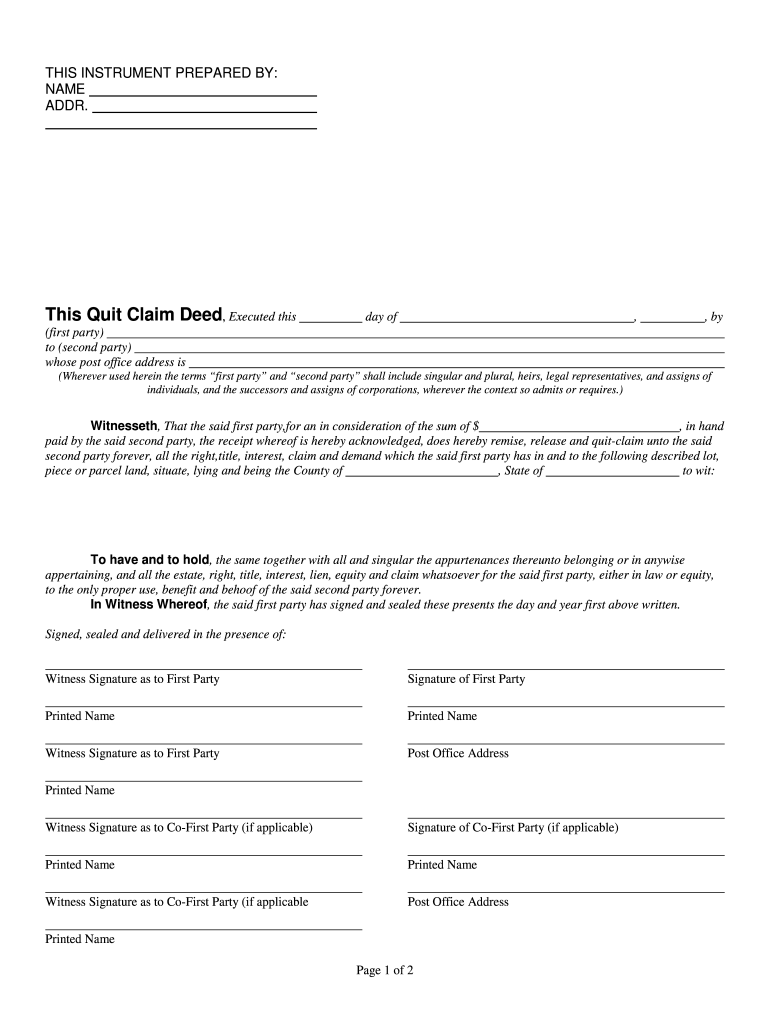







Definition and Meaning of the FL Quit Claim Deed
A Florida quit claim deed is a legal document utilized to transfer an individual's interests in a property without guaranteeing that the title is free of claims or encumbrances. This instrument is commonly executed when the grantor wants to relinquish any interest they may have in the property. It is especially prevalent in situations involving family members, divorces, or transferring property into or out of an estate.
Key attributes of a quit claim deed include:
- No Warranties: The grantor does not assure the grantee of clear title, which means the recipient assumes the risk of any existing claims.
- Simple Transfer: The quit claim deed facilitates a straightforward transfer of property rights, making it easier and quicker than other types of deeds.
- Common Uses: This document is often used among family members, in divorce settlements, or to clear up title discrepancies.
The quit claim deed may vary by county, necessitating attention to specific local requirements, such as those established by the Marion County Recorder's Office.
Steps to Complete the FL Quit Claim Deed
Filling out a Florida quit claim deed requires attention to detail. Here are the general steps to complete the form effectively:
-
Gather Necessary Information:
- Identify the grantor (current owner) and grantee (new owner).
- Prepare the legal description of the property, which can generally be found in a prior deed or tax documents.
-
Obtain the Form:
- Download the appropriate quit claim deed form from a reliable source, ensuring it meets Florida requirements. Various formats are available, including PDF and online fillable options.
-
Complete the Form:
- Fill in the names and addresses of both parties.
- Include the property's legal description, ensuring accuracy to avoid future disputes.
-
Sign the Document:
- All parties involved need to sign the quit claim deed.
- A notary public must witness the signatures to validate the document.
-
File the Document:
- Submit the completed quit claim deed to the appropriate county office for recording, such as the Marion County Clerk of Court's office.
- Pay any applicable recording fees.
-
Obtain a Copy:
- After recording, obtain a copy of the filed quit claim deed for your records.
This step-by-step process ensures compliance with Florida regulations and provides legal protection for both parties.
Important Terms Related to the FL Quit Claim Deed
Understanding specific terminology associated with the Florida quit claim deed is essential for clarity and effective use of the document. Here are several key terms:
- Grantor: The individual or entity transferring ownership or interest in the property.
- Grantee: The individual or entity receiving ownership or interest in the property.
- Legal Description: A precise description of the property being transferred, including boundaries and other relevant details.
- Notarization: The process of having the signatures on the deed recognized by a notary public, providing legal verification.
- Encumbrance: Any claim or liability attached to the property that may affect its value or use.
These terms help demystify the legal language associated with the quit claim deed, providing better understanding and utilization of the form.
Legal Use of the FL Quit Claim Deed
The legal validity of a Florida quit claim deed hinges on several factors and requires adherence to Florida laws concerning property transfer:
- Form Requirements: The quit claim deed must be in writing, signed by the grantor, and include a legal description of the property.
- Notarization: To be legally enforceable, the deed must be notarized.
- Recording: While not mandatory for all transactions, filing the deed with the county clerk’s office enhances its enforceability and puts third parties on notice regarding the property transfer.
- Family Transfers and Estates: The quit claim deed is particularly useful in transferring property among family members or within an estate, providing an efficient way to handle asset distribution during probate or after a separation.
Understanding these legal parameters is crucial in ensuring that the quit claim deed serves its intended purpose without future complications.
Examples of Using the FL Quit Claim Deed
Practical scenarios often demonstrate the utility of a Florida quit claim deed. Here are some common examples:
- Family Transfers: A parent conveying property to a child as a gift or part of an inheritance.
- Divorce Settlements: During the dissolution of marriage, one spouse may transfer their interest in the marital home to the other.
- Clearing Title Issues: If a person inherits a property but their name is not included on the title, a quit claim deed can be used to add their name.
- Adding Co-Owners: Individuals wishing to add a partner or relative as a co-owner can utilize a quit claim deed to formalize the arrangement.
These scenarios illustrate the diverse applications of the quit claim deed, streamlining what can often be complex property transactions.
State-Specific Rules for the FL Quit Claim Deed
Each state has specific requirements governing the use of quit claim deeds, and Florida is no exception. Notable regulations relevant to Florida include:
- Statutory Requirements: Florida Statute 689.02 outlines the necessary components of a valid deed, including the need for a legal description and the signatures of the grantor and a notary.
- County-Specific Procedures: Counties such as Marion may have unique forms or procedures for recording quit claim deeds, necessitating local research.
- Transfer Taxes: Although Florida does not impose a documentary stamp tax on transfers via a quit claim deed between relatives, taxpayers should verify if any fees apply based on their situation.
- Homestead Property: Special care must be taken when transferring homestead property to ensure compliance with the Florida Constitution regarding homestead rights.
Awareness of these state-specific rules is vital for any party looking to utilize a quit claim deed in Florida effectively.




