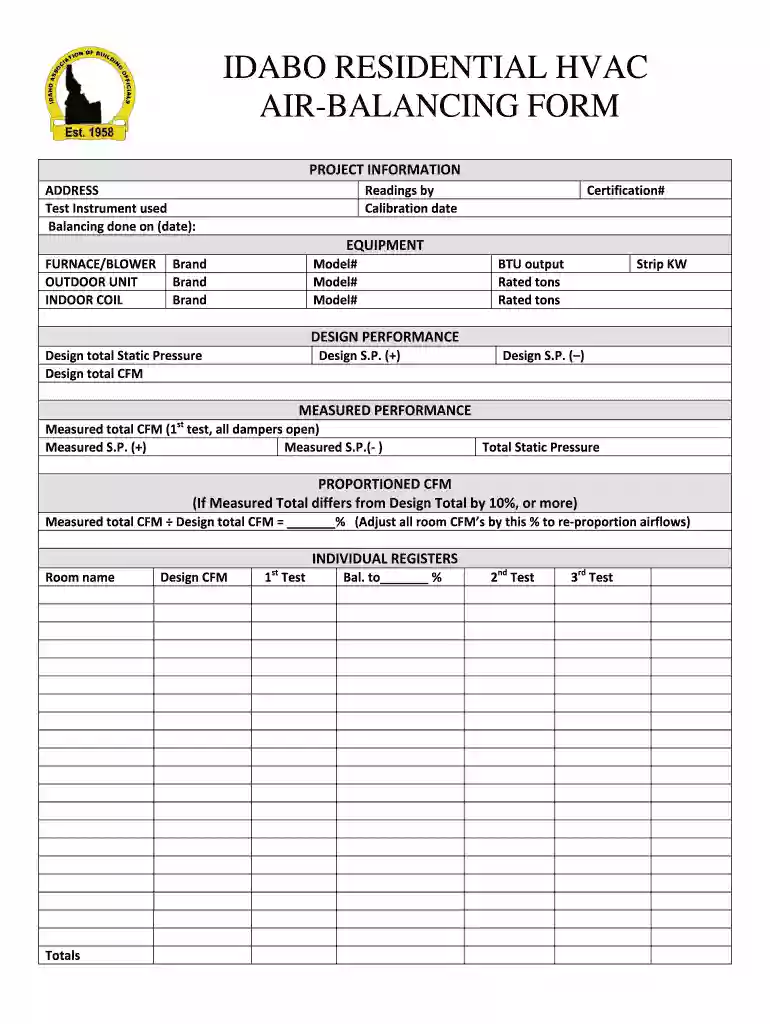
Hvac balancing check form 2026

Get Form
air balance report template Preview on Page 1

Here's how it works

01. Edit your air balance report template online
Type text, add images, blackout confidential details, add comments, highlights and more.

02. Sign it in a few clicks
Draw your signature, type it, upload its image, or use your mobile device as a signature pad.

03. Share your form with others
Send hvac air balancing report form via email, link, or fax. You can also download it, export it or print it out.

Definition and Importance of the HVAC Balancing Check Form

The HVAC balancing check form is a critical document used within the heating, ventilation, and air conditioning (HVAC) industry. This form serves as a detailed record of the airflow measurements taken during the balancing process to ensure that HVAC systems function effectively and efficiently. It typically includes information about the project, specific equipment, and performance metrics for air distribution in residential or commercial spaces.

Effective HVAC balancing is vital for maintaining indoor air quality and reducing energy consumption. A well-balanced system ensures that conditioned air is distributed evenly throughout a space, preventing hot or cold spots, thereby enhancing comfort for occupants. By documenting these measurements and subsequent adjustments on the HVAC balancing check form, technicians can provide evidence of compliance with industry standards and project specifications.

Using this form helps technicians communicate findings and outcomes to clients or project stakeholders, allowing for transparency and accountability throughout the HVAC balancing process.

How to Use the HVAC Balancing Check Form

Utilizing the HVAC balancing check form involves several steps to ensure thorough documentation and effective data collection.

  1. Preparation:

    • Gather necessary equipment such as an anemometer or manometer to measure airflow and pressure.
    • Obtain the specific project details and equipment list to accurately complete the form.
  2. Conducting Measurements:

    • Measure airflow at individual supply and return registers to identify any discrepancies in air distribution.
    • Document baseline measurements on the form to establish a point of reference for subsequent adjustments.
  3. Making Adjustments:

    • Adjust dampers or replace filters as necessary to correct airflow issues. These alterations should also be documented on the form.
  4. Final Measurements:

    • Re-measure airflow post-adjustments to confirm that the system performance meets design specifications.
    • Capture this data on the form for final review.
  5. Review and Submit:

    • Review the completed form for accuracy. Ensure that all sections, including calibration dates and certification numbers, are filled out correctly.
    • Share the completed form with project stakeholders and archive it for future reference.

By following these steps, individuals can effectively utilize the HVAC balancing check form and facilitate better HVAC system performance.

Important Elements of the HVAC Balancing Check Form

The HVAC balancing check form comprises essential components that ensure comprehensive documentation of the balancing process. Key elements typically include:

  • Project Information:

    • Project name, location, and date of service help contextualize the data recorded.
  • Equipment Specifications:

    • Detailed descriptions of the HVAC equipment used, including model and serial numbers, are vital for tracking performance.
  • Airflow Data:

    • This section typically features pre- and post-adjustment airflow measurements for each register, which are critical for understanding system changes.
  • Calibration and Certification:

    • Dates of equipment calibration, certification numbers, and technician signatures provide accountability and traceability.
  • Adjustments Made:

    • A checklist or narrative area where technicians can detail specific adjustments made during the balancing process.
  • Remarks and Recommendations:

    • An area for additional comments, including recommendations for future maintenance or adjustments.

By including these elements, the HVAC balancing check form fosters a clear understanding of HVAC system performance and aids in troubleshooting potential issues.

Steps to Complete the HVAC Balancing Check Form

Completing the HVAC balancing check form involves a systematic approach to ensure accuracy and thoroughness. Here are the steps:

  1. Start with Project Details:

    • Fill in relevant project information, including the job site address, project name, and date of the assessment.
  2. Record Equipment Details:

    • List all HVAC equipment involved, providing model numbers and specifications, which assists in tracking and accountability.
  3. Initial Airflow Measurements:

    • Measure and document airflow for each register before making any adjustments. This baseline is crucial for comparison.
  4. Adjust Dampers and Equipment:

    • Make necessary adjustments and modifications to dampers or equipment as indicated.
  5. Final Airflow Measurements:

    • After modifications, take new measurements and enter them on the form to verify whether the adjustments were effective.
  6. Certifications and Signatures:

    • Enter calibration dates and technician credentials to validate the accuracy of the process.
  7. Provide Additional Notes:

    • Include remarks regarding any unusual findings or further recommendations to enhance system performance.
  8. Review the Completed Form:

    • Check for completeness and accuracy before filing or sharing with necessary stakeholders.

Following these steps ensures thorough data collection, leading to effective HVAC system performance.

Examples of Using the HVAC Balancing Check Form

The HVAC balancing check form is employed in various scenarios within residential and commercial settings to document air balance results effectively. Some examples include:

  • Residential HVAC Installations:

    • After installing a new HVAC system, technicians use the form to assess airflow distribution throughout the house, ensuring that every room receives adequate heating or cooling.
  • Commercial Building Assessments:

    • In larger facilities, the form helps in documenting airflow for numerous zones. This ensures that different areas within the building maintain optimal climate control.
  • Post-Maintenance Checks:

    • Following regular maintenance, technicians may utilize the form to verify that system performance remains within established parameters, offering peace of mind to building occupants.
  • System Upgrades:

    • When upgrading an HVAC system, the form serves as an essential record to demonstrate that the new installation meets performance specifications.

These examples highlight the critical role the HVAC balancing check form plays in maintaining air quality and energy efficiency across different environments.

State-Specific Rules for the HVAC Balancing Check Form

Different states may implement specific regulations and guidelines concerning the use of HVAC balancing check forms. Understanding these state-specific considerations is essential for compliance and best practices.

  • Licensing Requirements:

    • Some states may require HVAC technicians to possess specific licenses or certifications before performing air balancing tasks. It is advisable to check state regulations to ensure compliance.
  • Documentation Standards:

    • Certain regions may mandate the documentation of HVAC performance data according to specific standards, especially for buildings adhering to energy efficiency codes.
  • Inspection Protocols:

    • Some jurisdictions require HVAC systems to pass official inspections, necessitating the submission of completed balancing check forms.
  • Local Codes and Ordinances:

    • Familiarizing oneself with local building codes can provide insight into additional requirements or best practices for HVAC system documentation.

By staying informed about these state-specific rules, HVAC professionals can ensure they meet necessary legal and operational standards, facilitating smoother project completion.

be ready to get more

Complete this form in 5 minutes or less

Get form

Got questions?

We have answers to the most popular questions from our customers. If you can't find an answer to your question, please contact us.
Contact us
HVAC balancing is the process of achieving the correct air and water flow throughout a commercial building. Why does your HVAC system need to be balanced? Balancing allows the ducts to deliver the right amount of air to each room in the building. It ensures that fresh air is continually being delivered.
Getting an air balance in HVAC systems, with no significant issues or modifications, can range from about $200 to $500. This typically includes airflow measurements, adjusting dampers, and ensuring proper temperature distribution.
Air balance test reports include an array of details, from equipment and system information to technical test data. They also include data gathered from the office and in the field. Without an air balance report form, its easy to overlook the small, but extremely important, details related to the HVAC test.
HVAC Air Balancing Procedure Ensure You Have Proper Documentation. Confirm The System is Running at Design Conditions. Record Airflows at Each Supply Outlet. Adjust Brand Dampers as Neccessary. Repeat Steps 3 and 4 Until All Outlet Airflows are Within 10% of the Design. Final Thoughts.
An air balance report is essential for uncovering HVAC system deficiencies which can negatively impact air quality in a building. The report is conducted through a series of tests to measure the volume of air delivered, the rate of recirculation, ventilation, and the balance between supply and return air.

Security and compliance

At DocHub, your data security is our priority. We follow HIPAA, SOC2, GDPR, and other standards, so you can work on your documents with confidence.

Learn more
ccpa2
pci-dss
gdpr-compliance
hipaa
soc-compliance

People also ask

Here are 5 ways you can help balance airflow in your home. Check the Location of Your Thermostat. Keep Rooms and Vents Open. Adjust Ductwork (fix, seal, add new return ducts) Increase Insulation (windows, walls) an Air Handler or Zoning System.
Air Balancing is the method of testing, adjusting, and balancing, also known as T.A.B. With unique testing equipment, air balancing techs precisely measure airflow from air moving devices, compare them to specifications supplied by a mechanical engineer, and adjust airflow to meet these specifications.

hvac air balancing form