




01. Edit your autoclave log sheet online
Type text, add images, blackout confidential details, add comments, highlights and more.

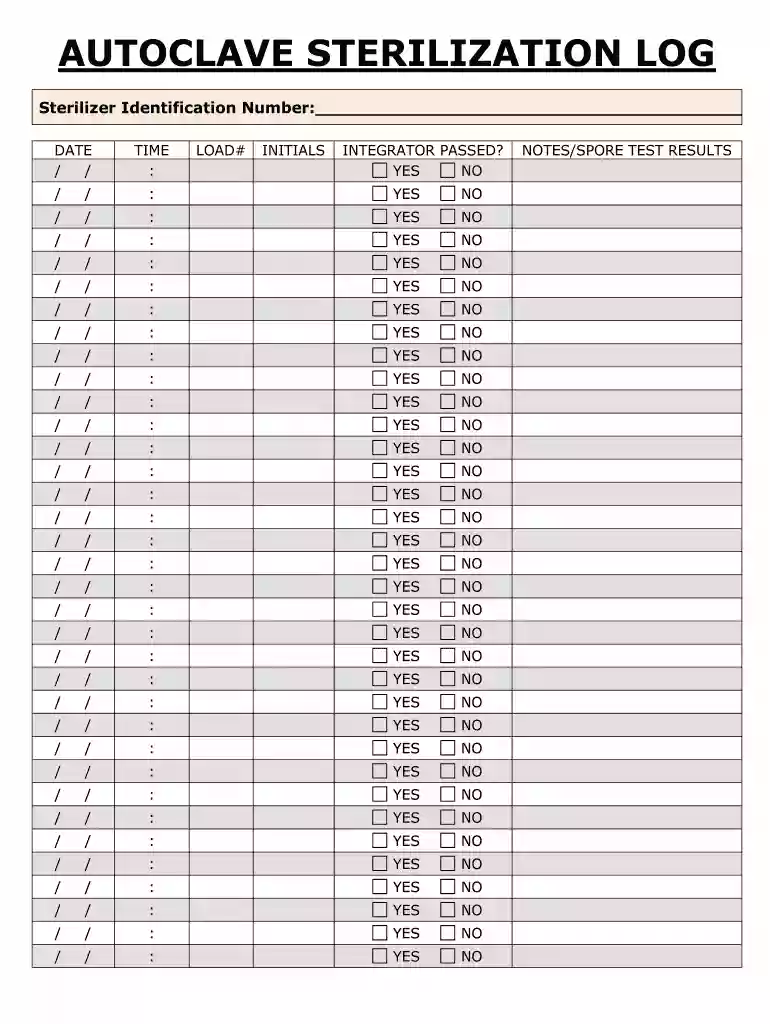
Type text, add images, blackout confidential details, add comments, highlights and more.

Draw your signature, type it, upload its image, or use your mobile device as a signature pad.

Send autoclave log sheet pdf via email, link, or fax. You can also download it, export it or print it out.
The EBAP Autoclave Sterilization Log is a critical tool used in healthcare and laboratory settings to document the sterilization process of equipment and instruments. This log is essential for ensuring compliance with safety standards, maintaining the quality of sterilization, and keeping a meticulous record of sterilization cycles. Key information documented typically includes:
The EBAP log not only serves as a compliance document but also as an audit tool that can help identify any issues with sterilization procedures and support quality control initiatives.
Utilizing the EBAP Autoclave Sterilization Log effectively involves following several important steps. These ensure that all necessary information is captured accurately, and the log fulfills its purpose as a verification document for sterilization processes.
Preparation: Before beginning sterilization, ensure the autoclave is in proper working condition. Gather all items that require sterilization and confirm they are compatible with the autoclave settings.
Filling Out the Log:
Post-Sterilization Review: After the log is filled out, review all entries for accuracy. This may include verifying that the integrator results match the expected outputs based on the sterilization conditions.
Storage and Accessibility: Store the completed log in a secure yet accessible location for future reference. This can be critical in case of audits or when assessing sterilization effectiveness over time.
Regular Audits: Conduct periodic audits to ensure that logs are filled correctly and consistently. This helps identify any areas for improvement in sterilization techniques and log usage.
Proper use of the EBAP Autoclave Sterilization Log can enhance operational efficiency and reinforce compliance with safety regulations.
When dealing with the EBAP Autoclave Sterilization Log, several key elements must be accurately represented to ensure comprehensive tracking and accountability. Essential components include:
These elements contribute not only to operational transparency but also to the legal compliance required in many healthcare and research environments.
Understanding specific terminology related to the EBAP Autoclave Sterilization Log is essential for effective use and compliance. Familiarity with these terms can assist operators in better managing sterilization protocols:
Clearly defining and understanding these terms ensures proper communication and enhances the effectiveness of sterilization programs within various healthcare settings.
The EBAP Autoclave Sterilization Log serves multiple critical purposes that justify its use in any facility relying on sterilization processes. Key reasons include:
Using the log effectively is integral for maintaining operational standards and ensuring patient safety.
Completing the EBAP Autoclave Sterilization Log properly involves a series of well-defined steps. These ensure clarity and accuracy in tracking sterilization processes:
Enter the Date and Time:
Document the Load Number:
Input Sterilizer Identification Number:
Operator Identification:
Record Integrator Results:
Additional Notes:
File for Future Reference:
Following these steps guarantees that the EBAP Autoclave Sterilization Log remains a reliable documentation tool in healthcare and laboratory settings.
You should use only trusted software solutions with strong data protection compliance to sign your documents electronically. DocHub is just the type of editor you need! It stores data on Amazon Web Servers and complies with all required security requirements and eSignature regulations, so it’s a trusted way to eSign your free printable autoclave sterilization log sheet or other documents using this tool.
When you edit your sterilization log sheet pdf with DocHub, you merely require a steady web connection and virtually any web browser installed on your device. No need to set up any third-party software or research tutorials. Simply open a tab with DocHub, drag and drop your file, and modify it immediately.
At DocHub, your data security is our priority. We follow HIPAA, SOC2, GDPR, and other standards, so you can work on your documents with confidence.
Feb 16, 2024 In many situations, a single autoclave, sterilizer, or glasswasher requires process steam. In those cases, we recommend that a localRead more
Sep 1, 2021 Steam sterilization integrators have been used and logged for each autoclaved load or cycle and each steam sterilization integrator indicatesRead more


