Form PC-220 - revenue wi 2026

Get Form
form pc 220 Preview on Page 1

Here's how it works

01. Edit your form pc 220 online
Type text, add images, blackout confidential details, add comments, highlights and more.

02. Sign it in a few clicks
Draw your signature, type it, upload its image, or use your mobile device as a signature pad.

03. Share your form with others
Send pc 220 wisconsin via email, link, or fax. You can also download it, export it or print it out.

How to use or fill out Form PC-220 - revenue wi with our platform

Form edit decoration
9.5
Ease of Setup
DocHub User Ratings on G2
9.0
Ease of Use
DocHub User Ratings on G2
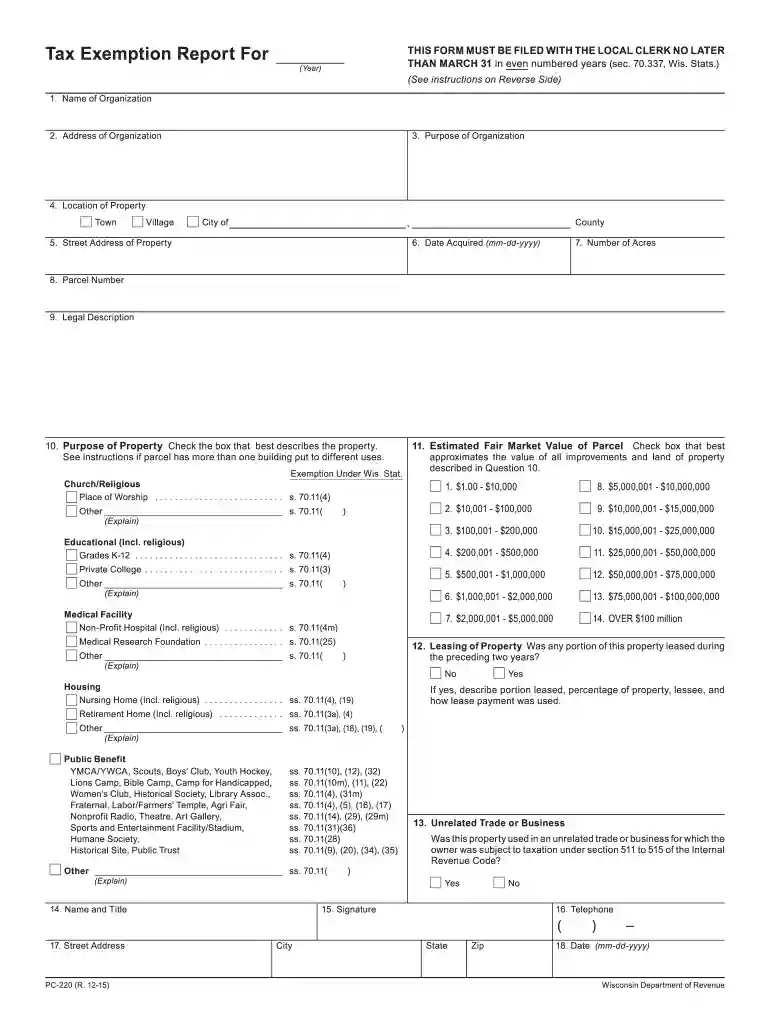
  1. Click ‘Get Form’ to open it in the editor.
  2. Begin by entering the 'Name of Organization' in the designated field. This should be the official name of the entity that owns the exempt property.
  3. Next, provide the 'Address of Organization'. Ensure this is the address of your administrative office or headquarters.
  4. In the 'Purpose of Organization' section, clearly state the primary mission or objective of your organization.
  5. For 'Location of Property', select the appropriate taxation district and county where your exempt property is situated.
  6. Fill in the 'Street Address of Property' with accurate details about where your property is located.
  7. Enter the 'Date Acquired' using the mm-dd-yyyy format to indicate when you obtained ownership of the property.
  8. Specify the 'Number of Acres' that your exempt property encompasses.
  9. Input the 'Parcel Number' as it appears on your assessment roll for identification purposes.
  10. Provide a detailed 'Legal Description' of your property as listed on your deed or assessment roll.

Start filling out Form PC-220 today for free and streamline your document management with our platform!

See more Form PC-220 - revenue wi versions

We've got more versions of the Form PC-220 - revenue wi form. Select the right Form PC-220 - revenue wi version from the list and start editing it straight away!
Versions Form popularity Fillable & printable
2016 4.8 Satisfied (60 Votes)
2015 4.4 Satisfied (165 Votes)
be ready to get more

Complete this form in 5 minutes or less

Get form

Got questions?

We have answers to the most popular questions from our customers. If you can't find an answer to your question, please contact us.
Contact us
To apply for an exemption, you must complete a Wisconsin Department of Revenue application form, which may be obtained from the local assessor. The form must be filed for any property that was taxed in the previous year but, because of a change in the use, occupancy, or ownership, may now qualify for exemption.
An applicant must be 65 years of age or older on the date of applica- tion, or a qualifying veteran of any age. Any co- owner must be at least 60 years of age on the date of application. If married, the applicants spouse must qualify as a co-owner.
If you are over 65 years of age, or permanent and totally disabled (regardless of age), or blind (regardless of age), you are exempt from the state portion of property tax. County taxes may still be due. Please contact your local taxing official to claim your homestead exemption.
E. Retirees age 62 or older or who are disabled and are full-year residents of Wisconsin may qualify for homestead credit if they meet certain conditions. Homestead credit provides direct relief to homeowners and renters.
Most states have a homestead property tax exemption that allows you to protect a certain amount of your primary propertys value from taxes. You can structure the exemption to either exclude a flat amount or a percentage of your taxable value. This limits the maximum amount you have to pay in real estate taxes.

Security and compliance

At DocHub, your data security is our priority. We follow HIPAA, SOC2, GDPR, and other standards, so you can work on your documents with confidence.

Learn more
ccpa2
pci-dss
gdpr-compliance
hipaa
soc-compliance

People also ask

Wisconsin eliminates personal property tax effective January 1, 2024.
Wisconsin is moderately tax-friendly toward retirees. Social Security income is not taxed. Withdrawals from retirement accounts are fully taxed. Wages are taxed at normal rates, and your marginal state tax rate is 4.40%.

Related links