
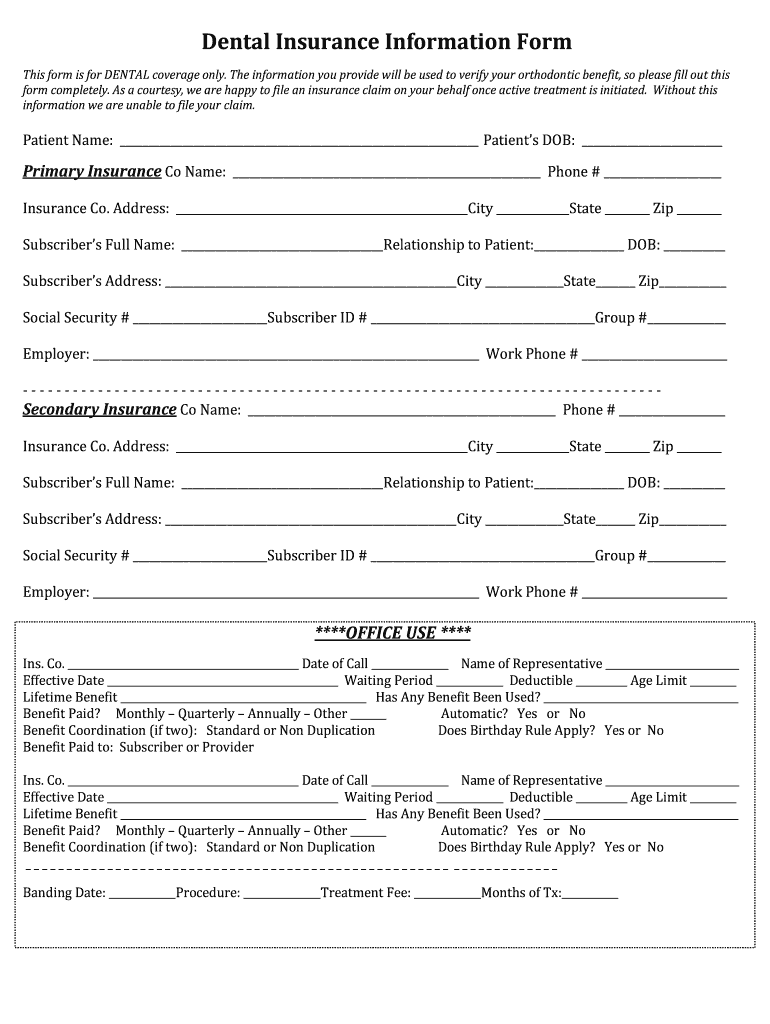







Definition and Purpose of the Dental Insurance Information Form
The dental insurance information form is a critical document utilized by dental practices to collect essential details necessary for verifying patients' orthodontic benefits. This form aims to ensure that dental providers have the accurate data needed to process insurance claims efficiently. Typically, it includes fields for patient information, along with data regarding primary and secondary insurance providers, and the subscriber's details.
Importance of Accurate Information
Providing complete and accurate information on the dental insurance information form is vital for several reasons:
- Facilitates appropriate billing by pre-verifying benefits.
- Reduces delays in processing claims, which can enhance the patient experience.
- Ensures compliance with insurance policies, promoting better communication between the practice and the insurance provider.
It is essential that patients check their entries carefully, as errors can lead to claim denials or delays in receiving coverage for services rendered.
Steps to Complete the Dental Insurance Information Form
Completing the dental insurance information form requires careful attention to detail. Here are the essential steps to follow:
-
Gather Required Information
- Obtain your personal information such as your name, address, and date of birth.
- Collect your insurance policy details, including the insurance company name and policy number.
-
Identify Insurance Providers
- If there is more than one insurance coverage, provide details for both the primary and secondary insurers.
- Include the subscriber’s name and the relationship to the patient if applicable.
-
Complete the Form Accurately
- Fill in each section of the form clearly and concisely.
- Use legible handwriting or type the information if the form is digital.
-
Review Before Submission
- Double-check all entries to ensure accuracy.
- Make sure all required fields are completed as indicated on the form.
-
Submit the Form
- Depending on your dental practice's protocol, submit the form either online or in person at the office.
Following these steps can significantly reduce the likelihood of errors and improve the processing efficiency of insurance claims.
Who Typically Uses the Dental Insurance Information Form
The dental insurance information form is predominantly used by:
-
Dental Practices: Dentists and orthodontic specialists use the form to facilitate insurance verification before starting treatments.
-
Patients: Individuals seeking dental care must fill out the form to provide necessary details to their dental provider.
-
Insurance Companies: Insurers may review the completed form to ensure that the claims submitted align with the patient’s coverage details.
For effective utilization, these users must understand the form's importance in the process of gaining access to covered dental services.


Key Elements of the Dental Insurance Information Form
The dental insurance information form comprises several key components that ensure all necessary information is captured for insurance verification:
-
Patient Information: This section includes personal details such as name, date of birth, and contact information.
-
Insurance Provider Details:
- Primary Insurance: This includes the name of the insurance company and policy number.
- Secondary Insurance: This captures similar information for any additional coverage.
-
Subscriber Information: If the subscriber is not the patient, their name and relationship to the patient must be included.
These elements are crucial, as they ensure that the information submitted for claims aligns accurately with insurer requirements.
Important Terms Related to the Dental Insurance Information Form
Understanding specific terminology associated with the dental insurance information form can enhance clarity for users. Some important terms include:
-
Subscriber: The individual who holds the insurance policy and may or may not be the patient receiving services.
-
Preauthorization: Approval from the insurance provider before specific treatments can be performed.
-
Deductible: The amount the insured must pay out-of-pocket before the insurance begins to cover eligible expenses.
Awareness of these terms is beneficial as it aids in understanding the broader context of dental insurance and its related processes.
Digital vs. Paper Version of the Dental Insurance Information Form
When considering the type of form to use, both digital and paper versions have their distinct advantages:
-
Digital Version:
- Enables easier editing and often features built-in validation checks.
- Allows for quicker submission times, especially if integrated with the dental practice's electronic health record systems.
-
Paper Version:
- Useful in environments where technology is limited or for patients who prefer a physical format.
- Provides a tangible record that some may find easier to handle or store.
Choosing the right version may depend on patient preferences and the capabilities of the dental practice.
Examples of Using the Dental Insurance Information Form
In real-world scenarios, a dental insurance information form can be applied in various contexts:
-
New Patient Registration: A new patient fills out the form as part of their initial visit to establish their insurance eligibility.
-
Updating Insurance Information: Returning patients may need to submit the form again if they have changed their insurance provider.
-
Claim Verification: After a procedure, the dental office uses the details on the form to confirm coverage before billing the insurer.
These examples illustrate the form's versatility and its significance in different phases of patient care in dental practices.




