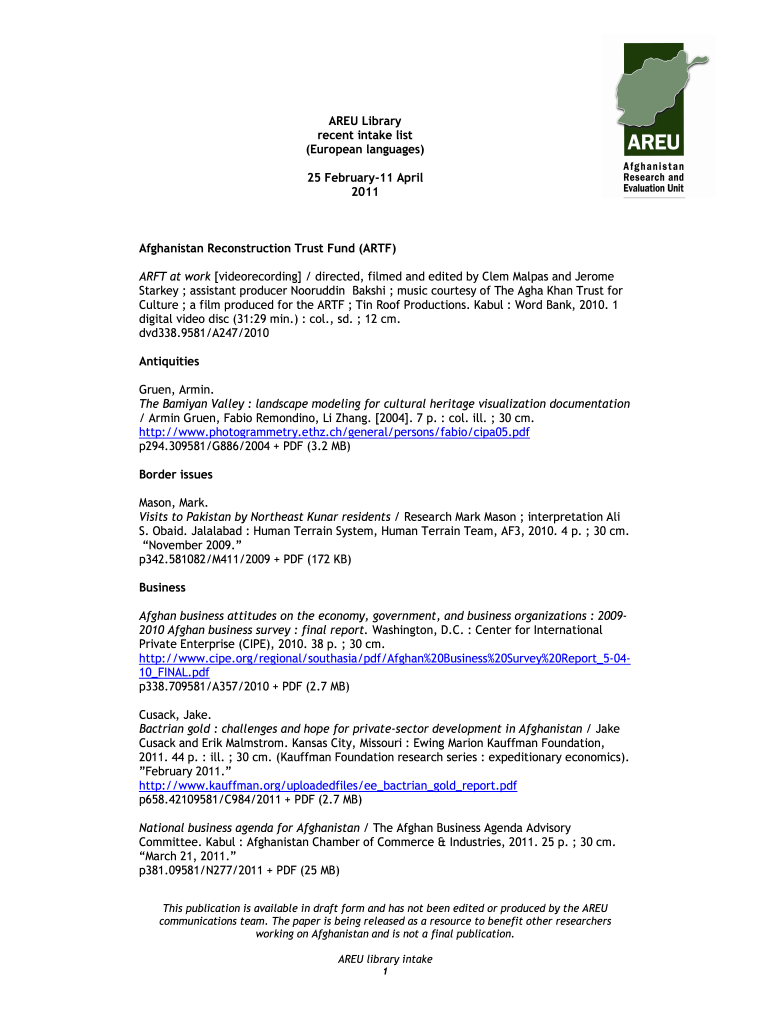

AREU Library recent intake list (European languages) 25 February ... 2026

Get Form
AREU Library recent intake list (European languages) 25 February ... Preview on Page 1

Here's how it works

01. Edit your form online
Type text, add images, blackout confidential details, add comments, highlights and more.
02. Sign it in a few clicks
Draw your signature, type it, upload its image, or use your mobile device as a signature pad.
03. Share your form with others
Send it via email, link, or fax. You can also download it, export it or print it out.

How to use or fill out AREU Library recent intake list (European languages) 25 February ... with our platform

Form edit decoration
9.5
Ease of Setup
DocHub User Ratings on G2
9.0
Ease of Use
DocHub User Ratings on G2
  1. Click ‘Get Form’ to open the AREU Library recent intake list in the editor.
  2. Begin by reviewing the title and date at the top of the document. This ensures you are working with the correct version of the intake list.
  3. Proceed to fill in your details in any designated fields, such as your name or contact information, if required.
  4. Navigate through each section of the form, which includes various categories like 'Business', 'Development', and 'Security'. Ensure you read each entry carefully for accurate data input.
  5. For any entries that require additional comments or notes, utilize the text boxes provided within our platform to add your insights or observations.
  6. Once all necessary fields are completed, review your inputs for accuracy before saving or submitting the form.

Start using our platform today to streamline your document editing and form completion process for free!

be ready to get more

Complete this form in 5 minutes or less

Get form

Got questions?

We have answers to the most popular questions from our customers. If you can't find an answer to your question, please contact us.
Contact us

Of course, you’ll find many different applications for this on the web. However, if you need to eSign your AREU Library recent intake list (European languages) 25 February ... without installing additional software, DocHub is the optimum choice you can make. This robust editor works on mobile devices just like on desktops. Open our editor in your preferred internet browser, register or log in to your account, and start processing your forms.

If your go-to electronic mail service is Gmail, it is simple to incorporate your DocHub editor into your work. Edit your AREU Library recent intake list (European languages) 25 February ... with DocHub tools and attach it to your drafts in Gmail. See how effortless it is to exchange papers and work together having a swift PDF editing solution at hand.

While the CEFR is a European scale and specifically designed to apply to any European language, it is now becoming a worldwide standard framework for language abilities, especially European languages, including English.
The first European Day of Languages took place on 26 September 2001 and was a flagship event of the European Year of Languages 2001 campaign organised jointly with the European Union.
Many European languages have a strong Latin base simply because the Romans ruled Europe for hundreds of years - languages such as French, and Spanish are called Romance languages for this reason. Most European languages are related, having originally derived from ancient Indian languages.

Security and compliance

At DocHub, your data security is our priority. We follow HIPAA, SOC2, GDPR, and other standards, so you can work on your documents with confidence.

Learn more
ccpa2
pci-dss
gdpr-compliance
hipaa
soc-compliance

People also ask

Previously, English, French and German were considered procedural languages, but this notion was abandoned by the European Commission, whereas the European Parliament accepts all official languages as working languages. Today, English and French are used in the day-to-day workings of the institutions of the EU.
European Day of Languages is jointly organised by the Council of Europe and the European Commission and celebrated each year on 26 September. There are 24 official languages in Europe but adding in regional and minority languages, the total number spoken across the continent is over 200.
On the occasion of the day, a range of events are organised across Europe, including those for children, television and radio programmes, language classes and conferences.
English remains, by far, the most widely studied language among both compulsory (96%) and vocational studies (80%).
Every 26 September, the EU celebrates the richness of its languages and cultures through the European Day of Languages. This day is an opportunity for people, schools and organisations across Europe to recognise the importance of multilingualism and to discover the fun of learning new languages.

Related links