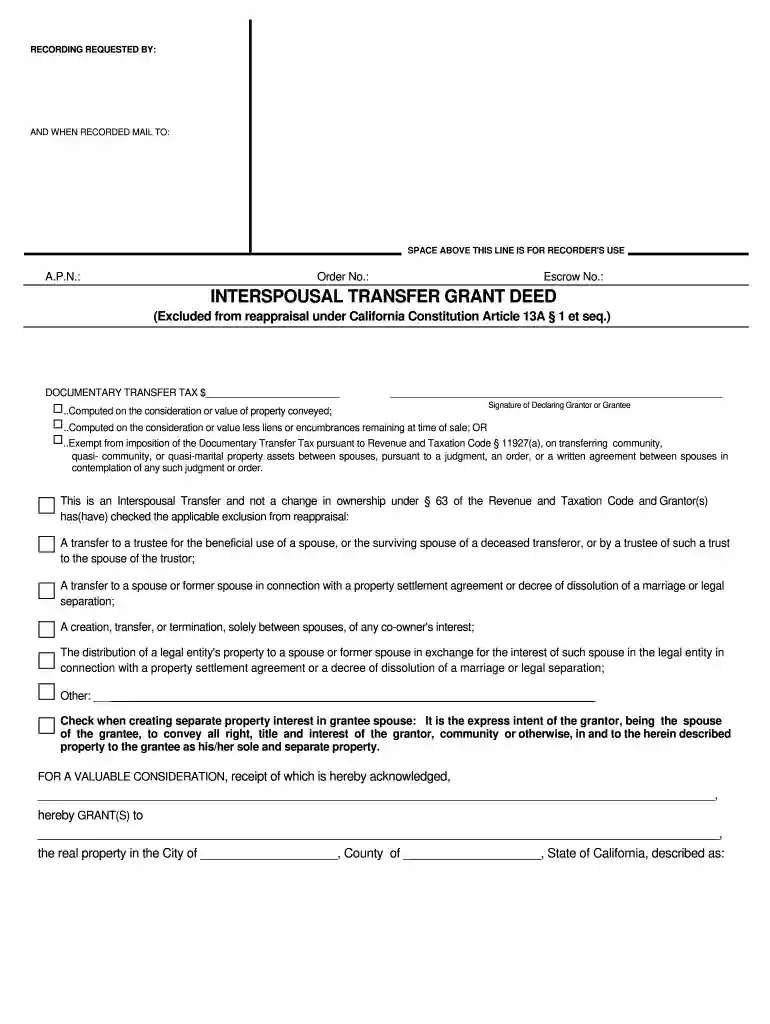
Interspousal transfer deed california 2026

Get Form
interspousal grant deed california Preview on Page 1

Here's how it works

01. Edit your interspousal grant deed california online
Type text, add images, blackout confidential details, add comments, highlights and more.

02. Sign it in a few clicks
Draw your signature, type it, upload its image, or use your mobile device as a signature pad.

03. Share your form with others
Send interspousal transfer deed california via email, link, or fax. You can also download it, export it or print it out.

Definition and Purpose of the Interspousal Transfer Deed in California

The Interspousal Transfer Deed is a legal instrument used in California to transfer property ownership between married partners. The primary purpose of this deed is to facilitate such transfers without triggering property tax reassessments under Proposition 13. The deed allows one spouse to relinquish their claim or interest in a property, effectively transferring it to the other spouse as their sole and separate property. This process can be beneficial during marital agreements, divorce settlements, or estate planning. An essential consideration in using this deed is its tax implications, which offer a distinct advantage by not altering the property’s assessed value for tax purposes.

Utilization of the Interspousal Transfer Deed

To utilize this deed effectively, you must ensure that the transfer meets specific criteria, keeping in mind its intended use for legitimate marital property redistribution. Common scenarios include gifting property interest to a spouse, aligning property ownership consistent with prenuptial agreements, or managing assets during reconciliation or separation. The deed is known for providing a streamlined and tax-efficient way to adjust property ownership while maintaining favorable tax conditions.

  • Property settlements in divorce cases
  • Estate planning to designate property inheritance

Process of Acquiring the Interspousal Transfer Deed

Acquiring an Interspousal Transfer Deed typically involves the preparation and notarization of the deed document. To obtain it, contact your county's recorders office in California or consult with a real estate attorney for personalized guidance. Many choose to work through experienced professionals to ensure compliance with specific local regulations and requirements. If you prefer a more straightforward approach, explore online legal document platforms offering customizable templates.

  1. Contact the county recorder: Verify form-specific requirements.
  2. Consult a real estate attorney: Receive personalized legal advice.
  3. Explore online templates: Use legal document services for customization.

Steps to Complete the Interspousal Transfer Deed

Completing an Interspousal Transfer Deed involves several careful steps to ensure its legality and effectiveness. Follow these general steps to complete the process accurately:

  1. Obtain the correct form: Ensure you have the accurate and updated version from your county recorder or a legal service provider.
  2. Fill out the deed: Include all necessary information such as the property description, grantor, and grantee details.
  3. Notarization: Have the deed notarized to validate the authenticity of the document.
  4. Submit for recording: File the completed and notarized deed with the local county recorder's office.
  5. Retain copies: Keep notarized copies for personal records and legal verification if necessary.

Why Use an Interspousal Transfer Deed

The primary motivation for using this deed includes avoiding property tax reassessment during property transfers between spouses. It is an efficient tool for managing property rights during marital transitions, facilitating division of assets or adjustments aligned with marital contracts. Additionally, it plays a crucial role in estate planning by ensuring clear and tax-efficient property inheritance.

  • Avoid property tax reassessment
  • Facilitate equitable marital property adjustments

Key Elements of the Interspousal Transfer Deed

Several essential components must be accurately represented in the deed to ensure its validity and enforceability:

  • Property Description: A complete legal description of the property being transferred.
  • Names of Grantors and Grantees: The transferring and receiving spouse’s full legal names.
  • Consideration Statement: Confirmation of the transfer without monetary exchange if applicable.
  • Signatures and Notarization: Both parties’ signatures and the notary public’s certification.

Legal Implications and Use Cases

The legal framework surrounding this deed is designed to protect marital property rights while supporting tax-efficiency. Given its significant benefits in property and estate management, its use is highly prevalent in:

  • Divorce proceedings: Simplifying property settlements without additional tax burdens.
  • Prudent estate planning: Establishing clear inheritance paths for marital assets.
  • Marital reconciliations: Restoring equal property ownership after reconciliation.

State-Specific Rules and Exemptions

California's legal provisions under Proposition 13 allow the interspousal transfer to occur without a change in property tax assessments. Understanding state-specific rules, such as local recording and filing requirements, is essential. Each county may have particular stipulations governing the transaction. Professional legal consultations ensure compliance with these location-based rules and help validate the deed’s use for various marital situations.

  • Proposition 13: Prevents property tax reassessment
  • Local county regulations: Dictate precise filing processes and necessary documentation
be ready to get more

Complete this form in 5 minutes or less

Get form

Got questions?

We have answers to the most popular questions from our customers. If you can't find an answer to your question, please contact us.
Contact us
Prop 19 loopholes in California refer to legal strategies designed to work around the laws stricter rules on transferring low property tax assessments (Prop 13 base values) to heirs or new properties, primarily through using LLCs (Limited Liability Companies), strategically managing the Family Farm Exclusion, utilizing co-tenancy arrangements, and leveraging the principal residence transfer benefits for seniors/disabled individuals, which aim to preserve tax benefits despite the laws intent to curb tax avoidance. Key Loopholes Strategies LLC Workaround: Real estate held in an LLC might fall under different tax rules (Change in Control vs. Change in Ownership), potentially allowing for tax base transfers in ways Prop 19 intended to prevent for other property types. Family Farm Exclusion: Specific rules allow certain parcels of a family farm, excluding the parcel with the family home, to retain their Prop 13 base value when transferred, requiring careful structuring. Co-Tenancy: Structuring ownership with others (like children) in a way that avoids triggering a change in ownership or change in control for tax purposes on the entire property. Principal Residence Transfer (Over 55/Disabled/Disaster): While not a loophole, effectively using the three-time transfer of a Prop 13 base to a replacement home (even a more expensive one) requires planning, as the original propertys value is reassessed and the new property must meet strict occupancy rules. This video explains the core aspects of Prop 19 and how it changed property taxes: 1mCunninghamLegalYouTube May 1, 2025 What Prop 19 Changed (Context for Loopholes) Eliminated Rental/Investment Property Transfers: Parents generally cant pass low tax bases on rental homes to kids anymore. Limited Family Home Exclusion: For inherited family homes, the exclusion is limited to $1 million over the assessed value, meaning a partial reassessment often occurs. Strict Occupancy Rules: Heirs must move into the inherited home and claim it as their primary residence within a year to get any benefit, notes a YouTube video. Watch this video for real-world examples of Prop 19s impact on property taxes: 59sCunninghamLegalYouTube Nov 6, 2025 Key Takeaway: These strategies are complex and involve DocHub legal and tax planning to navigate Prop 19s intricate rules, often requiring professional advice to implement successfully, according to legal experts from Cunningham Legal and Hollister Law Office. AI can make mistakes, so double-check responsesProp 19 Loopholes! How to Keep Low Prop 13 Taxes - YouTubeMay 1, 2025 each legal parcel that makes up the family farm is deemed to be itself a family farm except for a legal parcel containiYouTube CunninghamLegalCalifornia Prop 19 - Property Tax Transfers | SPURSPUR
Q: What Money Cant Be Touched in a Divorce? A: Money that was inherited, monetary gifts, or anything earned before marriage is considered separate property, and generally cant be touched in a divorce.
The interspousal exclusion protects the surviving spouse from property tax reassessment when property is transferred due to death or retained in a divorce settlement. This exclusion applies to both same-sex and opposite-sex married couples.
An interspousal transfer deed is a legal instrument used to provide sole ownership to a property that is jointly owned. For instance, the deed can be used to provide the title to a house to one person in a marriage. Note that the technical term for interspousal transfer deed is interspousal transfer grant deed.
An interspousal deed is used between spouses or registered domestic partners (DP) to change real estate to or from community property. Spouses/DPs can use grant or quitclaim deeds to do the same things, but the interspousal deed makes it clear that the transaction is intended to affect community property rights.

Security and compliance

At DocHub, your data security is our priority. We follow HIPAA, SOC2, GDPR, and other standards, so you can work on your documents with confidence.

Learn more
ccpa2
pci-dss
gdpr-compliance
hipaa
soc-compliance
be ready to get more

Complete this form in 5 minutes or less

Get form

People also ask

In California, seniors dont automatically stop paying property taxes at a certain age; instead, they can qualify for specific relief programs, like the Senior Citizen Homeowners Exemption (age 65+, income-based) or the ability to transfer their low property tax base (Proposition 19) to a new home (age 55+, subject to conditions), allowing them to reduce or defer taxes, not eliminate them entirely, though a proposed ballot initiative in 2026 aims to exempt seniors 60+ from property taxes entirely if passed. Current California Property Tax Relief Options for Seniors: Senior Citizen Homeowners Exemption: For homeowners 65 and older, this reduces the taxable value of their home, but requires meeting income criteria and applying with the county assessor. Property Tax Postponement Program: For seniors (62+), disabled, or blind individuals with low income, this allows you to delay paying property taxes, which are paid when you sell the home or move out. Proposition 19 (Base Year Value Transfer): Homeowners 55+ (or severely disabled/transferee victims) can transfer their original low property tax base to a new home, reducing taxes on the new property, but it has specific rules on value and location. Parcel Tax Exemptions: Some local parcel taxes (special assessments for schools, parks) offer exemptions for seniors 65+, but only if included in the original voter-approved measure. Proposed Ballot Measure (2026): A new initiative aims to let homeowners 60+ who have lived in California for 10 years (or 5 in the home) be exempt from property taxes on their primary residence if it passes. This is currently a proposal and not law. Key Takeaway: Theres no single age to stop paying; its about qualifying for state and local programs that provide DocHub relief or postponement, with a potential future initiative to eliminate them for older seniors if voters approve it. AI can make mistakes, so double-check responsesCalifornia ballot proposal would exempt seniors from - ABC10Feb 6, 2026 SACRAMENTO, Calif. California voters could be asked during the November election whether homeowners age 60 and older ABC10Property Tax Relief for Seniors - SDARCC.govWatch more on Property Tax Savings Programs. Proposition 19 allows homeowners who are 55 years of age or older the ability to tranSDARCC.gov
How to fill out the Sample Interspousal Transfer Deed Instructions? Gather required information such as names, addresses, and property details. Complete the Documentary Transfer Tax sections as per instructions. Sign the deed in front of a notary public. Fill out the Preliminary Change of Ownership Report.
An Interspousal Transfer Deed is used when one or both spouses (including registered domestic partners) want to change the way they own real estate from separate property to community property or from community property to separate property.

interspousal transfer deed sample