



Document generation and approval are main aspects of your daily workflows. These procedures are usually repetitive and time-consuming, which affects your teams and departments. Specifically, Restructuring Agreement creation, storage, and location are important to ensure your company’s efficiency. An extensive online solution can resolve numerous vital issues related to your teams' effectiveness and document management: it gets rid of tiresome tasks, eases the task of locating documents and collecting signatures, and leads to much more accurate reporting and statistics. That’s when you may need a robust and multi-functional platform like DocHub to take care of these tasks swiftly and foolproof.
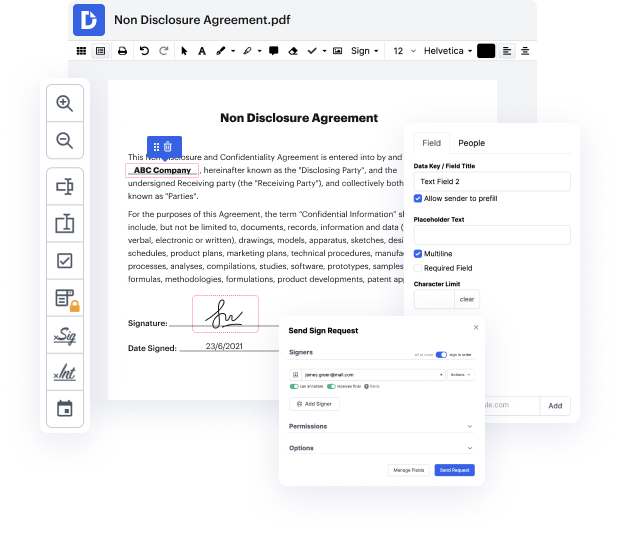
DocHub allows you to simplify even your most intricate task using its robust features and functionalities. A powerful PDF editor and eSignature enhance your day-to-day file administration and turn it into a matter of several clicks. With DocHub, you won’t need to look for additional third-party platforms to finish your document generation and approval cycle. A user-friendly interface lets you start working with Restructuring Agreement immediately.
DocHub is more than just an online PDF editor and eSignature software. It is a platform that helps you easily simplify your document workflows and integrate them with well-known cloud storage platforms like Google Drive or Dropbox. Try editing and enhancing Restructuring Agreement immediately and discover DocHub's considerable list of features and functionalities.
Start off your free DocHub trial right now, with no invisible fees and zero commitment. Unlock all features and opportunities of easy document administration done properly. Complete Restructuring Agreement, gather signatures, and boost your workflows in your smartphone application or desktop version without breaking a sweat. Enhance all your daily tasks with the best solution available out there.


In the last video we talked about the scenario where a company, for whatever reason, it just couldnt pay its debt holders. So lets say these are debt holders right here. This is the debt, or the liabilities. It couldnt pay its debt holders. It went into bankruptcy, and it was determined that these assets that it had right here, that it made no sense operating them as a company. And then the bankruptcy court essentially just decided to liquidate it. And we learned that the debt holders were actually more senior to the equity holders. And they get paid first. And if there wasnt enough money to pay all of the debt holders, then the equity holders got nothing. And that was called a Chapter 7. Were just focusing on the corporate world right now. Maybe well do personal soon. So thats Chapter 7 liquidation. That was the last video. And in that case, and I think thats what most people associate when you say that a company has gone bankrupt. That itll just disappear. That people jus


At DocHub, your data security is our priority. We follow HIPAA, SOC2, GDPR, and other standards, so you can work on your documents with confidence.
Learn more