
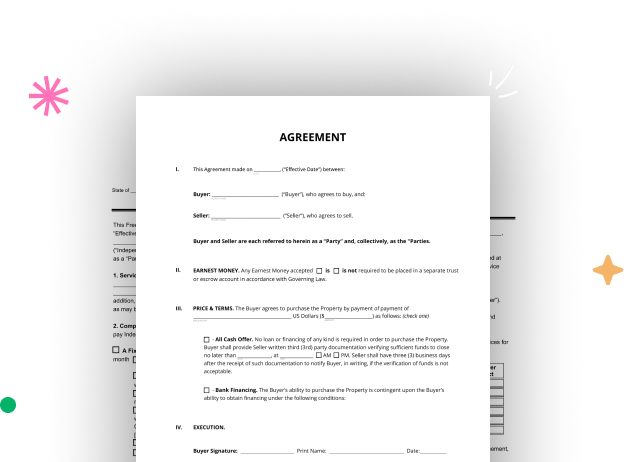
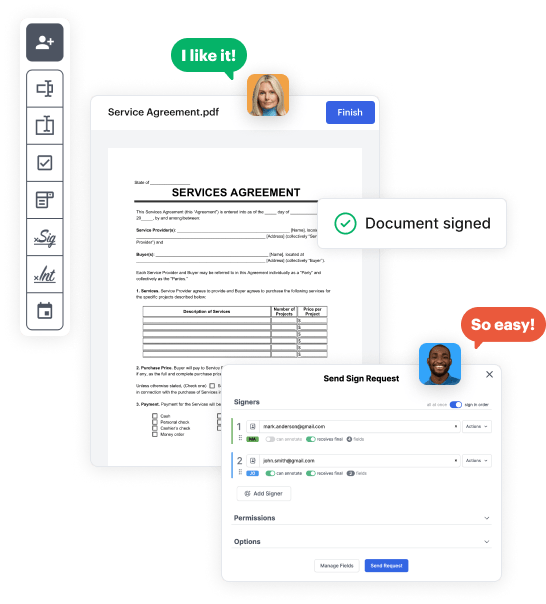
Create your Wisconsin Specific Legal Document from scratch

Start Building Now
Title decoration

Here's how it works

01. Start with a blank Wisconsin Specific Legal Document
Open the blank document in the editor, set the document view, and add extra pages if applicable.
02. Add and configure fillable fields
Use the top toolbar to insert fields like text and signature boxes, radio buttons, checkboxes, and more. Assign users to fields.
03. Distribute your form
Share your Wisconsin Specific Legal Document in seconds via email or a link. You can also download it, export it, or print it out.

Create Wisconsin Specific Legal Document from the ground up by following these step-by-step instructions

Form edit decoration

Step 1: Get started with DocHub.

Begin by signing up for a free DocHub account using any offered sign-up method. If you already have one, simply log in.

Step 2: Sign up for a free 30-day trial.

Try out the whole suite of DocHub's advanced features by registering for a free 30-day trial of the Pro plan and proceed to build your Wisconsin Specific Legal Document.

Step 3: Add a new blank doc.

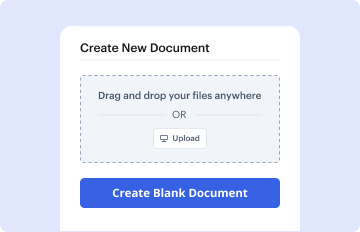
In your dashboard, hit the New Document button > scroll down and hit Create Blank Document. You’ll be taken to the editor.

Step 4: Organize the document’s layout.

Use the Page Controls icon indicated by the arrow to toggle between two page views and layouts for more flexibility.

Step 5: Start adding fields to create the dynamic Wisconsin Specific Legal Document.

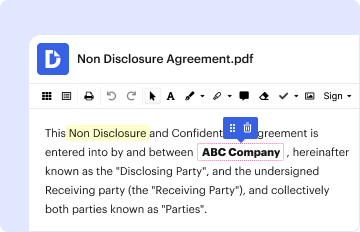
Explore the top toolbar to place document fields. Add and arrange text boxes, the signature block (if applicable), embed images, etc.

Step 6: Prepare and customize the added fields.

Arrange the fields you added per your desired layout. Modify each field's size, font, and alignment to make sure the form is user-friendly and neat-looking.

Step 7: Finalize and share your document.

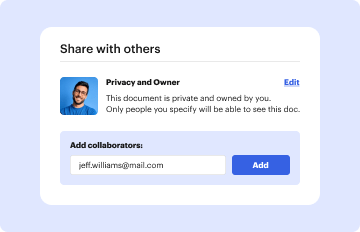
Save the ready-to-go copy in DocHub or in platforms like Google Drive or Dropbox, or create a new Wisconsin Specific Legal Document. Share your form via email or get a public link to reach more people.


be ready to get more

Build your Wisconsin Specific Legal Document in minutes

Start creating now

Got questions?

We have answers to the most popular questions from our customers. If you can't find an answer to your question, please contact us.
Contact us
By phone: Call the Records Department at (920) 448-4521. You will need the case number or name of the parties and specific document or information that you need. The clerk will make arrangements with you for payment and delivery by mail, in person, fax or email.
The public may view all nonconfidential portions of a circuit court record in person, at the office of the clerk of court for the county where the case was filed, or may view certain portions of the circuit court record online via the Director of State Courts public internet website.
In some situations, you might also make a motion by writing a letter to the judge that explains what you are asking for, and why. Any time you send anything in writing to the judge you must also send a copy to the other party or his/her attorney. The other party would then have a chance to respond.
Transcripts and recordings can be ordered through the Online Registry Website launch, provided users have an account. Anyone who is a party to a case can order a transcript or recording online. You will be able to order, track, process, pay and receive transcripts in one location.
Public records requests can be submitted directly into the public records request portal​ or sent to DOCmedia@wisconsin.gov.
be ready to get more

Build your Wisconsin Specific Legal Document in minutes

Start creating now

Related Q&A to Wisconsin Specific Legal Document

Preparing Wisconsins Divorce Forms You can find and download the forms for starting a divorce on the Wisconsin court systems website. Or you can use the courts Family Law Forms Assistant, which will take you through a series of questions to help you determine which forms you need and complete those forms.
Confidential Petition Addendumrequired form where sensitive information such as the parties and/or childrens social security numbers and dates of birth are listed so that the information is available to the court but is not accessible to the public.

Additional resources on building your forms


