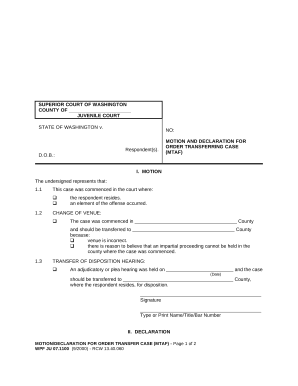
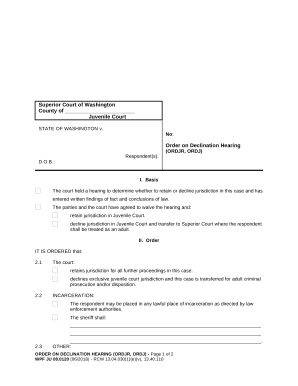
Raise your productiveness with Washington Juvenile Court Forms

Papers management consumes to half of your business hours. With DocHub, it is possible to reclaim your office time and enhance your team's productivity. Get Washington Juvenile Court Forms category and investigate all templates relevant to your daily workflows.

Easily use Washington Juvenile Court Forms:

  1. Open Washington Juvenile Court Forms and employ Preview to find the appropriate form.
  2. Click Get Form to begin working on it.
  3. Wait for your form to open in our online editor and begin modifying it.
  4. Add new fillable fields, symbols, and pictures, modify pages order, and many more.
  5. Fill your form or prepare it for other contributors.
  6. Download or deliver the form by link, email attachment, or invite.

Boost your daily document management with our Washington Juvenile Court Forms. Get your free DocHub profile right now to discover all forms.


Video Guide on Washington Juvenile Court Forms management

video background

Commonly Asked Questions about Washington Juvenile Court Forms

In Washington, juvenile court records dont automatically disappear when you turn 18. In fact, almost all your juvenile records remain open for the public to view, unless you ask a court to seal them. You must meet certain requirements to be eligible to have your record sealed.
The beyond a reasonable doubt standard is the highest standard of proof that may be imposed upon a party at trial, and it is the main standard used in criminal cases.
The arraignment will be your childs first hearing, unless they were jailed after the arrest. A plea of guilty or not guilty is entered at arraignment. A juvenile attorney will normally advise your child to enter a plea of not guilty. A trial date will then be set.
How to petition Get a Family Assessment. Contact your local Family Reconciliation Services (FRS) office at DSHS and request an appointment for intake and a Family Assessment. Fill Out an ARY Petition. File your petition. Serving the petition. Preparing for court. After hearing.
When a juvenile is charged with an act which would constitute a crime if committed by an adult, the due process clause also requires proof beyond a reasonable doubt. In re Winship, 397 U.S. 358 (1970). The Federal Rules of Evidence appear to apply to juvenile proceedings.
If the juvenile may be adjudicated delinquent or sentenced to incarceration, the prosecution has the burden of proving the charges beyond a reasonable doubt. In other situations, the prosecution has the burden of proving the charges by the preponderance of the evidence.
In in re Winship (397 U.S. 358), the Court required that juveniles charged with criminal acts be proved beyond a reasonable doubt to have committed them. Prior to this ruling, there was no constitutional decision that required more than the less stringent civil court standard of a preponderance of the evidence.
In the case In re Winship , the U.S. Supreme Court concludes that the standard of proof to find guilt in adult criminal proceedings, beyond a reasonable doubt, also applies in juvenile delinquency proceedings.