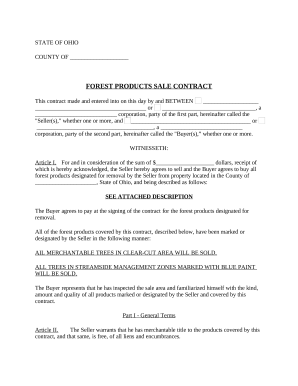
Boost your productivity with US Timber Sale Legal Forms

Document administration occupies to half of your office hours. With DocHub, it is easy to reclaim your time and enhance your team's efficiency. Access US Timber Sale Legal Forms collection and explore all document templates relevant to your daily workflows.

The best way to use US Timber Sale Legal Forms:

  1. Open US Timber Sale Legal Forms and apply Preview to get the relevant form.
  2. Click on Get Form to start working on it.
  3. Wait for your form to upload in the online editor and begin editing it.
  4. Add new fillable fields, icons, and pictures, adjust pages, etc.
  5. Fill your document or set it for other contributors.
  6. Download or deliver the form by link, email attachment, or invite.

Speed up your daily file administration with the US Timber Sale Legal Forms. Get your free DocHub profile right now to discover all forms.


Video Guide on US Timber Sale Legal Forms management

video background

Commonly Asked Questions about US Timber Sale Legal Forms

In this case, the sale of the timber may be subject to long-term capital gains tax rates, which are typically lower than short-term capital gains tax rates. To report the sale of timber on your tax return, you may need to file Form 4797 or use Schedule C and/or Schedule F. How to Report Sale of Timber on Tax Return - Corvee corvee.com blog how-to-report-sale-of-timber corvee.com blog how-to-report-sale-of-timber
Usually, income from the sale of standing timber that has been owned for more than 1 year qualifies for the favorable long-term capital gains tax rate (0, 15, or 20 percentdepending on your taxable income). Inherited timber automatically meets the long- term holding period requirement.
The part that may be considered a capital gain is the difference between the timbers adjusted basis (see p. 12 through 15) and its fair market value as stumpage on the first day of the tax year when cut, less expenses directly associated with the cutting.
How to enter Timber Sale Income For What type of investment did you sell? For Description enter Timber, For When did you receive this investment?, use the date you acquired the timber property. For cost basis, see Determining Timber Cost Basis | MU Extension or use another method that you can justify.
How to report sale of lumber using Capital Gains- Schedule D: You may receive income by cutting timber and opting to treat that cutting as a sale, or by disposing of standing timber, which is known as stumpage. In this case the income is treated as a Capital Gain and is reported by the taxpayer on their Schedule D.