
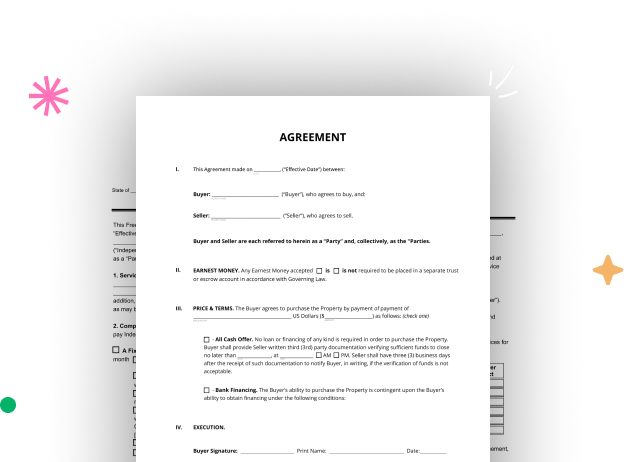


Create your US Legal Injunction Form from scratch

Start Building Now
Title decoration

Here's how it works

01. Start with a blank US Legal Injunction Form
Open the blank document in the editor, set the document view, and add extra pages if applicable.
02. Add and configure fillable fields
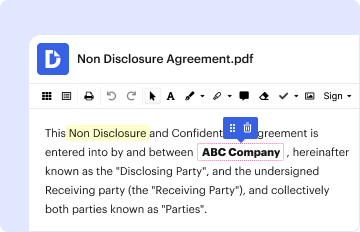
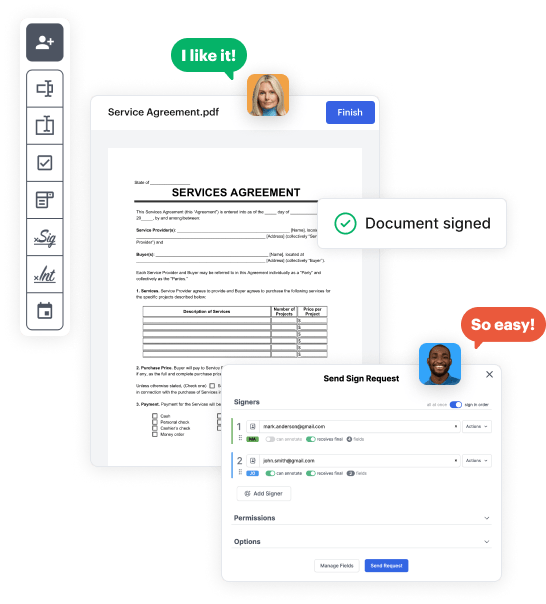
Use the top toolbar to insert fields like text and signature boxes, radio buttons, checkboxes, and more. Assign users to fields.
03. Distribute your form
Share your US Legal Injunction Form in seconds via email or a link. You can also download it, export it, or print it out.

A detailed walkthrough of how to craft your US Legal Injunction Form online

Form edit decoration

Step 1: Start with DocHub's free trial.

Navigate to the DocHub website and sign up for the free trial. This provides access to every feature you’ll require to create your US Legal Injunction Form with no upfront cost.

Step 2: Access your dashboard.

Sign in to your DocHub account and proceed to the dashboard.

Step 3: Initiate a new document.

Click New Document in your dashboard, and choose Create Blank Document to create your US Legal Injunction Form from the ground up.

Step 4: Use editing tools.

Insert various elements such as text boxes, radio buttons, icons, signatures, etc. Arrange these fields to match the layout of your document and designate them to recipients if needed.

Step 5: Organize the form layout.

Organize your document in seconds by adding, repositioning, deleting, or merging pages with just a few clicks.

Step 6: Craft the US Legal Injunction Form template.

Turn your freshly designed form into a template if you need to send many copies of the same document repeatedly.

Step 7: Save, export, or distribute the form.

Send the form via email, distribute a public link, or even post it online if you wish to collect responses from more recipients.


be ready to get more

Build your US Legal Injunction Form in minutes

Start creating now

Got questions?

We have answers to the most popular questions from our customers. If you can't find an answer to your question, please contact us.
Contact us
To seek a permanent injunction, the plaintiff must pass the four-step test: (1) that the plaintiff has suffered an irreparable injury; (2) that remedies available at law, such as monetary damages, are inadequate to compensate for the injury; (3) that the remedy in equity is warranted upon consideration of the balance
An application for an interim injunction must usually be supported by evidence. This will usually be in the form of a witness statement or affidavit including all material facts of which the Court should be made aware, and attaching relevant documents.
State as briefly as possible the facts showing that each plaintiff is entitled to the injunction or other relief sought. State how each defendant was involved and what each defendant did that caused the plaintiff harm or violated the plaintiffs rights, including the dates and places of that involvement or conduct.
To warrant preliminary injunctive relief, the moving party must show (1) a substantial likelihood of success on the merits, (2) that it would suffer irrepa- rable injury if the injunction were not granted, (3) that an injunction would not substantially injure other interested parties, and (4) that the public interest
It is well established that, to determine whether an injunction is just and proper, courts apply the familiar set of four equitable factors: the movants likelihood of success on the merits; the possibility of irreparable injury to the moving party; the extent to which the balance of hardships favors each party; and
be ready to get more

Build your US Legal Injunction Form in minutes

Start creating now

Related Q&A to US Legal Injunction Form

Although the test for obtaining a TRO or PI may vary slightly across jurisdictions, generally a plaintiff seeking preliminary injunctive relief must satisfy a four-factor test: (1) that he or she is likely to succeed on the merits of his claims; (2) that he or she is likely to suffer irreparable harm without
A district court may grant injunctive relief only if the movant establishes the following: (1) it has a substantial likelihood of success on the merits of the underlying case; (2) the movant will suffer irreparable harm in the absence of an injunction, (3) the harm suffered by the movant in the absence of an injunction

Additional resources on building your forms


