Get and manage US Legal Injunction Forms online

Speed up your document management using our US Legal Injunction Forms library with ready-made templates that meet your requirements. Get your document template, change it, complete it, and share it with your contributors without breaking a sweat. Start working more effectively together with your documents.

The best way to use our US Legal Injunction Forms:

  1. Open our US Legal Injunction Forms and search for the form you require.
  2. Preview your document to ensure it’s what you want, and click on Get Form to begin working on it.
  3. Edit, add new text, or point out important information with DocHub tools.
  4. Complete your form and preserve the changes.
  5. Download or share your form template with other people.

Discover all the opportunities for your online document management using our US Legal Injunction Forms. Get a free free DocHub account today!


Video Guide on US Legal Injunction Forms management

video background

Commonly Asked Questions about US Legal Injunction Forms

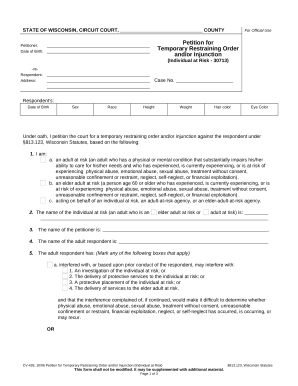
Description. An injunction or temporary restraining order is an order from the court prohibiting a party from performing or ordering a specified act, either temporarily or permanently.
One example of an injunction is when a court rules to forbid an employee from attending events of a competitor company. By doing so, the court aims to protect the interests of the employer and prevent potential conflicts of interest or disclosure of confidential information.
Injunctions are also used by a court when monetary restitution isnt sufficient to remedy the harm. For example, in addition to making a financial judgment against a defendant, a court might issue a permanent injunction ordering that the defendant does not participate in a certain activity or business.
In order to be granted an injunction, the plaintiff must demonstrate that he is likely to suffer irreparable harm without it, that the injunctions benefit to him outweighs its burden on the defendant, that the injunction is in the public interest, and (in the case of a preliminary injunction) that he is likely to
Preliminary and permanent injunctions may be sought to prevent the bulldozing of a historic building, the pollution of a public water supply, the infringement of a copyright, the manual recounting of ballots in a presidential election, or the enforcement of a constitutionally suspect law or executive order.
It is well established that, to determine whether an injunction is just and proper, courts apply the familiar set of four equitable factors: the movants likelihood of success on the merits; the possibility of irreparable injury to the moving party; the extent to which the balance of hardships favors each party; and
The three main instances of an injunction are restraining orders, preliminary (temporary) injunctions, and permanent injunctions. Cease and desist orders are a common type of injunction that demands an individual or entity to stop some activity.
Write a short and plain statement of the claim. Do not make legal arguments. State as briefly as possible the facts showing that each plaintiff is entitled to the injunction or other relief sought.