Create your US Garnishment Legal Form from scratch

Start Building Now
Title decoration

Here's how it works

01. Start with a blank US Garnishment Legal Form
Open the blank document in the editor, set the document view, and add extra pages if applicable.
02. Add and configure fillable fields
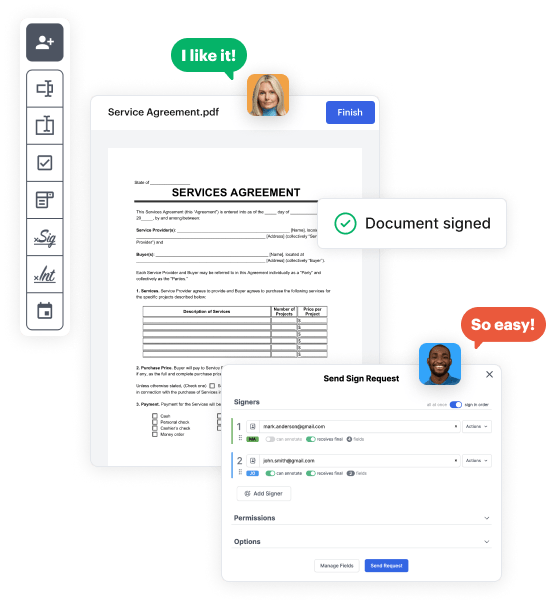
Use the top toolbar to insert fields like text and signature boxes, radio buttons, checkboxes, and more. Assign users to fields.
03. Distribute your form
Share your US Garnishment Legal Form in seconds via email or a link. You can also download it, export it, or print it out.

Create your US Garnishment Legal Form in a matter of minutes
Form edit decoration

Step 1: Access DocHub to set up your US Garnishment Legal Form.

Start by accessing your DocHub account. Explore the advanced DocHub functionality at no cost for 30 days.

Step 2: Navigate to the dashboard.

Once signed in, head to the DocHub dashboard. This is where you'll build your forms and handle your document workflow.

Step 3: Create the US Garnishment Legal Form.

Click on New Document and select Create Blank Document to be taken to the form builder.

Step 4: Set up the form layout.

Use the DocHub features to add and configure form fields like text areas, signature boxes, images, and others to your form.

Step 5: Insert text and titles.

Add needed text, such as questions or instructions, using the text field to lead the users in your form.

Step 6: Configure field properties.

Adjust the properties of each field, such as making them mandatory or arranging them according to the data you plan to collect. Assign recipients if applicable.

Step 7: Review and save.

After you’ve managed to design the US Garnishment Legal Form, make a final review of your form. Then, save the form within DocHub, export it to your selected location, or distribute it via a link or email.


be ready to get more

Build your US Garnishment Legal Form in minutes

Start creating now

Got questions?

We have answers to the most popular questions from our customers. If you can't find an answer to your question, please contact us.
Contact us
Federal law limits wage garnishments to 25% of your disposable income (15% for federal student loans) or the amount exceeding 30 times the federal minimum wage, whichever is less.
We often get asked, how do I stop IRS wage garnishments, and what is the maximum amount the IRS can garnish from your paycheck? Generally, the IRS will take 25 to 50% of your disposable income.
Description. A writ of garnishment is a process by which the court orders the seizure or attachment of the property of a defendant or judgment debtor in the possession or control of a third party. The garnishee is the person or corporation in possession of the property of the defendant or judgment debtor.
Dear Sir/Madam, I am writing to request that you stop the wage garnishment that is currently being imposed on me. I am unable to make the payments at this time due to [insert reason, such as financial hardship]. I have attached documentation that supports my claim.
The wage garnishment provisions of the Consumer Credit Protection Act (CCPA) protect employees from discharge by their employers because their wages have been garnished for any one debt, and it limits the amount of an employees earnings that may be garnished in any one week.
be ready to get more

Build your US Garnishment Legal Form in minutes

Start creating now

Related Q&A to US Garnishment Legal Form

However, the IRS is unfortunately not bound by this law. This means that they can choose how much to garnish from your wages each month, depending on how much you owe and how much you earn. The limit is typically between 25-50% of your disposable earnings after deductions are made.
The IRS determines your exempt amount using your filing status, pay period and number of dependents. For example, if youre single with no dependents and make $1,000 every two weeks, the IRS can take up to $538 of your check each pay period. IRS Publication 1484 explains how to figure out the exempt amount.
Federal income tax rates range from 10% up to a top marginal rate of 37%. The U.S. real median household income (adjusted for inflation) in 2022 was $74,580.

Additional resources on building your forms