Enhance your work productivity with US Discovery Legal Forms

Record managing takes up to half of your business hours. With DocHub, it is simple to reclaim your time and effort and boost your team's productivity. Access US Discovery Legal Forms collection and investigate all form templates related to your day-to-day workflows.

Effortlessly use US Discovery Legal Forms:

  1. Open US Discovery Legal Forms and use Preview to obtain the relevant form.
  2. Click Get Form to start working on it.
  3. Wait for your form to open in the online editor and start modifying it.
  4. Add new fillable fields, symbols, and images, modify pages order, and many more.
  5. Fill out your template or set it for other contributors.
  6. Download or deliver the form by link, email attachment, or invite.

Improve your day-to-day file managing with our US Discovery Legal Forms. Get your free DocHub account today to discover all templates.


Video Guide on US Discovery Legal Forms management

video background

Commonly Asked Questions about US Discovery Legal Forms

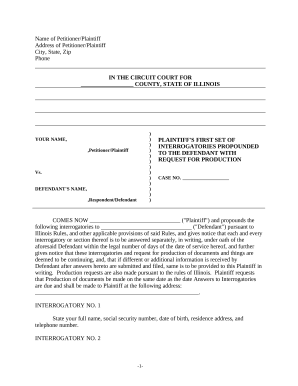
In the United States, there are five basic forms of discovery: depositions, interrogatories, requests for production of documents (or permission to inspect), physical and mental examinations, and requests for admission.
The Three Forms of Discovery Written - This form of discovery takes place on paper. Document Production - This form of discovery involves an exchange of documents. Oral - Sometimes known as depositions, this form of discovery allows parties to gain sworn statements from involved individuals.
Parties may obtain discovery by one or more of the following methods: depositions upon oral examination or written questions; written interrogatories; production of documents or things or permission to enter upon land or other property under Rule 34 or 45(a)(1) (C), for inspection and other purposes; physical and
Formal discovery is the process of using mechanisms provided for in the law to gather information. Formal discovery consists of things like interrogatories, depositions and requests for production of documents. Informal discovery is information gathering done outside the legally created processes for investigation.
Depositions are probably the most powerful discovery tool. Depositions, however, can be extremely expensive and are not always necessary or appropriate.
The options for Formal Written Discovery are Interrogatories Questions and Requests for Production of Documents and subpoenas for information or documents. There are also Requests for Admissions. These are more common in civil cases than domestic, but can be used in any type of case.
More broadly, the doctrine of discovery can be described as an international law doctrine giving authorization to explorers to claim terra nullius i.e. said inhabited land in the name of their sovereign when the land was not populated by Christians. doctrine of discovery | Wex | US Law | LII / Legal Information Institute cornell.edu wex doctrineofdiscov cornell.edu wex doctrineofdiscov
There are four main types of discovery requests: (1) depositions; (2) interrogatories; (3) requests for admissions; and (4) requests for the production of documents. Depositions are formal witness interviews.