Increase your output with US Bankruptcy Legal Documents

Papers administration takes up to half of your business hours. With DocHub, it is possible to reclaim your time and improve your team's efficiency. Get US Bankruptcy Legal Documents collection and check out all form templates relevant to your daily workflows.

Effortlessly use US Bankruptcy Legal Documents:

  1. Open US Bankruptcy Legal Documents and employ Preview to obtain the relevant form.
  2. Click Get Form to start working on it.
  3. Wait for your form to open in our online editor and begin modifying it.
  4. Add new fillable fields, icons, and images, adjust pages, etc.
  5. Fill your document or set it for other contributors.
  6. Download or deliver the form by link, email attachment, or invite.

Accelerate your daily document administration using our US Bankruptcy Legal Documents. Get your free DocHub profile today to explore all templates.


Video Guide on US Bankruptcy Legal Documents management

video background

Commonly Asked Questions about US Bankruptcy Legal Documents

In the United States, bankruptcy is largely governed by federal law, commonly referred to as the Bankruptcy Code (Code). The United States Constitution (Article 1, Section 8, Clause 4) authorizes Congress to enact uniform Laws on the subject of Bankruptcies throughout the United States. Bankruptcy in the United States - Wikipedia Wikipedia wiki BankruptcyintheU Wikipedia wiki BankruptcyintheU
Once you file for bankruptcy, your creditors must halt all collection attempts, including things like foreclosure, repossession and wage garnishment. That said, only certain types of debt can be included in bankruptcymore on that in a minute. Bankruptcy: How It Works, Types and Consequences - Experian Experian blogs credit-education b Experian blogs credit-education b
A bankruptcy expires, or falls off your credit report after 10 years if you file for Chapter 7 bankruptcy, or after seven years if you file Chapter 13 bankruptcy. When Does Bankruptcy Fall Off My Credit Report? - Experian Experian blogs ask-experian when Experian blogs ask-experian when
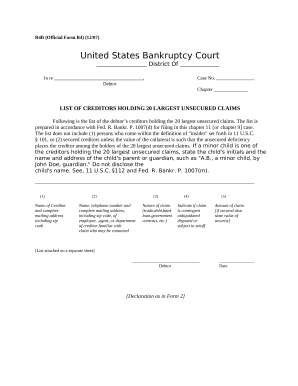
A proof of claim is a form used by the creditor to indicate the amount of the debt owed by the debtor on the date of the bankruptcy filing. The creditor must file the form with the clerk of the same bankruptcy court in which the bankruptcy case was filed.
Generally, Chapter 7 is more appropriate for simple cases while Chapter 13 for more complicated bankruptcies. Or somewhat more accurately, Chapter 13 can give you more power over and flexibility with certain kinds of creditors, and if you have non-exempt assets.
These documents have various titles including: Schedules Exhibits and then a combination of other forms titled Statements, Declarations, Summary, Disclosure, Verification, Notice, Debtors Certification, Plan (chapter 13 only), and Venue Disclosure (chapter 11 only).
Bankruptcy law provides for the development of a plan that allows a debtor, who is unable to pay his creditors, to resolve his debts by dividing his assets among his creditors. This supervised division also allows the interests of all creditors to be treated with some measure of equality.