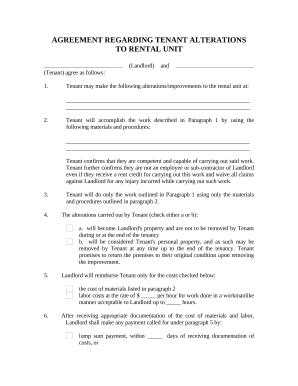
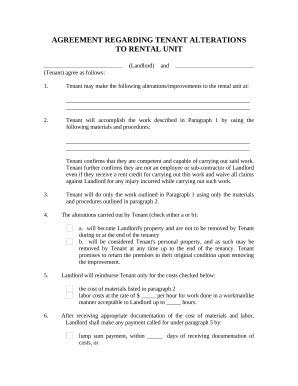
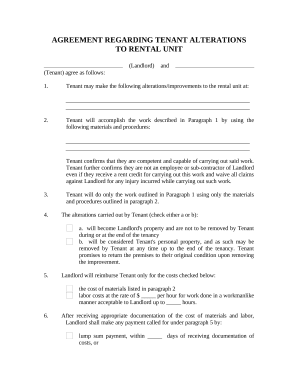
Get and handle Tenant Improvement Agreement online

Improve your form management with our Tenant Improvement Agreement online library with ready-made templates that suit your needs. Access the document template, modify it, complete it, and share it with your contributors without breaking a sweat. Begin working more effectively with your forms.

The best way to manage our Tenant Improvement Agreement:

  1. Open our Tenant Improvement Agreement and search for the form you require.
  2. Preview your document to ensure it’s what you want, and click on Get Form to start working on it.
  3. Modify, include new text, or point out important information with DocHub tools.
  4. Fill out your form and save the modifications.
  5. Download or share your document template with other people.

Examine all the possibilities for your online file administration using our Tenant Improvement Agreement. Get your free free DocHub account today!


Video Guide on Tenant Improvement Agreement management

video background

Commonly Asked Questions about Tenant Improvement Agreement

The tenant improvement (TI) allowance, or build-out allowance, is the amount of money that a landlord is willing to give or reimburse a tenant for renovations and improvements, or sometimes other expenses associated with moving into a new space.
The real estate definition of a TI (tenant improvements) is the customized alterations a building owner makes to rental space as part of a lease agreement, in order to configure the space for the needs of that particular tenant.
What are some examples of TIs? Every business has specific needs and TIs enable them to customize a lease space to meet specific needs. Some examples of TIs include adding walled offices, a break room or kitchen, an additional bathroom, conference rooms, drop ceilings and painting.
The tenant improvement allowance is typically given based on the rental square feet (RSF) of the commercial space. To calculate the Tenant improvement allowance simply multiply the RSF by the TI allowance you have negotiated. If you need help we created a free tenant improvement calculator.
If the improvement allowance is paid after the leases commencement date, the payments will be factored into both the lease liability and ROU asset measurement. The lease liability is calculated as the present value of all future payments, including those received for the allowance. Tenant Improvement Allowance Accounting for ASC 842 Example finquery.com blog tenant-improvement-allow finquery.com blog tenant-improvement-allow
Per-Square-Foot Basis: Many leases calculate TIAs based on a per-square-foot basis. This involves multiplying the agreed-upon per-square-foot allowance by the total square footage of the leased space. For example, if the TIA is $10 per square foot, and your space is 2,000 square feet, your TIA would be $20,000.
Tenant improvements can range widely depending on the property type and the tenants needs, but can generally be split into two categories, hard costs, and soft costs.
You should present your proposal and plan to the landlord in a clear and professional manner. You should emphasize the mutual benefits and the win-win potential of the deal. You should also be prepared to answer any questions or objections they may have. You should not accept the first offer or give up too easily. Tips for Negotiating Tenant Improvement Allowance - LinkedIn linkedin.com advice how-do-you-negoti linkedin.com advice how-do-you-negoti
TI Plans means architectural plans, construction drawings and mechanical, electrical and plumbing (MEP) drawings for the Premises, in form sufficient for the permitting and construction of the Premises. TI Plans means the final T.I. Plans as approved by Tenant and Landlord pursuant to Section 3.0.
TIA is typically expressed as a per square foot amount. For example, if a landlord is offering $20.00 per square foot on a 2,500 square foot commercial space, the landlord has agreed to reimburse the tenant for $50,000 worth of construction costs.