Oh landlord tenant 2026

Get Form
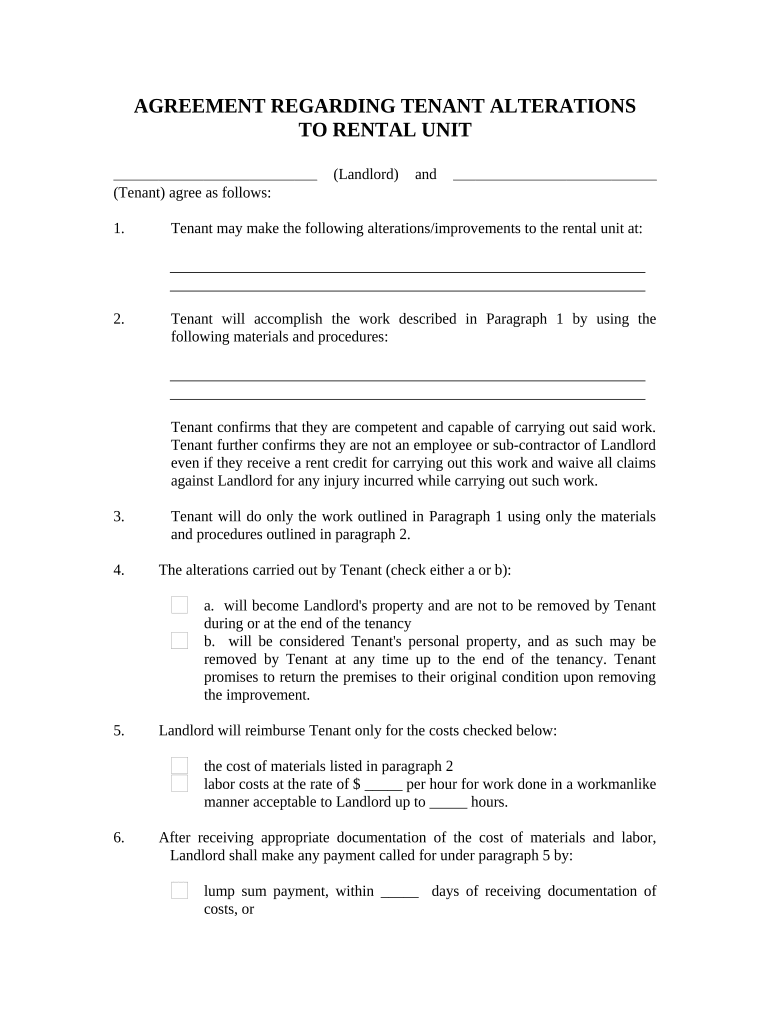
oh landlord tenant Preview on Page 1

Here's how it works

01. Edit your form online
Type text, add images, blackout confidential details, add comments, highlights and more.
02. Sign it in a few clicks
Draw your signature, type it, upload its image, or use your mobile device as a signature pad.
03. Share your form with others
Send it via email, link, or fax. You can also download it, export it or print it out.

How to use or fill out oh landlord tenant with our platform

Form edit decoration
9.5
Ease of Setup
DocHub User Ratings on G2
9.0
Ease of Use
DocHub User Ratings on G2
  1. Click ‘Get Form’ to open it in the editor.
  2. Begin by entering the names of the Landlord and Tenant in the designated fields at the top of the form.
  3. In Paragraph 1, specify the alterations or improvements that the Tenant is permitted to make to the rental unit.
  4. Detail the materials and procedures for these alterations in Paragraph 2, ensuring clarity on how the work will be accomplished.
  5. Indicate whether the alterations will become Landlord's property or remain Tenant's personal property in Paragraph 4 by checking either option a or b.
  6. Fill out Paragraph 5 with any reimbursement details, including costs for materials and labor rates, as applicable.
  7. Complete payment terms in Paragraph 6, specifying how and when payments will be made after documentation is received.
  8. Review all sections for accuracy before signing. Ensure both parties sign and date at the bottom of the form.

Start using our platform today to easily fill out your oh landlord tenant agreement for free!

be ready to get more

Complete this form in 5 minutes or less

Get form

Got questions?

We have answers to the most popular questions from our customers. If you can't find an answer to your question, please contact us.
Contact us
Ohio Landlord Tenant Law Landlord obligations tenant rights. Tenant rights under Ohio Landlord Tenant Laws require that landlords must supply running water, comply with all housing, building, health and safety laws, keep rental properties safe and sanitary, and make all necessary repairs in a reasonable time period
To evict you, your landlord must give you a 3, 30, 60 or 90-day notice. If you get one of these, its important that you take action, like pay the rent you owe, move out, or get legal help.
Depending on the reason for the eviction, the notice to leave may be 3 or 30 days. For nonpayment of rent, or in cases where the landlord has knowledge of a search warrant executed against the tenant for illegal drug activity, a 3 day notice can be given.
When a landlord wants to terminate a tenancy before the lease term has ended, the landlord must have legal cause (a valid reason). The most common reasons to evict a tenant are failure to pay rent and violation of the lease or rental agreement.
Landlord Notice Requirement: Must give at least 2 months notice, aligned with rental periods, under Section 21. This remains the statutory minimum until the Renters Rights Bill is enacted. Tenants Notice Requirement: Must give at least 1 months notice (if rent is paid monthly) or 4 weeks notice (if paid weekly).

Security and compliance

At DocHub, your data security is our priority. We follow HIPAA, SOC2, GDPR, and other standards, so you can work on your documents with confidence.

Learn more
ccpa2
pci-dss
gdpr-compliance
hipaa
soc-compliance