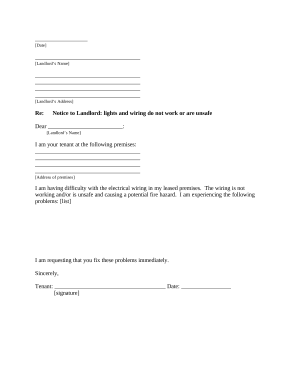
Manage State Specific Landlord Tenant Forms quickly online

Document managing can stress you when you can’t find all the documents you require. Fortunately, with DocHub's considerable form categories, you can find all you need and easily take care of it without the need of switching between software. Get our State Specific Landlord Tenant Forms and start working with them.

How to use our State Specific Landlord Tenant Forms using these basic steps:

  1. Examine State Specific Landlord Tenant Forms and select the form you require.
  2. Review the template and click Get Form.
  3. Wait for it to open in the online editor.
  4. Modify your document: include new information and images, and fillable fields or blackout certain parts if required.
  5. Fill out your document, save changes, and prepare it for delivering.
  6. When all set, download your form or share it with your contributors.

Try out DocHub and browse our State Specific Landlord Tenant Forms category without trouble. Get a free profile today!

Video Guide on State Specific Landlord Tenant Forms management

video background

Commonly Asked Questions about State Specific Landlord Tenant Forms

A wave of new legislation strengthening tenant protections in California goes into effect in 2024. These laws limit evictions, cap security deposits, extend rent control, and make it easier for tenants to fight back against landlords trying to skirt housing regulations.
Quick Summary: In California, landlords can enter a rental property without prior notice only in emergencies, with tenant approval, for abandoned property, or under court orders.
Under the Rent Stabilization Ordinance (RSO), a landlord is only required to pay monetary relocation assistance payments to tenants being evicted through no fault of their own. Without a RSO cause, a tenancy may not be terminated.
California Civil Code 1954, a key law governing the landlord-tenant relationship, provides guidelines on a landlords right to enter a rental property. This law has been in effect since the 1970s and seeks to balance the rights of both landlords and tenants when it comes to entry into a rental unit.
Californias Tenant Protection Act The only lawful way to evict a tenant is to file lawsuit and wait for the court to order the Sheriff or Marshal to carry out the eviction. Landlords cannot change the locks, shut off power, or remove personal property in order to force a tenant out of their home.
But, your landlord can still require you to move out for one of the no-fault reasons listed in the law. If your landlord evicts you for one of these reasons, they must first give you one months rent or waive one months rent to help you move out.
Rent cannot be raised over any 12-month period more than the rate of inflation (Consumer Price Index or CPI.tenantprotections.org/calculator) + 5%. In no case can it be more than 10%. Rent can only be raised twice within any given 12-month period. California law limits the reasons why a renter can be evicted.