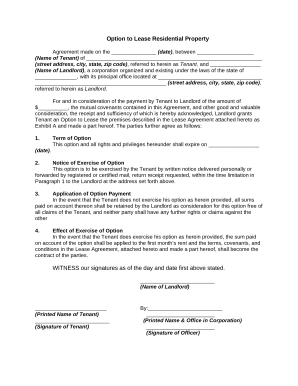
Transform your document operations with Residential Property Lease Contracts

Your workflows always benefit when you can easily get all of the forms and documents you require on hand. DocHub provides a vast array of document templates to alleviate your day-to-day pains. Get a hold of Residential Property Lease Contracts category and quickly browse for your form.

Begin working with Residential Property Lease Contracts in a few clicks:

  1. Open Residential Property Lease Contracts and discover the document you require.
  2. Click on Get Form to open it in our editor.
  3. Begin editing your file: add fillable fields, highlight paragraphs, or blackout sensitive details.
  4. The application saves your modifications automatically, and after you are all set, you can download or distribute your file with other contributors.

Enjoy effortless record management with DocHub. Check out our Residential Property Lease Contracts online library and get your form right now!


Video Guide on Residential Property Lease Contracts management

video background

Commonly Asked Questions about Residential Property Lease Contracts

A fixed-term lease is the most traditional lease. Theyre called fixed term because tenants and landlords are agreeing to abide by the lease for a fixed amount of time, normally six to 14 months.
Yes, Microsoft Word has a free lease agreement template that you can customize to create your own contract and minimize any potential problems between tenant and landlord.
Gross leases are commonly used for commercial properties, such as office buildings and retail spaces. Modified leases and fully service leases are the two types of gross leases. Gross leases are different from net leases, which require the tenant to pay one or more of the costs associated with the property.
The main difference is the length of tenancy. A rental agreement is usually short term or month-to-month, while a lease is typically for a longer period of time, usually six months or more. Find out more about what it means to rent or lease and the pros and cons of each.
Explanation: A gross lease is a type of lease agreement where the landlord pays all the property expenses, including the property taxes, insurance, maintenance, and repairs. This type of lease is most often used with residential property (Option A).
Gross Lease Gross leases are most common for commercial properties such as offices and retail space. The tenant pays a single, flat amount that includes rent, taxes, utilities, and insurance.
Net leases A triple net lease, sometimes known as an NNN lease, is the most common type of commercial lease. A triple net lease is a lease whose monthly rent fee does not include operating expenses. Typical operating expenses include insurance, utilities, property taxes and maintenance costs.