


Create your Real Estate Mortgages and Deed from scratch

Start Building Now
Title decoration

Here's how it works

01. Start with a blank Real Estate Mortgages and Deed
Open the blank document in the editor, set the document view, and add extra pages if applicable.
02. Add and configure fillable fields
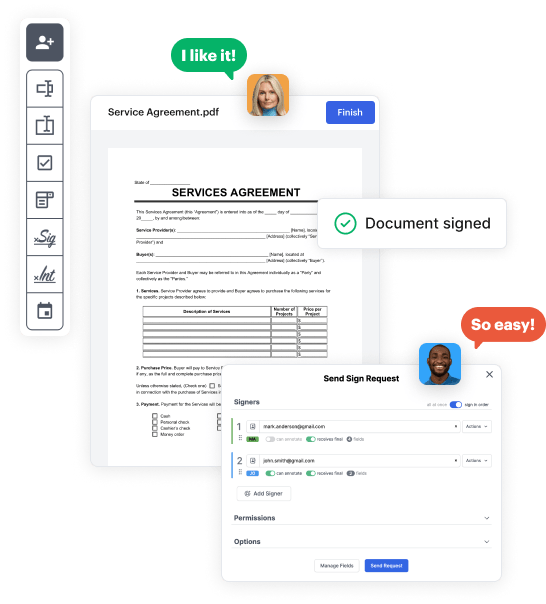
Use the top toolbar to insert fields like text and signature boxes, radio buttons, checkboxes, and more. Assign users to fields.
03. Distribute your form
Share your Real Estate Mortgages and Deed in seconds via email or a link. You can also download it, export it, or print it out.

A brief guide on how to create a polished Real Estate Mortgages and Deed

Form edit decoration

Step 1: Log in to DocHub to create your Real Estate Mortgages and Deed.

First, sign in to your DocHub account. If you don't have one, you can easily sign up for free.

Step 2: Head to the dashboard.

Once logged in, head to your dashboard. This is your main hub for all document-focused activities.

Step 3: Launch new document creation.

In your dashboard, select New Document in the upper left corner. Opt for Create Blank Document to create the Real Estate Mortgages and Deed from a blank slate.

Step 4: Add form fillable areas.

Place various items like text boxes, images, signature fields, and other options to your form and designate these fields to particular users as required.

Step 5: Customize your form.

Personalize your document by inserting walkthroughs or any other crucial details leveraging the text tool.

Step 6: Review and adjust the document.

Attentively review your created Real Estate Mortgages and Deed for any errors or essential adjustments. Leverage DocHub's editing features to polish your form.

Step 7: Send out or export the form.

After completing, save your copy. You may choose to retain it within DocHub, export it to various storage solutions, or forward it via a link or email.


be ready to get more

Build your Real Estate Mortgages and Deed in minutes

Start creating now

Got questions?

We have answers to the most popular questions from our customers. If you can't find an answer to your question, please contact us.
Contact us
A deed of trust is a legal agreement thats similar to a mortgage, which is used in real estate transactions. Whereas a mortgage only involves the lender and a borrower, a deed of trust adds a neutral third party that holds rights to the real estate until the loan is paid or the borrower defaults.
Regarding property ownership, two essential documents are the deed and mortgage. Out of these two, the deed is undoubtedly the most important one. It acts as concrete evidence of your rightful ownership of the property.
To put simply, the deed is the legal document that proves who holds title to a property, while a mortgage is an agreement between a financial lender and borrower to repay the amount borrowed to purchase a home.
The filing fee is generally $125 for residential and farm properties and $250 for all other properties. The county clerks office collects the RP-5217 filing fee. The county clerks office should be reviewing the RP-5217 forms for completeness, not for accuracy.
Call 311 or 212-NEW-YORK (212-639-9675) for help. You can request a certified or uncertified copy of property records online or in person. Certified copies cost $4 per page. Uncertified copies printed at a City Register Office cost $1 per page.
be ready to get more

Build your Real Estate Mortgages and Deed in minutes

Start creating now

Related Q&A to Real Estate Mortgages and Deed

If your name is on the mortgage, but not the deed, this means that you are not an owner of the home. Rather, you are simply a co-signer on the mortgage. Because your name is on the mortgage, you are obligated to pay the payments on the loan just as the individual who owns the home.
A deed is void at its inception if it attempts to transfer property to an inadequately designed grantee. Delivery and acceptance of the deed is presumed if it has been recorded. Both the grantor and the grantee sign the deed. It is not necessary for the grantor to physically deliver the deed to the grantee.
You should have received your deed at the closing upon purchasing the property. Unlike a car title, a new deed is not generated when you pay off your mortgage. The lender will record a Release/Satisfaction of Mortgage with our office to prove the mortgage has been paid.

Additional resources on building your forms