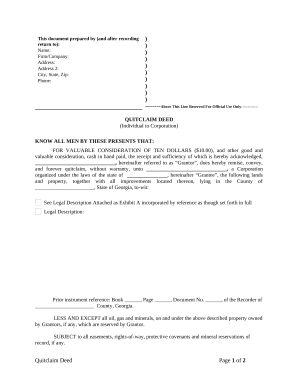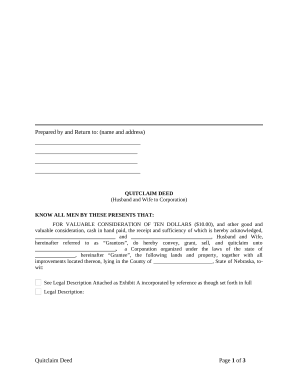
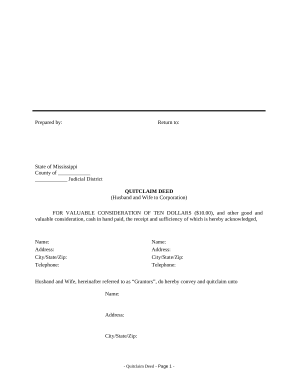
Get and manage Quitclaim Deed from Husband and Wife online

Speed up your form management with the Quitclaim Deed from Husband and Wife collection with ready-made templates that suit your needs. Get the form template, modify it, complete it, and share it with your contributors without breaking a sweat. Start working more efficiently with your forms.

The best way to manage our Quitclaim Deed from Husband and Wife:

  1. Open our Quitclaim Deed from Husband and Wife and look for the form you want.
  2. Preview your document to ensure it’s what you want, and click on Get Form to start working on it.
  3. Edit, include new text, or highlight important information with DocHub features.
  4. Fill out your form and save the adjustments.
  5. Download or share your form with other recipients.

Explore all of the opportunities for your online document management using our Quitclaim Deed from Husband and Wife. Get your free free DocHub profile today!


Video Guide on Quitclaim Deed from Husband and Wife management

video background

Commonly Asked Questions about Quitclaim Deed from Husband and Wife

Quitclaim deeds lack certain protections and promises found in other types of deed to real property. Because of this, they should only be used under certain circumstances. These include transferring real estate between close family membersfor instance, from a parent to a child.
What are the Disadvantages of a Quit Claim Deed? No Protections For The Transaction: Unlike warranty deeds, a quitclaim deeds does not offer protections for the new property owner. There is no way to guarantee that the property is owned free and clear, and that there are no easements or restrictions.
An interspousal transfer deed is used to transfer the property title from one spouse to another. This special type of deed is most commonly used in the case of divorce, when the proceedings result in the requirement that property goes to one spouse over the other.
It can be used to release a nominal real estate interest as it can effectively transfer whatever interest the grantor has, regardless of its value. However, a quitclaim deed cannot be used to warrant that a title is valid since it does not guarantee the grantors ownership interest.
In a quitclaim deed, the rights of one party pass to another party, called the grantor and grantee, respectively. As a spouse, you give up your interest in the property when you sign a quitclaim deed. This means that you no longer have a legal right to it.
A docHub disadvantage to a buyer receiving a quitclaim deed is the lack of warranties and guarantees about the propertys title. Unlike other types of deeds, a quitclaim deed does not assure that the grantor has a valid ownership interest in the property or that the property is free from liens or encumbrances.
An interspousal transfer gives full interest in the property to the transferee, whereas a quitclaim leaves the transferer still liable for any obligations related to the property, even though the transferer no longer has a residential interest in it.
Quitclaim deeds themselves are not directly reported to the IRS. However, the transfer of property using a quitclaim deed can have tax implications that may need to be reported, depending on the specifics of the transaction.