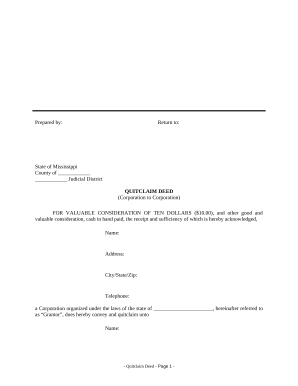
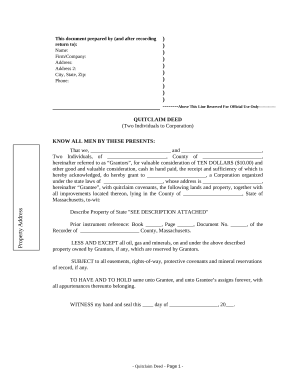
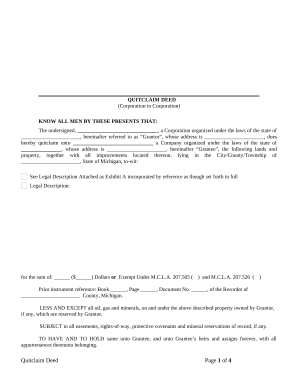
Get and manage Quitclaim Deed for Corporations online

Speed up your document administration using our Quitclaim Deed for Corporations library with ready-made templates that meet your needs. Get the document template, alter it, fill it, and share it with your contributors without breaking a sweat. Start working more efficiently with the documents.

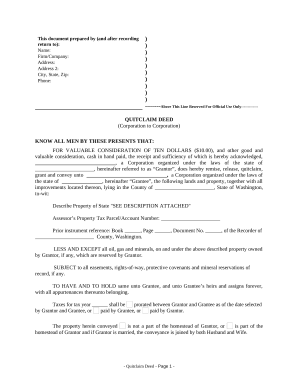
The best way to use our Quitclaim Deed for Corporations:

  1. Open our Quitclaim Deed for Corporations and look for the form you need.
  2. Preview your form to ensure it’s what you want, and click Get Form to begin working on it.
  3. Change, include new text, or highlight important information with DocHub features.
  4. Complete your form and save the changes.
  5. Download or share your form with other recipients.

Discover all of the possibilities for your online document management with the Quitclaim Deed for Corporations. Get your totally free DocHub account right now!

Video Guide on Quitclaim Deed for Corporations management

video background

Commonly Asked Questions about Quitclaim Deed for Corporations

A quitclaim deed is most often used for transferring property between family members, or to add or remove a person to the title, or or to cure a simple defect on the title, such as a mistake in an address or the misspelling of a name. What Is A Quitclaim Deed? - Bankrate bankrate.com real-estate quitclaim-deed bankrate.com real-estate quitclaim-deed
A quitclaim deed transfers the title of a property from one person to another, with little to no buyer protection. The grantor, the person giving away the property, gives their current deed to the grantee, the person receiving the property.
In North Carolina, a quitclaim deed must include the following information: the grantors name, the grantees name, the legal description of the property being conveyed, the consideration paid for the property, any agreements made between the parties to the deed, and a statement of whether or not the grantor is making
Quitclaim deeds typically are not used in situations where the property involved has an outstanding mortgage. After all, it would be difficult for many grantors to pay off a mortgage without proceeds from the sale of the property. In some instances, however, quitclaim deeds are used when the grantor has a mortgage.
A quitclaim deed conveys whatever title the grantor holds and gives no warranties or convents, past or future.
It can be used to release a nominal real estate interest as it can effectively transfer whatever interest the grantor has, regardless of its value. However, a quitclaim deed cannot be used to warrant that a title is valid since it does not guarantee the grantors ownership interest.
A quitclaim bill of sale also presents some downsides. Because the bill of sale makes no guarantees at all, a buyer may find themselves owning property that is tied up with liens, or even property the seller didnt actually own at all.