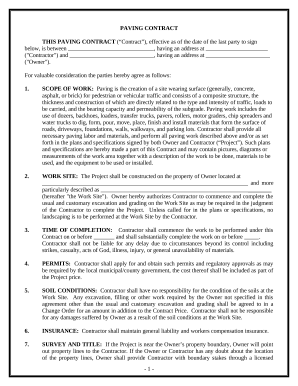
Enhance your form management with Paving Contract Forms

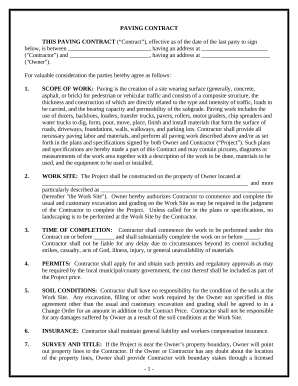
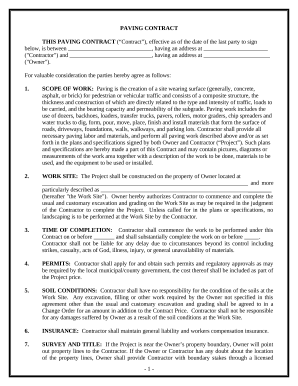
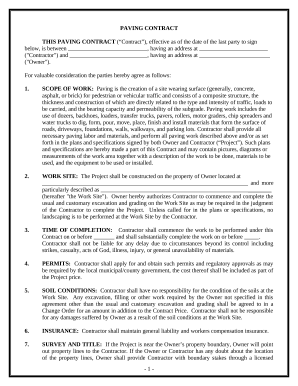
Your workflows always benefit when you can discover all the forms and documents you require at your fingertips. DocHub gives a a huge collection of forms to relieve your daily pains. Get a hold of Paving Contract Forms category and quickly find your document.

Begin working with Paving Contract Forms in a few clicks:

  1. Open Paving Contract Forms and get the form you require.
  2. Click on Get Form to open it in the editor.
  3. Begin editing your file: add more fillable fields, highlight paragraphs, or blackout sensitive details.
  4. The application saves your modifications automatically, and after you are all set, you are able to download or share your file with other contributors.

Enjoy easy form managing with DocHub. Explore our Paving Contract Forms category and look for your form today!

Video Guide on Paving Contract Forms management

video background

Commonly Asked Questions about Paving Contract Forms

How to draft a contract between two parties: A step-by-step checklist Know your parties. Agree on the terms. Set clear boundaries. Spell out the consequences. Specify how you will resolve disputes. Cover confidentiality. Check the legality of the contract. Open it up to negotiation.
Lump sum contracts This is the most basic and common type of construction contract. Lump sum contracts work especially well for projects with a well-defined scope of work, which enables contractors to make an accurate estimate of the projects cost.
Lump sum contracts (also sometimes known as fixed price contracts) are usually considered the most popular type of contract when it comes to building and engineering agreements, however they do have minor differences.
The main contract is generally that which is awarded by the client (sometimes referred to as the employer) to the general contractor, or main contractor, whose tender has been accepted.
A lump sum contract is an agreement that sets a predetermined cost for construction work. In other words, the contractor performing the work agrees to complete the project for a fixed amount no more or less.
Here are four main construction contracts to choose from, plus their pros and cons: Lump-Sum Contracts. Cost-Plus-Fee Contracts. Guaranteed Maximum Price Contracts. Unit-Price Contracts.
A bilateral contract is a contract that includes two parties who agree to certain terms. This type of contract is common, especially in the workplace.
Lump sum contracts Lump sum contracts work especially well for projects with a well-defined scope of work, which enables contractors to make an accurate estimate of the projects cost.