
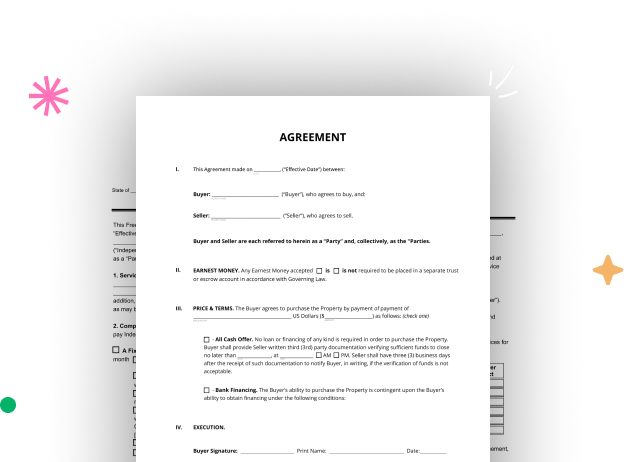
Create your Mortgage Holder Document from scratch

Start Building Now
Title decoration

Here's how it works

01. Start with a blank Mortgage Holder Document
Open the blank document in the editor, set the document view, and add extra pages if applicable.
02. Add and configure fillable fields
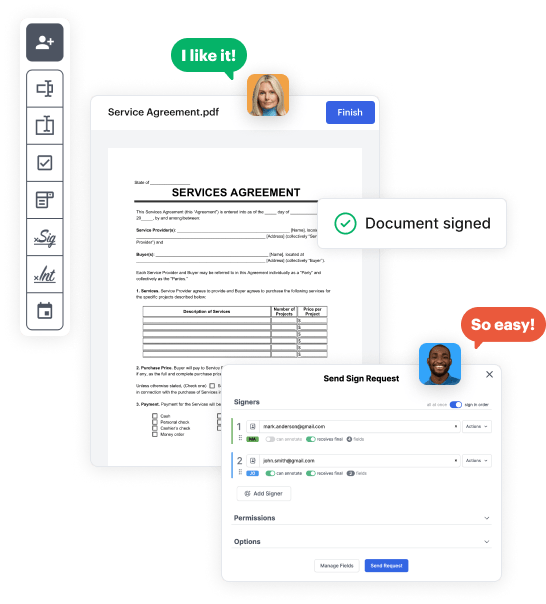
Use the top toolbar to insert fields like text and signature boxes, radio buttons, checkboxes, and more. Assign users to fields.
03. Distribute your form
Share your Mortgage Holder Document in seconds via email or a link. You can also download it, export it, or print it out.

A detailed guide on how to design your Mortgage Holder Document online

Form edit decoration

Step 1: Start with DocHub's free trial.

Go to the DocHub website and sign up for the free trial. This provides access to every feature you’ll need to build your Mortgage Holder Document with no upfront cost.

Step 2: Access your dashboard.

Log in to your DocHub account and proceed to the dashboard.

Step 3: Craft a new document.

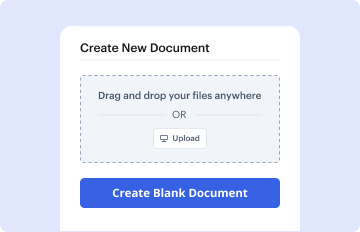
Click New Document in your dashboard, and select Create Blank Document to design your Mortgage Holder Document from the ground up.

Step 4: Use editing tools.

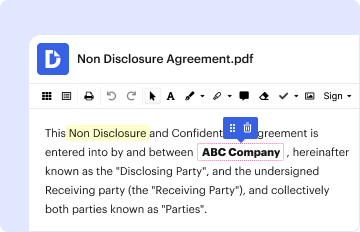
Add various elements such as text boxes, radio buttons, icons, signatures, etc. Organize these fields to suit the layout of your document and assign them to recipients if needed.

Step 5: Modify the form layout.

Rearrange your document effortlessly by adding, repositioning, deleting, or combining pages with just a few clicks.

Step 6: Craft the Mortgage Holder Document template.

Turn your freshly designed form into a template if you need to send multiple copies of the same document repeatedly.

Step 7: Save, export, or share the form.

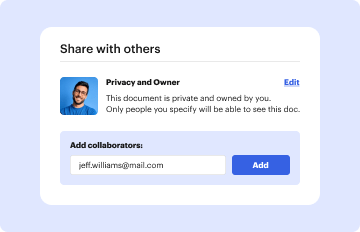
Send the form via email, share a public link, or even publish it online if you wish to collect responses from a broader audience.


be ready to get more

Build your Mortgage Holder Document in minutes

Start creating now

Got questions?

We have answers to the most popular questions from our customers. If you can't find an answer to your question, please contact us.
Contact us
A deed is an official written document declaring a persons legal ownership of a property, while a title is a legal concept that refers to ownership rights. Heres a way to remember the difference: You can own a physical copy of a book, but you cant hold the books title in your hand.
A property deed is a legal document that transfers the ownership of real estate from a seller to a buyer. For a deed to be legal it must state the name of the buyer and the seller, describe the property that is being transferred, and include the signature of the party that is transferring the property.
Generally speaking, a mortgage is an official agreement between a lender and a homebuyer to use the property as security to buy a home. The type of document and requirements may vary by state or loan type. For example, in some states you may use a security deed and in other states a deed of trust.
You should have received your deed at the closing upon purchasing the property. Unlike a car title, a new deed is not generated when you pay off your mortgage. The lender will record a Release/Satisfaction of Mortgage with our office to prove the mortgage has been paid.
Contacting your existing mortgage lender is pretty much what it says on the tin you can give them a call and discuss the potential option of adding a second person and what the process would be for this. Both of these options typically include a comprehensive financial assessment.
be ready to get more

Build your Mortgage Holder Document in minutes

Start creating now

Related Q&A to Mortgage Holder Document

Contact your lender. Instead, they will likely make you refinance your home, in effect taking out an entirely new mortgage. Adding a person to your mortgage without refinancing can only work if the mortgage is assumable. Federal Housing Administration (FHA) loans tend to be assumable, but other types may not be.
Title deeds and documents are legal papers proving your right to own real property and are vital during a real estate transaction. These documents show legal ownership of tangible property. They detail the propertys history, including previous ownership and changes in ownership structure.
mortgage. To put simply, the deed is the legal document that proves who holds title to a property, while a mortgage is an agreement between a financial lender and borrower to repay the amount borrowed to purchase a home.

Additional resources on building your forms


