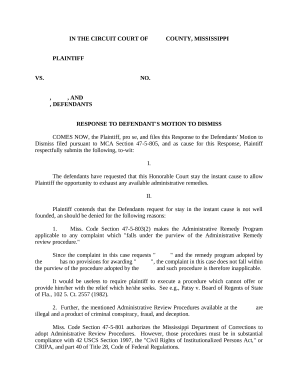
Improve your template managing with Mississippi Civil Case Forms

Your workflows always benefit when you can easily get all of the forms and files you will need on hand. DocHub supplies a a huge library of documents to ease your everyday pains. Get hold of Mississippi Civil Case Forms category and quickly find your form.

Begin working with Mississippi Civil Case Forms in a few clicks:

  1. Open Mississippi Civil Case Forms and get the form you require.
  2. Click Get Form to open it in the editor.
  3. Start modifying your document: add fillable fields, highlight paragraphs, or blackout sensitive data.
  4. The app saves your changes automatically, and once you are all set, you can download or share your form with other contributors.

Enjoy easy document management with DocHub. Check out our Mississippi Civil Case Forms collection and find your form today!

Video Guide on Mississippi Civil Case Forms management

video background

Commonly Asked Questions about Mississippi Civil Case Forms

Rule 54(b) is designed to facilitate the entry of a final judgment upon one or more but fewer than all the claims or as to one or more but fewer than all the parties in an action involving multiple claims or multiple parties, so as to enable the non-prevailing party to perfect an appeal as of right of a final judgment.
Any admission made by a party under this rule is for the purpose of the pending action only and is not an admission by him for any other purpose nor may it be used against him in any other proceeding. The purpose of Rule 36 is to identify and establish facts that are not in dispute.
The statute of limitations is the period of time you have to file a civil case in court. It differs from the time limits imposed on bringing actions against an insurance company. The statute of limitations varies by statein Mississippi, it ranges from one to seven years for civil cases.
The first step in a civil action is the filing of the complaint with the clerk or judge. Service of process upon the defendant is not essential to commencement of the action, but Rule 4(h) does require service of the summons and complaint within 120 days after the filing of the complaint.
Once a default judgment has been entered, a creditor can then use it to seek to garnish your wages and other property. In Mississippi, a default judgment acts as a lien against property you have in any county where the judgment has been properly entered.
Rule 19 covers, generally, those individuals who under prior Massachusetts practice would be classified as necessary parties or indispensable parties. Rule 19(b) deals with persons who fall within Rule 19(a) but cannot be made parties.
On a motion for a new trial in an action tried without a jury, the court may open the judgment if one has been entered, take additional testimony, amend findings of fact and conclusions of law or make new findings and conclusions, and direct the entry of a new judgment.
A defendant shall serve his answer within thirty days after the service of the summons and complaint upon him or within such time as is directed pursuant to Rule 4. A party served with a pleading stating a cross-claim against him shall serve an answer thereto within thirty days after the service upon him.
A person who is subject to the jurisdiction of the court shall be joined as a party in the action if: (1) in his absence complete relief cannot be ed among those already parties, or (2) he claims an interest relating to the subject of the action and is so situated that the disposition of the action in his absence
37. Rule 37 - Failure to Make or Cooperate in Discovery: Sanctions (a)Motion for Order Compelling Discovery. A party, upon reasonable notice to other parties and all persons affected thereby, may apply for an order compelling discovery.