Improve your form operations with Massachusetts Lease Agreements

Your workflows always benefit when you can find all the forms and documents you require on hand. DocHub delivers a huge selection of templates to alleviate your everyday pains. Get hold of Massachusetts Lease Agreements category and easily discover your document.

Start working with Massachusetts Lease Agreements in several clicks:

  1. Browse Massachusetts Lease Agreements and get the document you require.
  2. Click Get Form to open it in the editor.
  3. Begin editing your document: add fillable fields, highlight paragraphs, or blackout sensitive data.
  4. The application saves your adjustments automatically, and after you are all set, you can download or share your file with other contributors.

Enjoy seamless document administration with DocHub. Discover our Massachusetts Lease Agreements category and find your form right now!


Video Guide on Massachusetts Lease Agreements management

video background

Commonly Asked Questions about Massachusetts Lease Agreements

Every rental agreement must have certain terms, and is prohibited from containing certain other terms. The lease must include the name, address, and phone number of the owner, the person responsible for maintenance, and the person to whom the tenant can give copies of formal notices, complaints, or court papers.
If the tenant is able to prove their claim to their landlord, they may be able to break the lease early. Overall, tenants must provide a notice letter with an attached copy of a valid protection order, court record, or written verification from a qualified person that confirms the claim.
A Tenant at Will is one who occupies a rented apartment without a lease, but pays rent periodically (typically monthly). Either the landlord or the tenant may terminate this arrangement at any time by giving written notice of 30 days or one full rental period in advance, whichever is longer. No reason is required.
Generally, a landlord cannot take possession of the rental property, physically remove the tenant or their personal property, or change the locks without going through a court. Depending on the reason for eviction, a landlord must provide the tenant either a 14-Day or 30-day Notice to Quit.
A tenancy-at-will can be either oral or written. The landlord or tenant can end a month-to-month tenancy-at-will by giving a written 30 days (minimum) notice to quit that must expire at the end of a rental period. Pay special attention if the notice to quit is given in February, which has less than 30 days.
On average, it would take anywhere between a little over 1 month to more than 1 year for a complete eviction process. Give your tenant a written Notice to Vacate prior to the eviction process. Make sure no mistakes were made in the filing process.
Physical move out To physically remove the tenant from your apartment, you must hire a constable and a moving company, if the tenant has refused your request to go. The constable must give the tenant 48 hours notice that s/he is coming with the truck.
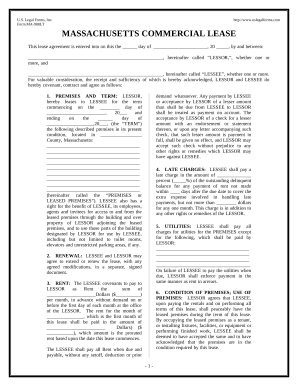
The most commonly used Massachusetts lease agreement is the Standard Form of Lease. This document covers essential details such as rent amount, lease duration, security deposit, maintenance responsibilities, property managers, and other crucial provisions.