


Create your Legal Guaranty Document from scratch

Start Building Now
Title decoration

Here's how it works

01. Start with a blank Legal Guaranty Document
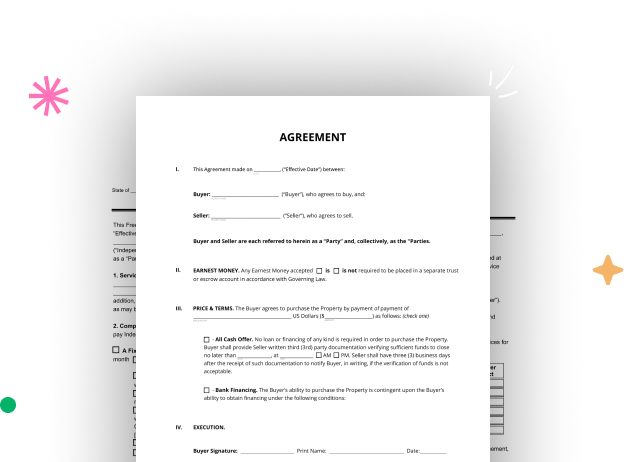
Open the blank document in the editor, set the document view, and add extra pages if applicable.
02. Add and configure fillable fields
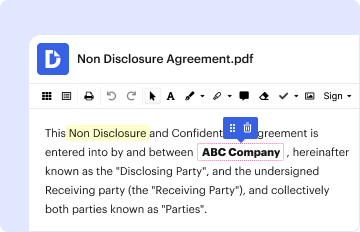
Use the top toolbar to insert fields like text and signature boxes, radio buttons, checkboxes, and more. Assign users to fields.
03. Distribute your form
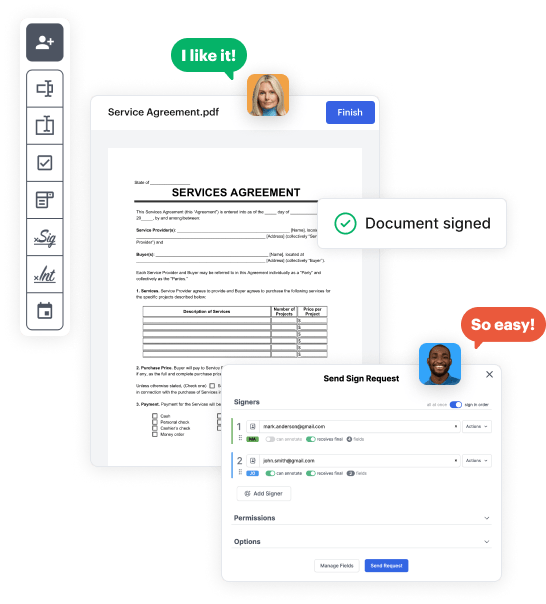
Share your Legal Guaranty Document in seconds via email or a link. You can also download it, export it, or print it out.

Design your Legal Guaranty Document in a matter of minutes

Form edit decoration

Step 1: Access DocHub to build your Legal Guaranty Document.

Start signining into your DocHub account. Explore the advanced DocHub functionality free for 30 days.

Step 2: Navigate to the dashboard.

Once signed in, go to the DocHub dashboard. This is where you'll create your forms and manage your document workflow.

Step 3: Create the Legal Guaranty Document.

Click on New Document and choose Create Blank Document to be redirected to the form builder.

Step 4: Set up the form layout.

Use the DocHub tools to add and arrange form fields like text areas, signature boxes, images, and others to your form.

Step 5: Insert text and titles.

Add necessary text, such as questions or instructions, using the text field to lead the users in your document.

Step 6: Customize field settings.

Modify the properties of each field, such as making them required or arranging them according to the data you expect to collect. Assign recipients if applicable.

Step 7: Review and save.

After you’ve managed to design the Legal Guaranty Document, make a final review of your form. Then, save the form within DocHub, export it to your preferred location, or distribute it via a link or email.


be ready to get more

Build your Legal Guaranty Document in minutes

Start creating now

Got questions?

We have answers to the most popular questions from our customers. If you can't find an answer to your question, please contact us.
Contact us
A guaranty agreement is a contract between two parties where one party agrees to pay a debt or perform a duty in the event that the original party fails to do so. The party who makes the guaranty is called the guarantor. An agreement of this nature is often used in real estate, insurance, or financial transactions.
Lack of Consideration: A personal guarantee, like any contract, requires consideration (something of value exchanged between the parties) to be valid. If the guarantor can show that they did not receive adequate consideration for providing the guarantee, it might be challenged.
Corporate credit cards that are issued to an individual are another example of a personal guarantee. The individual or employee is responsible for the debt that the organization takes on and the overall spending on the credit card. Here, the cardholder takes the role of a guarantor.
Draft the personal guarantee agreement. This should include: the name of the guarantor, the name of the borrower, the date of the agreement, the amount of the loan, the interest rate, and the duration of the guarantee. Include any other key clauses.
The Guarantor(s) declare that the Guarantor(s) has/have not received any security from the Borrower for the giving of this guarantee and the Guarantor(s) agree that so long as any moneys remain owing by the Borrower to the Bank or any liability incurred by the Bank remains outstanding, the Guarantor(s) will not take
be ready to get more

Build your Legal Guaranty Document in minutes

Start creating now

Related Q&A to Legal Guaranty Document

To get a letter of guarantee for one of your suppliers, your company must apply to your bank just like any other loan application. If approved, your bank essentially transfers its credit rating to your company, so the supplier company can rely on it for payment.
A guarantors form should include a space to fill in the home address, work address, phone number, and email address. The contact details are what will be used to contact the guarantor in the future if the principal fails to meet agreement terms.
A personal guarantee is a legally binding agreement between a finance lender and a business owner or director which states that the business owner or director will be personally liable for repaying the loan if the business defaults on loan repayments or becomes insolvent.

Additional resources on building your forms


