Get and handle Legal Deed Transfer Documents online

Improve your form management with the Legal Deed Transfer Documents category with ready-made form templates that meet your requirements. Get your document template, modify it, complete it, and share it with your contributors without breaking a sweat. Start working more effectively together with your documents.

How to use our Legal Deed Transfer Documents:

  1. Open our Legal Deed Transfer Documents and search for the form you need.
  2. Preview your document to ensure it’s what you want, and click on Get Form to begin working on it.
  3. Modify, include new text, or highlight important information with DocHub features.
  4. Complete your form and preserve the changes.
  5. Download or share your form template with other people.

Discover all of the opportunities for your online file administration using our Legal Deed Transfer Documents. Get a free free DocHub profile today!


Video Guide on Legal Deed Transfer Documents management

video background

Commonly Asked Questions about Legal Deed Transfer Documents

The most common way to transfer property is through a general warranty deed (sometimes called a grant deed). A general warranty deed guarantees good title from the beginning of time.
Can I prepare my own deed? We suggest that you have someone with experience in the field prepare it for you to make sure it is correct. Attorneys can perform this service for you. Employees for the Recorder of Deeds Office cannot and will not prepare deeds for you.
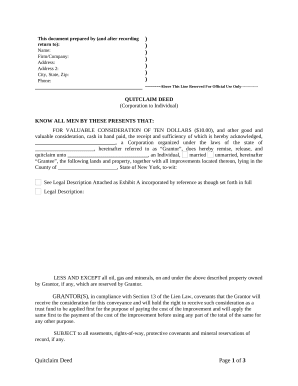
The deed must be prepared on a white paper with a dimension of 8 by 11 The deed must have a minimum 10-point font and one-inch margins on all pages. The deed must identify the municipality and county where the real estate property is located. The deed must include a notarys acknowledgment for any signature on it.
The document must have a formal acknowledgment (not sworn and subscribed) by a notary public, and must include the following: state and county; date (should not predate the document date); name of individual, corporate or authorized officer appearing; notary signature, notary stamp (where applicable), and expiration
It takes about two to three weeks. The papers are sent back to the person who records them in most cases a Title Company or Attorney. We require a self-addressed stamped envelope if they are to be returned by mail. 7.
A Michigan property owner transfers title to real estate by signing and recording a deed. A deed allows the current owner (grantor) to transfer real estate to a new owner (grantee). Depending on the situation, there may be multiple grantors or multiple grantees within a single deed.
Sign and date the quitclaim deed in a notarys presence, then file it with the County Register of Deeds Office in the propertys county, not the county where you live. Once the deed is filed and recorded, the transfer is deemed legal.
You need to have an attorney draft a deed for you. Then you bring it to the Register of Deeds office for recording. There may be many questions that should be asked of an attorney when you are thinking about adding someones name on your deed.
The reason for the exemption must be shown on the face of the document. County transfer tax is payable at the rate of $. 55 per $500.00 ($1.10 per $1,000) consideration. State transfer tax is payable at the rate of $3.75 per $500.00 ($7.50 per $1,000) consideration.
Documents executed in Michigan which convey or encumber real estate require a notarys acknowledgment. Documents must be on 8.5 x 11 or 8.5 x 14 paper and must have a 2.5 top margin for the first page, and a minimum 0.5 margin on the other three sides of all pages.