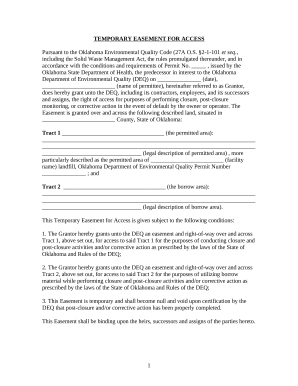
Transform your form managing with Land Easement Forms

Your workflows always benefit when you can discover all the forms and documents you will need at your fingertips. DocHub provides a huge selection of form templates to alleviate your daily pains. Get hold of Land Easement Forms category and easily discover your form.

Begin working with Land Easement Forms in several clicks:

  1. Browse Land Easement Forms and get the document you require.
  2. Click on Get Form to open it in the editor.
  3. Start editing your file: add fillable fields, highlight paragraphs, or blackout sensitive details.
  4. The app saves your modifications automatically, and once you are ready, you can download or distribute your form with other contributors.

Enjoy easy document management with DocHub. Discover our Land Easement Forms category and look for your form today!


Video Guide on Land Easement Forms management

video background

Commonly Asked Questions about Land Easement Forms

There are generally two types of easements described in New York State case law: (1) an easement appurtenant (or an easement that runs with the land); and (2) an easement in gross (or a personal easement/license).
Filing of maps and abandonment of subdivisions in Suffolk county; penalty for nonfiling.
A conservation easement is a voluntary, legal agreement that protects the natural resources of a parcel of land by restricting future land use and/or development on the property in perpetuity (permanently).
An easement once granted may be ended by merger. Under the merger doctrine, an easement will terminate when the dominant and servient estates become vested in one person. To satisfy this, there must be a complete unity of the dominant and servient estates, meaning that one person or entity owns the entire plot of land.
Land that is subject to, and therefore encumbered by, the easement is called a servient estate or servient tenement.
a. Express Grant: An easement can be created through a written agreement between the property owner (the grantor) and the person receiving the easement (the grantee). The agreement should be properly executed, signed, and recorded in the county where the property is located.
131 sets out the four essential characteristics of an easement which are as follows: There must be a dominant and servient tenement; The easement must accommodate the dominant tenement; The dominant and servient owners must be different people; The right must be capable of forming the subject matter of a grant. What is an easement and how are they created and used? tanfieldchambers.co.uk 2016/02/16 what tanfieldchambers.co.uk 2016/02/16 what
In New York, an easement is a legal right that allows someone to use or access another persons property for a specific purpose. It grants a non-possessory interest in the land, meaning that the easement holder does not own the property but has a limited right to use it.
Under common law, the owner of a property that gets its access by way of the easement has a duty to maintain the easement, but need only maintain the easement to the degree that the owner deems necessary for access to their own property.