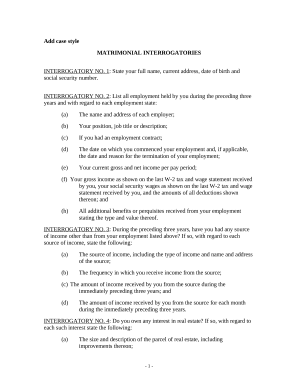
Improve your file managing with Interrogatories in Divorce Proceedings

Your workflows always benefit when you are able to find all the forms and files you will need at your fingertips. DocHub offers a wide array of forms to alleviate your daily pains. Get hold of Interrogatories in Divorce Proceedings category and quickly browse for your form.

Begin working with Interrogatories in Divorce Proceedings in a few clicks:

  1. Access Interrogatories in Divorce Proceedings and find the form you need.
  2. Click on Get Form to open it in the editor.
  3. Start modifying your file: add more fillable fields, highlight paragraphs, or blackout sensitive information.
  4. The app saves your adjustments automatically, and after you are all set, you are able to download or share your form with other contributors.

Enjoy easy file administration with DocHub. Check out our Interrogatories in Divorce Proceedings online library and get your form right now!


Video Guide on Interrogatories in Divorce Proceedings management

video background

Commonly Asked Questions about Interrogatories in Divorce Proceedings

Read the question very carefully. Answer only the question that is asked, and avoid the temptation to over-explain your answer. If the question contains several parts, you may break your answer into parts as well. It is also possible that you might object to the question.
Tips for Responding to Marital Interrogatories, Custody Interrogatories, or Parental Allocation Interrogatories Your answers should be short and concise. Type your responses, please do not handwrite your responses. Be truthful. You must sign and verify that the information provided is true in the presence of a notary.
Usually, lawyers use interrogatories to obtain detailed information about persons, corporations, facts, witnesses, and identity and locations of records and documents. Court rules usually limit the number of questions included in an interrogatory.
You have to respond to interrogatories in writing to the best of your ability. If you do not answer an interrogatory question, and then the other side learns that you did in fact know the answer, it could have a negative impact on your case at trial.
Interrogatories are written questions sent by one party in a lawsuit to another party in that same suit, which the responding party must answer under penalty of perjury. Interrogatories allow the parties to ask who, what, when, where and why questions, making them a good method for obtaining new information.
The person who makes the answers must sign them, and the attorney who objects must sign any objections. (c) Use. An answer to an interrogatory may be used to the extent allowed by the Federal Rules of Evidence.
Divorce interrogatories are often a part of the discovery process. Discovery is a legal tool that allows each party to the divorce to gain information from the other regarding marital finances, assets, liabilities, and any other relevant divorce matters.
Always give the full truth: Even if the interrogatories request information that could be uncomfortable or damaging to your case, you must provide truthful responses. Lying in an interrogatory could come back to harm you greatly later in your case. Tips for Responding to Divorce Interrogatories jrmgtattorneys.com blog tips-for-respon jrmgtattorneys.com blog tips-for-respon
Using Draft Interrogatories in Legal Proceedings Review applicable rules of civil procedure and review specific guidelines of your jurisdiction. Determine what types of interrogatories are appropriate for the situation. Draft interrogatories using clear and succinct language. Make sure to include all relevant questions.
How to use Special Interrogatories Download a template for Special Interrogatories. There are many different templates available for Special Interrogatories. Fill out basic information at the top. Add your own definitions (if useful) Write your questions (interrogatories) Sign and date the document. Make copies. Use Special Interrogatories to request information | California Courts ca.gov discovery-civil special-i ca.gov discovery-civil special-i