Get and manage Individual Real Estate Transfer Forms online

Boost your form managing with the Individual Real Estate Transfer Forms collection with ready-made templates that suit your needs. Access the form, alter it, complete it, and share it with your contributors without breaking a sweat. Begin working more efficiently together with your forms.

The best way to manage our Individual Real Estate Transfer Forms:

  1. Open our Individual Real Estate Transfer Forms and search for the form you want.
  2. Preview your form to ensure it’s what you want, and click on Get Form to begin working on it.
  3. Modify, add new text, or point out important information with DocHub tools.
  4. Prepare your form and save the modifications.
  5. Download or share your document with other recipients.

Explore all the possibilities for your online file management with the Individual Real Estate Transfer Forms. Get your totally free DocHub profile right now!


Video Guide on Individual Real Estate Transfer Forms management

video background

Commonly Asked Questions about Individual Real Estate Transfer Forms

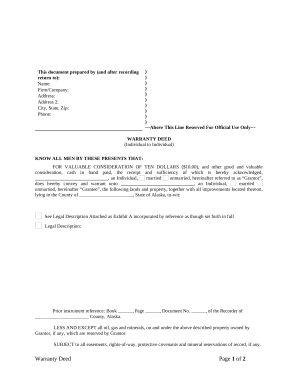
The most common way to transfer property is through a general warranty deed (sometimes called a grant deed). A general warranty deed guarantees good title from the beginning of time.
A deed must be in writing. You cannot use an oral agreement to transfer real estate. The grantor must sign the deed in front of a notary or two credible witnesses. A grantor can only transfer their own rights to property.
Who is Exempt from the Tax? A foreign government, a person acting on behalf of a foreign government, or the head of a foreign governments diplomatic mission. The premises must be used exclusively for diplomatic or consular purposes. Other usage may result in the payment of tax.
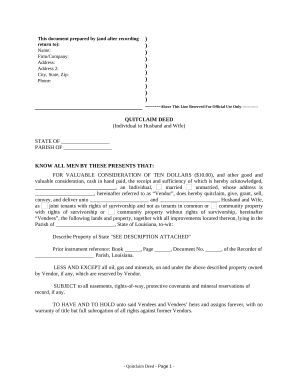
A property deed is a legal document that transfers the ownership of real estate from a seller to a buyer. For a deed to be legal it must state the name of the buyer and the seller, describe the property that is being transferred, and include the signature of the party that is transferring the property.
Form TP-584 must be filed for each conveyance of real property from a grantor/transferor to a grantee/transferee. It may not be necessary to complete all the schedules on Form TP-584. The nature and condition of the conveyance will determine which of the schedules you must complete.
The filing fee is generally $125 for residential and farm properties and $250 for all other properties. The county clerks office collects the RP-5217 filing fee. The county clerks office should be reviewing the RP-5217 forms for completeness, not for accuracy.
Today, the title to real property is conveyed by a paper deed. Deeds are either official, meaning they are executed as a result of a court or legal ruling, or more commonly, private, meaning they are executed by a deal struck between individuals or businesses.
A deed is a document that transfers the title to property from one owner to another. It describes the property being transferred and names all parties to the transaction.
To change a deed in New York City, you will need a deed signed and docHubd by the grantor. The deed must also be filed and recorded with the Office of the City Register. Transfer documents identifying if any taxes are due must also be filed and recorded with the City Register.
A property deed is a formal, legal document that transfers one person or entitys rights of ownership to another individual or entity.