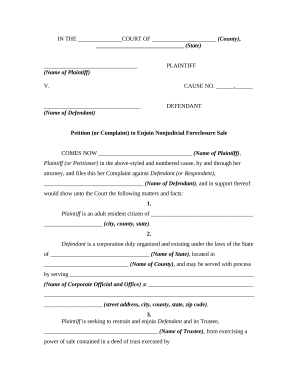
Get and handle Foreclosure Legal Documents online

Boost your file administration using our Foreclosure Legal Documents online library with ready-made form templates that meet your needs. Get your form template, modify it, fill it, and share it with your contributors without breaking a sweat. Start working more effectively together with your forms.

The best way to use our Foreclosure Legal Documents:

  1. Open our Foreclosure Legal Documents and search for the form you want.
  2. Preview your document to ensure it’s what you want, and click on Get Form to begin working on it.
  3. Modify, add new text, or highlight important information with DocHub features.
  4. Fill out your form and save the adjustments.
  5. Download or share your document with other recipients.

Examine all of the possibilities for your online file administration using our Foreclosure Legal Documents. Get a totally free DocHub account right now!


Commonly Asked Questions about Foreclosure Legal Documents

Your Guide to the Florida Foreclosure Process Step 1: Borrower Begins Missing Payments. Step 2: Pre-Foreclosure Loss Mitigation Period. Step 3: Meeting With Foreclosure Defense Attorney. Step 4: Lender Issues Notice of Default. Step 5: Filing of the Summons and Complaint. Step 6: Debtor Answers. Your Guide to the Florida Foreclosure Process | Kelley Kaplan Eller kelleylawoffice.com your-guide-to-the-flo kelleylawoffice.com your-guide-to-the-flo
The new law amends New Yorks election of remedies law to provide that once a foreclosure action is barred by the statute of limitations, a loan owner or servicer is prohibited from bringing any other action to recover the same part of the mortgage debt, including both another foreclosure action and an action to
Upon a judgment of foreclosure and sale, the new owner can seek to evict you from the property. If the home is resold for more than what you owe, you have a right to file an application with the court for the surplus funds, subject to certain deadlines.
For Residential Cases. Lender must mail you information on getting help at least 90 days before starting a court case. Lender asks court for a judgment on default and to appoint a Referee to decide the amount you owe and write a report. Lender asks court to accept the Referees findings. Judge orders sale of your home.
ing to the New York State Department of Financial Services, an average foreclosure case takes about 445 days to be concluded in New York, with some taking much longer depending on the court in which the case was filed.
What is commonly called a foreclosure is a lawsuit that the mortgage holder files against a homeowner in the supreme court where the property is located.
Eviction proceedings following a foreclosure auction: In a holdover eviction proceeding after a foreclosure, the papers must include the 90 day notice and a certified copy of the new deed must be attached or the case can be dismissed. Tenants may also ask the judge for up to six months to move out.
It takes at least 6 to 8 months for a fore- closure lawsuit to go from summons and complaint to auction even if you ignore the court case. In reality, however, the process is taking much longer.
Set forth in Section 1301 of the New York Real Property Actions and Proceedings Law (NYRPAPL Article 13), the one action rule provides that, While [an] action is pending or after final judgment for the plaintiff therein, no other action shall be commenced or maintained to recover any part of the mortgage debt,