
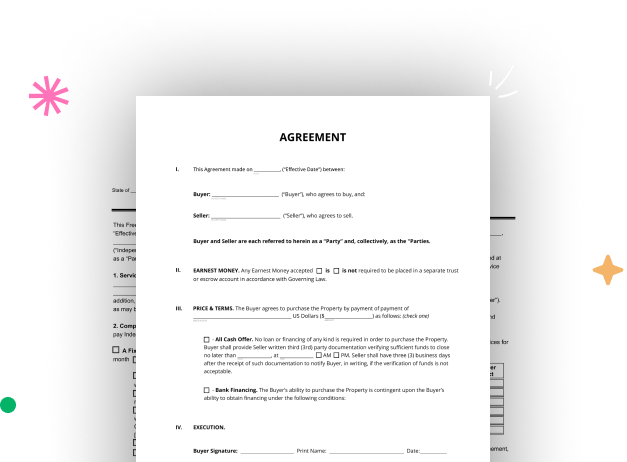

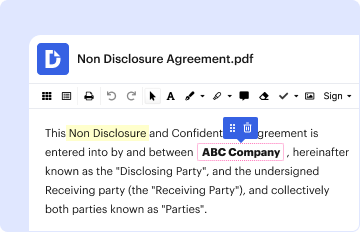

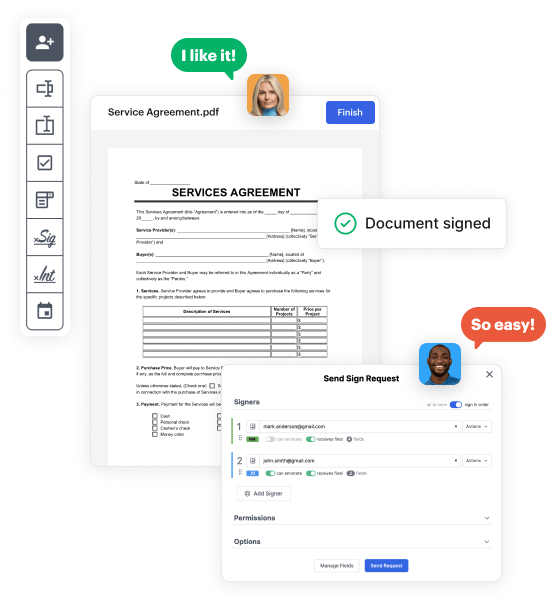
Create your Estate Administration Legal Form from scratch

Start Building Now
Title decoration

Here's how it works

01. Start with a blank Estate Administration Legal Form
Open the blank document in the editor, set the document view, and add extra pages if applicable.
02. Add and configure fillable fields
Use the top toolbar to insert fields like text and signature boxes, radio buttons, checkboxes, and more. Assign users to fields.
03. Distribute your form
Share your Estate Administration Legal Form in seconds via email or a link. You can also download it, export it, or print it out.

Create Estate Administration Legal Form from the ground up with these comprehensive instructions

Form edit decoration

Step 1: Start off by launching DocHub.

Begin by registering a free DocHub account using any available sign-up method. If you already have one, simply log in.

Step 2: Register for a 30-day free trial.

Try out the entire suite of DocHub's advanced features by signing up for a free 30-day trial of the Pro plan and proceed to craft your Estate Administration Legal Form.

Step 3: Create a new blank doc.

In your dashboard, select the New Document button > scroll down and choose to Create Blank Document. You will be redirected to the editor.

Step 4: Arrange the view of the document.

Use the Page Controls icon indicated by the arrow to switch between different page views and layouts for more flexibility.

Step 5: Start inserting fields to design the dynamic Estate Administration Legal Form.

Navigate through the top toolbar to add document fields. Add and configure text boxes, the signature block (if applicable), insert images, etc.

Step 6: Prepare and configure the added fields.

Configure the fillable areas you added based on your chosen layout. Customize the size, font, and alignment to make sure the form is user-friendly and professional.

Step 7: Finalize and share your form.

Save the completed copy in DocHub or in platforms like Google Drive or Dropbox, or create a new Estate Administration Legal Form. Distribute your form via email or get a public link to engage with more people.


be ready to get more

Build your Estate Administration Legal Form in minutes

Start creating now

Got questions?

We have answers to the most popular questions from our customers. If you can't find an answer to your question, please contact us.
Contact us
Who may become a voluntary administrator? A. If the decedent died without a Will, the right to act as voluntary administrator is given first to the spouse and then, in order of preference, to an adult child or grandchild, parent, brother or sister, niece or nephew or aunt or uncle of the decedent.
The court will choose an administrator ing to the same rules it uses to distribute assets if there is no will. The court will look to appoint the next of kin in the following order: Surviving spouse. Children.
If there is no valid will, and you are the next-of-kin, you can apply to be an administrator in the following order of priority: you are the married partner or civil partner of the person who has died. you are the child of the person who has died. you are the grandchild of the person who has died.
A probate attorney is not required under New York law, but legal assistance can save time and effort by ensuring that paperwork is completed properly and everyone with an interest in the estate receives the required notifications.
VOLUNTARY ADMINISTRATION or SMALL ESTATE PROCEEDING may be used when a fiduciary is needed to transfer estate assets (personal property only) and the value of the assets does not exceed $50,000, exclusive of property set off under EPTL 5-3.1. This is a legal proceeding and you may need the assistance of a lawyer.
be ready to get more

Build your Estate Administration Legal Form in minutes

Start creating now

Related Q&A to Estate Administration Legal Form

An EXECUTOR is the person named in a will to administer an estate. If the decedent leaves no Will (INTESTATE), the proceeding is called an ADMINISTRATION PROCEEDING and the court appoints an ADMINISTRATOR ing to the RULES OF INTESTACY who performs duties similar to those of an executor.
New York letters of administration will only be granted to someone who is a direct relative of the decedent or related to the decedent.
Filing for a Small Estate If there is a Will, the Executor files the original Will and a certified death certificate with the small estate affidavit petition and other supporting documents in the Surrogates Court in the county where the Decedent had their primary residence.

Additional resources on building your forms