
Create your Employment Policy Document from scratch

Start Building Now
Title decoration

Here's how it works

01. Start with a blank Employment Policy Document
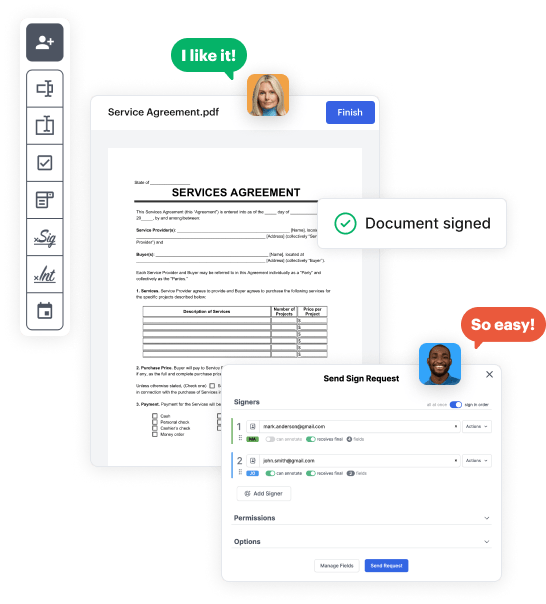
Open the blank document in the editor, set the document view, and add extra pages if applicable.
02. Add and configure fillable fields
Use the top toolbar to insert fields like text and signature boxes, radio buttons, checkboxes, and more. Assign users to fields.
03. Distribute your form
Share your Employment Policy Document in seconds via email or a link. You can also download it, export it, or print it out.

Design your Employment Policy Document in a matter of minutes

Form edit decoration

Step 1: Access DocHub to build your Employment Policy Document.

Start signining into your DocHub account. Try out the advanced DocHub functionality at no cost for 30 days.

Step 2: Navigate to the dashboard.

Once logged in, head to the DocHub dashboard. This is where you'll create your forms and manage your document workflow.

Step 3: Create the Employment Policy Document.

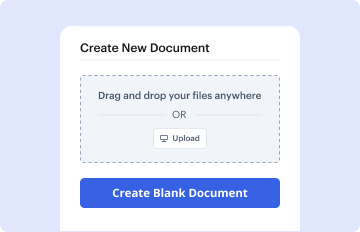
Hit New Document and choose Create Blank Document to be redirected to the form builder.

Step 4: Design the form layout.

Use the DocHub tools to insert and arrange form fields like text areas, signature boxes, images, and others to your document.

Step 5: Add text and titles.

Include necessary text, such as questions or instructions, using the text tool to assist the users in your form.

Step 6: Customize field properties.

Alter the properties of each field, such as making them mandatory or arranging them according to the data you plan to collect. Designate recipients if applicable.

Step 7: Review and save.

After you’ve managed to design the Employment Policy Document, make a final review of your document. Then, save the form within DocHub, transfer it to your selected location, or distribute it via a link or email.


be ready to get more

Build your Employment Policy Document in minutes

Start creating now

Got questions?

We have answers to the most popular questions from our customers. If you can't find an answer to your question, please contact us.
Contact us
Using a scenario, it walks learners through each of the seven stages of this process: (1) Issue identification and definition; (2) Data, research and analysis for policymaking; (3) Policy formulation; (4) Consultation; (5) Policy adoption; (6) Policy implementation; (7) Policy monitoring and evaluation.
A complete 5-step guide on developing effective policies and proceduresfrom writing to implementation: Step 1: Define the Purpose of the Policy. Step 2: Write the Policy Using a Template. Step 3: Prepare for Policy Implementation. Step 4: Get Feedback and Assign Enforcers. Step 5: Implement and Improve on the Policy.
Policy Writing Guidance Keep it simple. Policies should be written in plain language not legalese. Keep it general. Policies cannot contemplate all possible situations. Make it relevant. Check for accuracy and compliance. Ensure the policy can be enforced. Clearly state who does what. Less is more.
How to Introduce New Policies Decide on the purpose and need for a new policy. Consult with managers, workers and their representatives and any other interested parties. Give a person or a group overall responsibility for developing the policy. Write the policy, making sure it is concise, clear and unambiguous.
How to write an employee handbook Include your companys mission statement. Write a brief section on company history. State any legal declarations. Explain your dress code. Include details about work hours. Define duties. Include department-specific policies. Describe company benefits.
be ready to get more

Build your Employment Policy Document in minutes

Start creating now

Related Q&A to Employment Policy Document

Heres the step-by-step guide for writing the policy. Step 1: Perform internal research. Step 2: Identify the policies you want to create. Step 3: Include the key elements in the policy. Step 4: Create content for each element of the policy. Step 5: Add more information to clarify the policy for stakeholders.
These are (1) problem emergence, (2) agenda setting, (3) consideration of policy options, (3) decision-making, (5) implementation, and (6) evaluation (Jordan and Adelle, 2012).
Best Practices For Writing HR Policies Align with organizational goals and values. Be clear and concise. Ensure legal compliance. Involve stakeholders in the development process. Keep it flexible. Focus on the employee experience. Provide examples. Outline responsibilities and consequences.

Additional resources on building your forms


