Supercharge your productiveness with Court Procedure Legal Forms

Form managing occupies to half of your office hours. With DocHub, you can reclaim your office time and enhance your team's efficiency. Access Court Procedure Legal Forms collection and explore all templates related to your everyday workflows.

Effortlessly use Court Procedure Legal Forms:

  1. Open Court Procedure Legal Forms and apply Preview to find the relevant form.
  2. Click on Get Form to begin working on it.
  3. Wait for your form to open in our online editor and start modifying it.
  4. Add new fillable fields, icons, and pictures, modify pages, and many more.
  5. Fill your template or prepare it for other contributors.
  6. Download or deliver the form by link, email attachment, or invite.

Boost your everyday document managing with our Court Procedure Legal Forms. Get your free DocHub account today to discover all forms.


Video Guide on Court Procedure Legal Forms management

video background

Commonly Asked Questions about Court Procedure Legal Forms

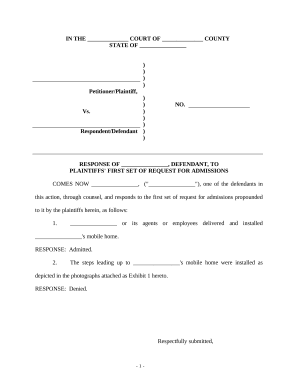
Every pleading, written motion, and other paper shall be signed by at least one attorney of record in the attorneys individual name, or, if the party is not represented by an attorney, shall be signed by the party. Each paper shall state the signers address and telephone number, if any.
For example, if a plaintiff fails to provide a copy of the complaint with the summons or the summons is served too late, the defendant can move to dismiss the case for insufficient process. Insufficient service of process means that the summons was not properly served.
There is a process for making a motion without giving notice. This type of motion is called an Order to Show Cause. This alternative motion does not have to wait eight days and can be heard at any time the court directs. In real emergencies, the court may even hear a motion in a matter of hours.
Rule 11 provides that sanctions for violations are within the judges discretion; that a party should have a period of time, a safe harbor, within which to withdraw or correct a filing alleged to violate Rule 11; and that Rule 11s primary purpose is to deter future violations and not necessarily to compen- sate the
The New York State Unified Court System has developed a number of ADR programs in the courts at every level for different types of cases throughout the state. Alternative Dispute Resolution represents a variety of processes through which potential litigants may resolve disputes as an alternative to litigation.
A civil action is a noncriminal lawsuit that begins with a complaint and usually involves private parties. The plaintiff is the party filing the complaint, and the defendant is the party defending against the complaints allegations. civil action | Wex | US Law | LII / Legal Information Institute cornell.edu wex civilaction cornell.edu wex civilaction
After a summons with notice is served, the defendant will demand that the plaintiff serve a complaint. The plaintiff must then have the complaint served within 20 days after being served with the demand, or the case may be dismissed.
Case law and field research indicate that the primary goals of sanctions imposed under Rule 11 include deterrence and compensation. Satellite litigation occurred primarily in cases involving large compensatory sanction awards, not in those involving modest monetary or nonmonetary sanctions.
The pleadings allowed in civil actions are complaints, demurrers, answers, and cross-complaints. 422.30. (a) Every pleading shall contain a caption setting forth: (1) The name of the court and county in which the action is brought. (2) The title of the action.