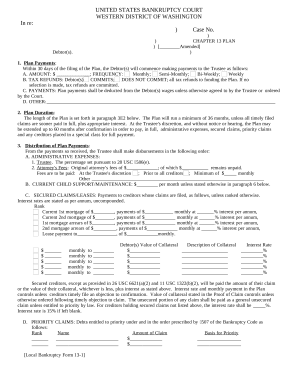
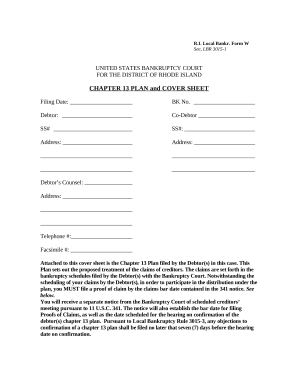
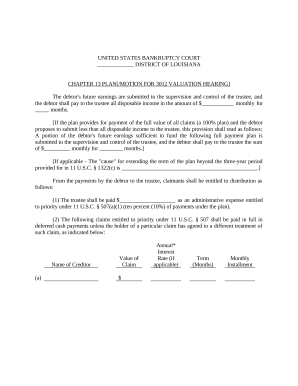
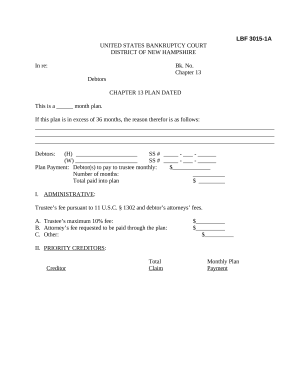
Get and manage Chapter 13 Documents online

Accelerate your form administration with our Chapter 13 Documents online library with ready-made document templates that meet your needs. Access the document, alter it, fill it, and share it with your contributors without breaking a sweat. Start working more efficiently with your documents.

How to use our Chapter 13 Documents:

  1. Open our Chapter 13 Documents and look for the form you want.
  2. Preview your form to ensure it’s what you want, and click on Get Form to begin working on it.
  3. Modify, add new text, or highlight important information with DocHub tools.
  4. Prepare your form and preserve the modifications.
  5. Download or share your form with other recipients.

Explore all of the opportunities for your online file management using our Chapter 13 Documents. Get a free free DocHub profile right now!


Video Guide on Chapter 13 Documents management

video background

Commonly Asked Questions about Chapter 13 Documents

The debtor must also file a certificate of credit counseling and a copy of any debt repayment plan developed through credit counseling; evidence of payment from employers, if any, received 60 days before filing; a statement of monthly net income and any anticipated increase in income or expenses after filing; and a Chapter 13 - Bankruptcy Basics | United States Courts uscourts.gov services-forms chapter-13- uscourts.gov services-forms chapter-13-
Does the Trustee Monitor Your Bank Account or Credit Report? In assessing your initial Chapter 13 filing, the court-appointed trustee will make a request to authorize turnover of bank statements/transaction histories, and that request is commonly granted by a bankruptcy judge.
Your Chapter 13 bankruptcy case officially ends when the court issues a final decree. This is different from the discharge order, which erases qualifying debts but does not close the case. The court can close a case without issuing a discharge if the debtor does something wrong or forgets a step in the process. How Do I Know When My Chapter 13 Is Over? Your Guide to Navigating lss.law how-do-i-know-when-my-chapter-13-is- lss.law how-do-i-know-when-my-chapter-13-is-
Debts not discharged in chapter 13 include certain long term obligations (such as a home mortgage), debts for alimony or child support, certain taxes, debts for most government funded or guaranteed educational loans or benefit overpayments, debts arising from death or personal injury caused by driving while intoxicated
A Chapter 13 discharge is a formal document signed by the bankruptcy judge that says youve successfully met the terms of your repayment plan. It means that any remaining balances on your qualified debt are forgiven, and its a red-light-full-stop for creditors trying to collect debts.
To complete a Chapter 13 bankruptcy, you need to make monthly payments for either three or five years. Whether you pay for three years or five years depends on your income. If your income is less than the state median, you pay for three years. If your income is more than the state median, you pay for five years.
Chapter 13 bankruptcy This bankruptcy type allows people with regular income to develop a repayment plan for part or all their debt. Chapter 13 bankruptcy is typically removed from your credit report seven years after the date you filed, and this is done automatically.
Youll receive the final decree once the court is ready to close the case. In Chapter 13, youll receive a debt discharge after completing your three- or five-year repayment plan. The court will close the case by mailing a final decree after the trustee submits a final payment distribution report.
Generally, a discharge removes the debtors personal liability for debts provided for by the chapter 13 plan. In a case involving community property: Special rules protect certain community property owned by the debtors spouse, even if that spouse did not file a bankruptcy case.